

The light rail came to the stop, silently slowing down along the magnetic guides embedded into the permeable, water-collecting street surface. Inside, Zach stared out at the solar-tinted glass of the vertical gardens climbing the sides of the classic architecture buildings across the street.
"I'm still dubious Logan," Zach said, turning towards his friend. "I mean, it's Casablanca. Colorizing it feels wrong. Blasphemous, maybe. Hope they haven't just changed the saturation. The whole point is the noir, the shadows."
Logan scratched his scalp and leaned forward.
"I get it. If the Neuro-Spectra renderer they're using is purely a restorative model, if it's trained on period film stocks and color references, it _could_ be an interesting interpretation. When they use AI to fill in the gaps, or speculate as to the emotional intent, that it gets dodgy. Look, it's not like it's a generative model trying to rewrite Rick's dialog. There are no new scenes. The code is supposed to interpret, not invent."
"Easy for you to say, Mr. Live-Code," Zach ribbed as they stood up and stepped onto the platform. "You get to make algorithms dance for a paying crowd every Saturday. This feels more like tech necromancy. Re-animating something that was already perfect just to say you can."
They stepped out into the evening air, which carried the scent of damp earth from the wall gardens and the faint, clean-ozone tang of atmospheric purifiers.
"Hey, using a code as the instrument, shaping a frequency based on the crowd's vibes in real-time is just using a tool. The intent is human. The performance is human," Logan countered cordially.
This was a long-running discussion, ever since they'd bonded over a bootleg print of Blade Runner in a dorm room a decade ago.
"That's my actual worry here," Logan continued, gesturing towards the giant cineplex in front of them. "Not that the colors are bad, but that the algorithm sands off the human fingerprints. The beautiful flaws, you know?"
"Yeah," Zach shrugged. "I get it."
The Edison Biome was recognisably an old Art Deco cineplex whose internals have been renewed, absorbed into the neighborhood's green infrastructure. Thick, living panels of moss scaled the refurbished facade, threaded with thin glowing strips of algae that accented the original architecture. The old marquee was still there, its old bulbs now replaced with a sharp, low-power e-ink display. The parking lot had shrunk, with e-bike docks and a train station taking up much of the land now.
They pushed through the original, heavy brass doors and into the main lobby. Zach looked up at the elegant ceiling and the futuristic digital signage. It felt both old and new, a careful, respectful fusion.
"Okay, at least they respect the architecture," Logan nodded slightly, taking it in.
"Respect for the container. Let's see how much they respect the contents," Zach murmured.
Walking further into the lobby, they approached the concession stand: a curved bar made of a polished marble embedded with fragments of recycled glass. Behind it, automated dispensers were ready to offer everything from algae chips to classic synth-buttered popcorn.
Digital menu boards glowed overhead, but Zach’s attention was drawn to the large screens listing the features:
Screen 3: CASABLANCA (Neuro-Spectra Restoration). 14:00.
Screen 5: HYPER-NOVA DRIFTERS (AlgoStream Part 76.4). Continuous Feed.
Screen 6: MAGIC REALM: AWAKENING (Procedural Narrative Feed). Ongoing.
A small crowd of teens and young twenty-somethings drifted towards the corridors for theaters 5 and 6, with many already bathed in the glow of their personal phones without acknowledging the world around them.
"Look at that," Zach grumbled. "Procedural narrative feed? It's not even a discrete movie. It's just digital slop, designed to just... keep going. And they're choosing it."
Logan sighed, leaning back against a pillar with a vine wrapped around it.
"It's frictionless, man. Engineered engagement. My guess is the diffusion model is pumping out the visuals based on popular aesthetics, linked with a language model trained on generic fantasy scripts, all governed by an engagement algorithm that tweaks the feed based on biometric feedback from the seats."
He watched a trio of kids laugh at something flashing on a preview monitor near the entrance to Theater 5: a splash of neon, a generic-looking starship, and a cartoonish hero character.
"But why choose that?" Zach asked, genuinely confused. "When actual, crafted art is right here?"
"Because art asks you to meet it halfway," Logan said with the authority of a practitioner. "A film, a piece of music, a performance... they ask for your focus, for your interpretation. This stuff asks for nothing. It's designed to flow over you, to trigger the dopamine, to fill time. It requires zero effort. It's the exact opposite of that a-ha moment I'm looking for when I'm live-coding a set."
He pushed off the pillar.
"When I'm performing at a rave, I'm using algorithms as a responsive tool. I'm there, shaping the sound, building the tension, and playing off the crowd's energy. My goal is to create a shared, unique moment. It's a conversation. That is an automated, interactive monologue designed to hold eyeballs, not to move souls. It watches the watchers and optimizes itself continually to keep them passive."
"So the free market of ideas ends with algorithm-tuned slop," Zach remarked grimly.
"Seems that way," Logan agreed, speaking with a sadness that went deeper than Zach’s annoyance. "That's the core of it. Nobody is forcing them. They have the choice between the infinite, shallow stream versus the finite, deep well. And the stream is just easier."
He clapped Zach on the shoulder.
"Come on, let's go see something that a person poured their soul into. Theater 3 is down this way."
After picking up their drinks and snacks, the headed down the corridor towards the theater. The hallway, lit by the soft glow of floor strips, forked.
"Theater 3 is this way, I think?" Zach gestured towards the right.
He pushed the door bar. They stepped inside.
The sound hit them first. It wasn't a score, but a throbbing, repetitive, bass-heavy synth track overlaid with generic, loud crashes and zaps, all mixed slightly too high.
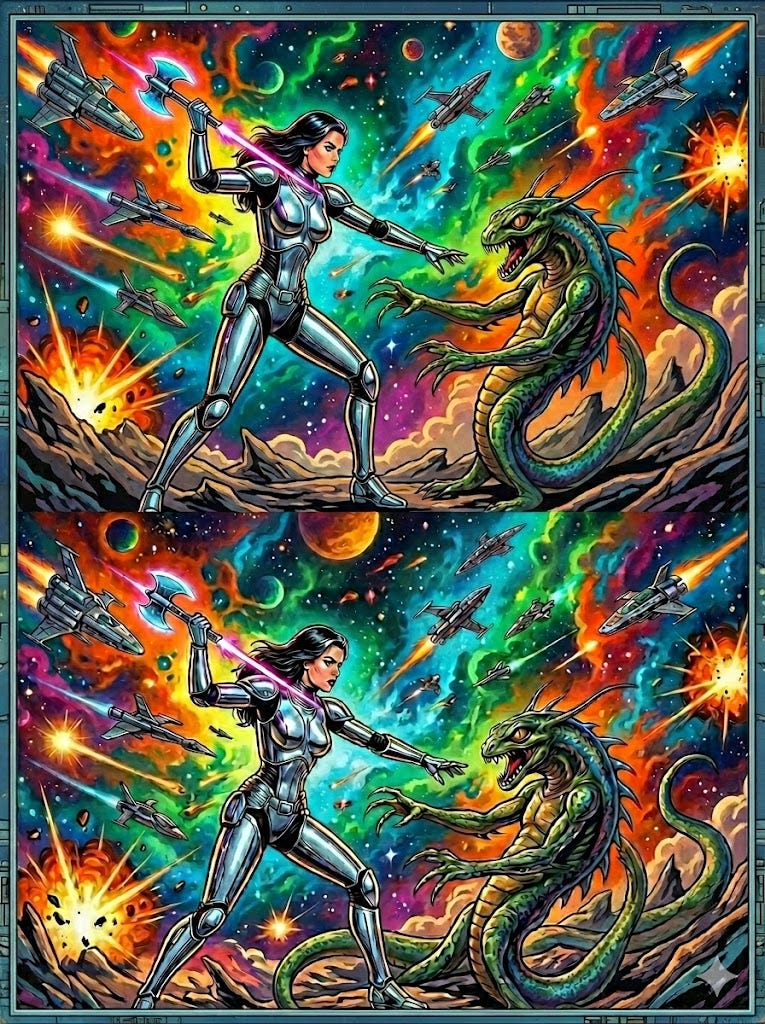
The screen was a hyper-saturated, jarring, visual assault. What looked like a chrome-armored knight held a glowing laser-axe against a creature that seemed to shift. It looked like a lizard one moment, then an insect the next, as if the algorithm couldn't quite decide.
The cuts were frantic, the colors were bright flashes, and everything had an uncanny waxy sheen common with generative video. It was a firehose of recycled tropes calculated by an algorithm to trigger responses but signifying nothing.
More jarring though was the audience.
Bathed in the flickering, strobing light, they sat utterly still. There was no shared gasp, no laughter, no collective emotion, just rows of passive, captivated faces. Some slumped, their mouth slightly open, simply consuming thoughtlessly. A few wore thin, silver headbands, budget neural-haptic interfaces, to get the stimulus feed directly. They weren't watching a story, they were being overwhelmed by an endless stream of data.
It only took three seconds before Logan gently tugged on Zach’s sleeve. Wordlessly they backed out, cutting off the sensory assault.
They stood there for a beat. The hum of the building's air conditioning suddenly seemed loud.
"JFC," Zach breathed, his voice low.
Logan just shook his head.
"See what I mean? No friction, no soul. Just stimulus. Automated and empty."
A quiet, shared sadness hung in the air between them.
"There's the right door," Logan said, pointing to a door on the opposite side of the hallway.
The pushed through, and the difference was clear. The theater was darker. The sound was quieter. The AI-restored Casablanca had just started.
They slipped into their seats as the camera panned across Rick's Café Américain. The color was there. It was tastefully done, muted, leaning into sepia tones without being garish. The Neural-Spectra renderer had done its technical job: sharpening the image, removing film artifacts, and adding a palette that felt historically plausible.
But after what they had just witnessed, the technological feat seemed irrelevant.
What they felt, what they experienced, was everything the other place lacked. The pacing was artful, letting a scene breathe and trusting the audience. Even colorized the shadows held meaning, shaped by a human Director of Photography. The faces weren't exaggerated or perfected. They remained imperfect and utterly human.
They saw the human fingerprints that Logan had worried about. They weren't sanded off because they had been embedded in the very DNA of the film. The AI had placed a clean coat of paint, but the original genius remained soulful.
Compared to the frantic, empty flashing next door, Rick's felt more real, more vital, than ever.
When the lights came up, they remained in their seat a moment longer before joining the shuffling of feet exiting the theater. Stepping back into the lobby, they bypassed the crowds still heading into the ScreenCAST feeds.
"Well, that was actually quite good," Zach remarked. "The color was there, it didn't ruin the movie."
"No it didn't," Logan agreed. "It's not really about the tech, is it? Good or bad."
"No, I guess it still goes back to what we choose to watch."
Zach thought of the blank faces still bathed in the light of the algorithm.
"Makes you want to go home and, I dunno. Build something with your hands."
Zach looked at his friend.
"Yeah," Logan agreed. "Or at least, watch something that somebody else did."
The melancholy hadn't vanished, but they shared a moment of clarity. It felt less like despair and more like a resolve to keep seeking out the art that mattered.