

Betting on a Hurricane
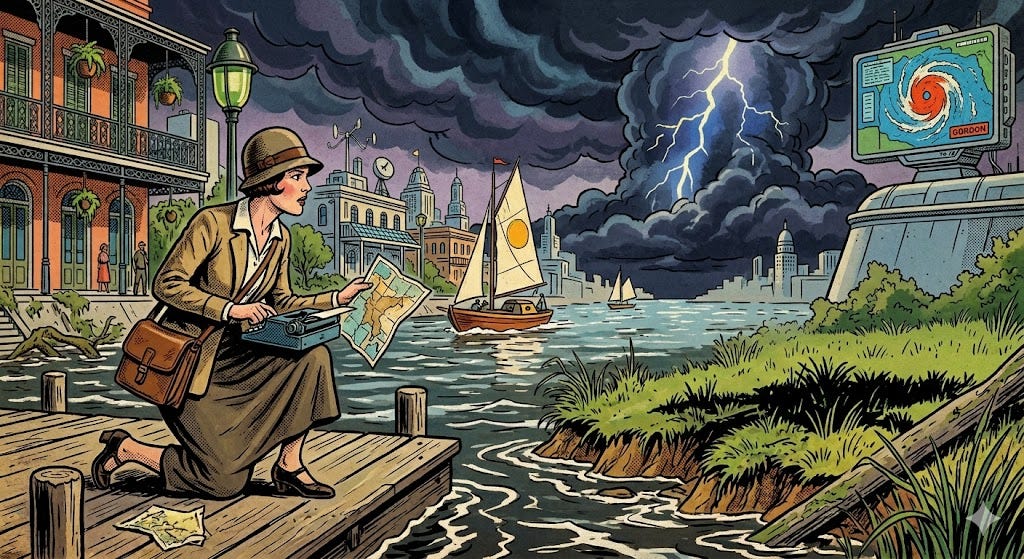
New Orleans was a city at a crossroads. For much of the public, the city represented history integrated with nature. Ornate iron balconies looked over streets and canals where the community traveled back and forth. They were resourceful, constructing algae lamps and solar-sail skiffs to adapt to the changing climate among the gulf. Despite these changes, the residents were always nervous as the storm season began.
For a small section of the public, the privileged few, they were occupied with a new, terrifying innovation: The Disaster Delta Derivatives market. The D3 was a decentralized blockchain network hosted in international waters to host bets on the precise outcomes of climate events. They could short a levee's integrity, go long on a storm surge height, or gamble on the number of displaced residents.
The leaders of this network were a crew of crypto-anarchists and free-market zealots, who believed this represented the ultimate expression of predictive power. Some even believed it could be positive for disaster relief, that it could provide greater information to first responders where there was the most need. Yet all of them enjoyed the vast wealth they would be able to accumulate from the suffering of others.
Though most didn't participate in these markets, many paid attention to them. This included Leila Hadid, a journalist working at the Pelican Post. In actuality she was sitting in Armstrong Park with a mess of windows on her laptop including message boards, currency exchanges, and weather projection models. Gordon was a large storm, a hurricane at Category 3 and rapidly strengthening.
"Look at this," she muttered, more to herself than to the duck watching her hungrily.
She highlighted a thread on OracleJazz, one of the more popular D3 discussion forums:
Shorting FQ's pump stations. Bergeron's budget cuts have left them with just prayers and decade-old firmware. Easy pickings.
Below it was another post:
Anyone else feel like Gordon is going to be the *BIG ONE*? Goign all in on a Cat 5 landfall + mass evac failure. To the moon, right? Else the bottom of the gulf.
Leila felt her chest grow tight. It was more than just the callousness and the gleeful speculation on misery. She worried this new market could incentivize the worst in people or even reward those who had the power to ensure the worst. Although the blockchain was meant to bring transparency in transactions, anonymity protocols and tumblers kept finances in a murky swamp.
Her current investigation into the D3 phenomenon, the wild new frontier of disaster capitalism, had been taking a turn for the worst due to the sheer volume of pessimistic bets against New Orleans where she was.
Then, a ping. The governor was just beginning a live broadcast. The video feed began with him sitting in the cool grandeur of the Governor's Mansion. Hughes Bergeron adjusted his silk tie against a backdrop of mahogany wood panels. He flashed his signature folksy grin towards the camera.
"My fellow Louisianans, I'm here live to talk to you about Hurricane Gordon. No doubt it is a serious storm, but let me assure you that the state is prepared. We've bolstered our coastal defenses. Our first responders, our heroic neighbors, are the best in the nation. We've worked hard to ensure evacuations will proceed safely and orderly. We believe in the strength and resilience of our people, and trust you can make the best choices for your families. We've learned from the past. This administration will continue to advocate for fiscal responsibility and efficient action. Together, we will weather this storm."
The Governor sat in his private study with a paperback in his hands. It was part of his grand collection. Though most preferred the eInk tablets, he enjoyed the status obtained from demonstrating his vast assortment of acquired works.
"Moreau, do you have those calculations?" he asked, looking up at his assistant.
The sharp-featured man nodded and brought only a sleek gray tablet. The Governor took it and navigated its complex interface with expertise. It wasn't StormStake directly, but a series of nested accounts within a private wealth management platform that specialized in discreet digital assets.
Bergeron authorized a significant transfer of Ethereum Classic into a high-risk, high-yield derivative pool on D3. The wager was very specific: catastrophic failure of three designated pumping stations in the Garden District, a storm surge of twelve feet or more in the French Quarter, and a city-wide power outage that lasted over 72 hours. If the bets won, it would have an astronomical payoff. They also mirrored, with uncanny precision, the areas that saw cuts in the maintenance budget.
"A bold move, Governor," Moreau raised an eyebrow. "The premiums on that specific set of outcomes are substantial."
"Fortune favors the bold," Bergeron had a thin smile growing on his lips. "And the well-informed. It's just a matter of market dynamics, hedging against the inevitable. Besides, a market correction is exactly what a bloated system needs."
In the ensuing days Leila worked overtime to study the volume of D3 bets and helping her readers prepare for the storm. Beyond the sheer number of bets, there were a number of highly specific, pessimistic wagers. They were not betting on broad damage from a hurricane, the bets were on specific points of failure like they were just checking off a list.
"It's more than just cynical opportunism," she remarked to her editor, a gruff elderly journalist named Greg. "Some of these high-stake bets on infrastructure align too perfectly with the projects whose funding has dried up or are stuck in red tape."
"That's the governor's fiscal responsibility? Cutting essential services while preaching self-reliance? That's the standard playbook. Nothing new under the sun, right? Doesn't mean he's causing it just to make a buck."
"Yes, I remember. Nothing new under the sun," she conceded.
She was only paying half-attention as she scrolled through city budget amendments and watched transaction graphs moving up and down every minute. "It's circumstantial, but the timing of some bets seem to coincide with maintenance contracts getting deferred. It's like someone knew the chair was about to be pulled out from under us."
Although Greg encouraged her to focus more on the immediacy of the storm, she couldn't shake this bad feeling in her gut. At his urging, she was told to reach out to Marky Dubois.
As she reached the low-lying district of Gentilly Terraces, she saw activity buzzing all around the local community center.
"Mark?" she called out.
"Marky," said a tall, slim boy as he placed a box of supplies down on the ground. "You are Leela?"
"Leila," she clarified. "I'm with the Post, doing a piece on community resilience."
"We're buckling down for this storm. Our local co-op has been working on supporting our people. Check out those solar panels on the roof. We've got a full microgrid installed. Even if the governor fails us, we can still keep the lights on."
"The governor was on the radio this morning," remarked a young woman, one of Marky's lieutenants. "Talked a lot about targeted action, but we haven't seen a state engineer down here in months."
"We've learned to figure things out on our own," Marky continued. "We can't rely on the state to keep us safe."
"It seems like a lot of work," Leila remarked, looking around at all the volunteers.
"It takes a village," Marky chuckled. "Not all of us are great at everything, but we all have a place. Look at the gardens planted along the streets. Bioswales. They should be able to suck up a lot of the storm surge. I don't have a green thumb, but a few of us do. And we've got a tidal generator in the local canal. Experimental, sure, but we'll get some good data in a few days."
"Doesn't that fit into the governor's narrative around self-reliance?"
"Look, we do need to be prepared for ourselves, but it doesn't absolve him of his responsibility to maintain the systems we depend on."
"It's a partnership between communities and the state," the woman commented.
"It's supposed to be," Marky added. "But his 'targeted action' feels a lot closer to 'targeted neglect'."
He had the same unease that she did, but with a confidence that she didn't share. Marky looked up at the sky, already turning a foreboding purple.
She jotted down notes on the conversation. He didn't know his observations of local failures would soon become a key background for her digital forensics.
Leila decided to focus on the D3 bets against the 17th Street Canal's aging floodwalls. They had been flagged a year ago by the Army Corps of Engineers for urgent upgrades, but the governor had "indefinitely postponed" them because of budget overruns elsewhere. The wagers were complex and highly leveraged, based on new wallets using Ethereum Classic and obfuscated through a tumbler.
She knew trying to trace the wallets directly was a fool's errand. Mixers like EctoPlasma were designed to sever any links between the sender and receiver by pooling transactions and distributing them randomly. But no system was infallible.
"They rely on volume and time distortion," she talked to herself as she began pulling the contracts into a CSV file. "But if the deposits and withdrawals are significant enough, you can correlate them with off-chain data and find signals from the noise."
With the vast volume of bets, she thought it best to focus exclusively on the floodwalls. She cross-referenced the withdrawal patterns from EctoPlasma with new wallets activated on various exchanges which were known for lax Know-Your-Custom and Anti-Money Laundering protocols. Many of them were situated out of the gulf on floating data centers. Days of this intense, painstaking work yielded little more than eye strain and a growing pile of discarded energy drink cans.
Then, something.
A series of withdrawals from EctoPlasma were not sent to a tumbler or an exchange, but a single new wallet which purchased a non-fungible token. It was for a piece of digital art sold at auction for an unfathomable price. The gallery was a quiet favorite of the governor's wife.
This wasn't a smoking gun, but the revelation still made her breath stop. The NFT could've been purchased by anyone. She didn't know who owned the wallet. The timing could've been a coincidence. But it was a small piece of evidence, a small thread she could begin pulling.
The hurricane arrived with a furious roar. The sky had turned black and unleashed winds which screamed like banshees. Buildings and streets were attacked with the deep wrath of nature. Rain didn't fall; it flew horizontally faster than a speeding bus. Streets turned into churning brown rivers in the first few minutes.
Leila worked from the community center in Gentilly Terraces. Marky and the co-op fought to keep the water out, manually pumping water from the basement. The microgrid seemed to hold, with lights flickering overhead as the city's power grid predictably collapsed in a series of explosive blue flashes. Families huddled inside, drenched.
"The pumping station in Elysian Fields just went offline," Marky yelled, watching the data trickle in from the local mesh network. "The backup generators never kicked in, just like those crypto vultures predicted."
"That doesn't make sense," Leila remarked, looking up from her laptop. "The generators were new, funded by the state. I saw the installation crews last year."
The reports had been glowing. But were they just another fiction? Intentional neglect?
She turned back to her work. She had to be quick. The backup battery was rapidly depleting and her allocated charging time wasn't until the next morning. While the solar panels held, there was more people here than supply. Power had to be rationed. And with the failure of the pump, the overflowing canals would flood additional houses. The community center would see more people seeking refuge.
Her pricey Internet connection to a satellite was tenuous, and each update of the newsfeed showed chaos and pleas for rescue. The NFT was an interesting clue, but she needed something more direct. She had to find something that tied the betting wallets not just to the Governor's circle, but to his finances.
As Gordon's eye crawled over the city, there was a brief respite. The wind dropped to mere gale and the rain softened to a torrential downpour. With the chance to recharge her batteries and a clearer connection to the satellite, Leila got back to work.
One of the larger wallets had received a significant payout from EctoPlasma, a wallet from one of the D3 whales. Days before it placed bets, this wallet had received a significant infusion of Ethereum Classic from a new, unverified wallet. This new wallet had been funded by a single transaction from a known digital asset custodian.
This custodian was used by a very specific, very private "Family Office" investment firm that Leila had investigated months ago. They managed several blind trusts established for the benefit of Governor Bergeron and his immediate family.
"Gotcha," she whispered, her word immediately droned out by a sudden gust of wind from the second half of the storm. The satellite's connection immediately wavered. "The custodian is the link. He didn't bet directly. He funded a new, anonymous wallet through his family office's custodian, then used that money for his D3 bets through EctoPlasma. Layers of obfuscation."
The 17th Street Canal floodwall chose that moment to catastrophically fail. It just surrendered with an explosion of dark, frothing water from the Gulf. This was one of the scenarios heavily bet upon by the wallet.
Leila watched a drone live-streaming the damage. It was jerky and pixelated, broadcast by an amateur storm chase for as long as possible. The stream showed water roaring into Lakeview and Mid-City, where evacuations had been slow due to "logistical issues" and a lack of available city transit. These logistical issues now felt chillingly deliberate.
The failure of the canal sent floodwater through the drainage canals, overwhelming the community center's strained defenses. Water was already seeping onto the main floor.
"We have to get to the attic," Marky yelled as he scooped up a young child. "Everyone, carefully use the emergency ladders."
Their ingenuity had bought time and likely saved lives, but they couldn't fight against a flood exacerbated by the very people sworn to prevent it.
Leila had to move too. Before shutting down her machine, she mirrored the data to an encrypted drive and to a secure cloud dropbox. The evidence wasn't quite ready for frontpage news. Not yet. It was a complex chain of financial forensics reliant on linking public data with anonymous transactions. It would be derided by the governor was circumstantial, as a politically motivated attack. With his public media inspecting the damage, anything not bulletproof would be easily dismissed.
In the silt-caked dawn that followed, Gordon had departed. The city was left in sorrow and destruction. The official response was slow, mired in the very bureaucratic inertia the governor had cultivated.
Yet where the state faltered, the people surged. Marky and the other volunteers, operating from the functional upper floors of the community center, formed a hub to serve the community. The solar cells were still working, allowing them to sterilize water. Their mesh network allowed families to reconnect and organize recovery operations on repaired electric skiffs. Supplies and medicine were shuttled back and forth through the flooded streets. They were exhausted and grieving, but kept their gritty determination.
Days later, the governor toured the most camera-friendly devastation sites with a mask of solemn concern. Flanked by FEMA officials and a fawning press corp, he pledged unwavering support and promised to rebuild stronger.
"We will allocate every necessary resource," he declared.
What was left unsaid were the untraceable crypto assets in his secret wallets whose total sum could've funded all of the city's repairs. He lauded individual responsibility and community efforts. Subtly the disaster was framed as an unfortunate act of nature rather than a crisis caused by his negligence.
Then, the Pelican Post published her finished story: Blood on the Blockchain: Governor Bergeron's Gordon Windfall?
Leila's byline was accompanied by explanations of blockchain forensics, annotated public records, and expert commentary on the disaster derivative markets. The uproar was instantaneous. As the national lens remained on Louisiana, she was immediately booked by news influencers to talk more about her reporting and the markets as a whole.
On the OracleJazz forum, some decried the "doxxing" of a successful trader, championing instead the inviolability of the blockchain and the pure information of the market.
He just made a good call
System worked as intended. Don't hate the player. Learn to play the game.
But in the streets, the reaction was fury. The idea that their suffering, their lost homes, their dead, were just a calculated variable to enrich the governor was a betrayal hard to comprehend. Protests formed across the state, covering the Governor's mansion and other state government buildings.
The governor's office issued a swift denial. "A desperate, baseless smear campaign online is trying to exploit the suffering of our state during this period of emergency. The governor's personal finances are managed ethically and transparently through a blind trust as per the law. These wild accusations of 'blockchain wizardry' are an insult to hard-working Louisianans who know better than to fall for conspiracies."
He was protected by the legal ambiguities. Even if you could prove the bets were made from his account, these betting markets were still operating in a gray zone. Could this be legally considered insider trading? Could you prove intent to defraud the populace when the bets were made on publicly observable vulnerabilities? Was it illegal to be well-informed even if that information came from your own dereliction of duty? None of that had been tested in a court.
Leila watched the fallout from her small apartment, which had become a nerve center of displaced citizen journalists trying to corroborate and expand on her findings. She should've felt proud at exposing the rot, but she still felt uneasy. The story was out. The data was public. But justice was far from certain.