

[Chapter 3] American Bletchley
Chapter 3: Decoding the Danger
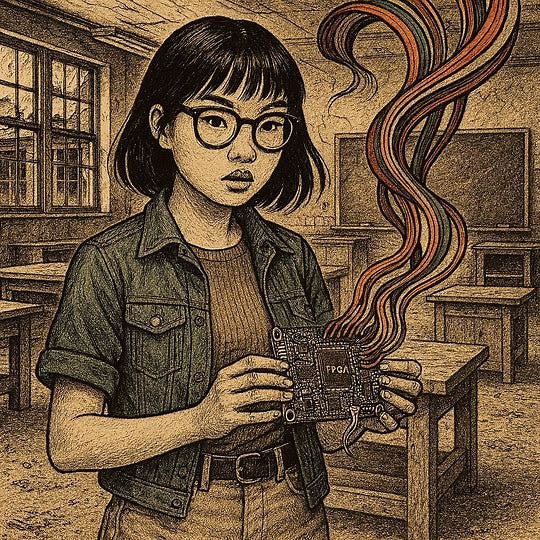
Obtaining the FPGA was the easy part. The hard part was turning it into a useful coprocessor. The next several days were spent carefully writing and debugging Verilog to build it. The air throughout the building became thick with the smell of stale coffee as they worked around the clock in a coding marathon to make this work.
Special Agent Davies occasionally asked questions but more often just relayed messages between Yu and Terry as they worked at the problem from opposite ends. Terry’s focus was more on the interface between the workstation and the FPGA, which would transfer messages from the Internet into this device, decrypt it, and send it back into a stream of text through a cable to a brand new USB port.
Terry struggled to make sense of the unknown cipher. He had printed out the messages and laid them on the table so he could see them all at once. He could tell there was a repeating block structure, but the exact nature eluded him.
“Any update, Terry?” Davies asked, handing over a fresh cup of warm coffee.
“Well, I think I have an idea, but not a good one,” Terry answered. “Each block’s decryption influences the key for the next. So if you guess the first part wrong, the rest will also be garbage. It is supposed to make full decryption computationally impossible.”
“Uh-huh. So how do we get around that?” Davies asked, acting more as a rubber duck than a coworker.
“We need to find the seed. That means that FPGA will need to try a lot of keys in parallel until it finds one that makes any semblance of sense. Then we move forward from there.”
“And the FPGA will be able to do that?”
“It can do pretty much anything we program it to do, as long as it fits in the memory and logic gates we have available.”
“Anything you need me to pass along to Yu?” Davies asked.
“Just make sure there are Verilog logic blocks so it can handle core mathematical functions. Adders. XORs. Rotations. Bit-shifts. That sort of thing. We can optimize more if we know what operations we need.”
“Ex-ORs?”
“Yeah, Exclusive-ORs. It’s a basic operation in a lot of ciphers.”
“Maybe you better write that down,” Davies suggested, pulling out a notepad. “Or tell her yourself?”
“I don’t have time to get into a long conversation,” Terry grunted, taking the notepad and jotting down a list of operations. “Just give her this.”
“Will do,” Davies nodded before leaving.
