

Evolution by Lithium
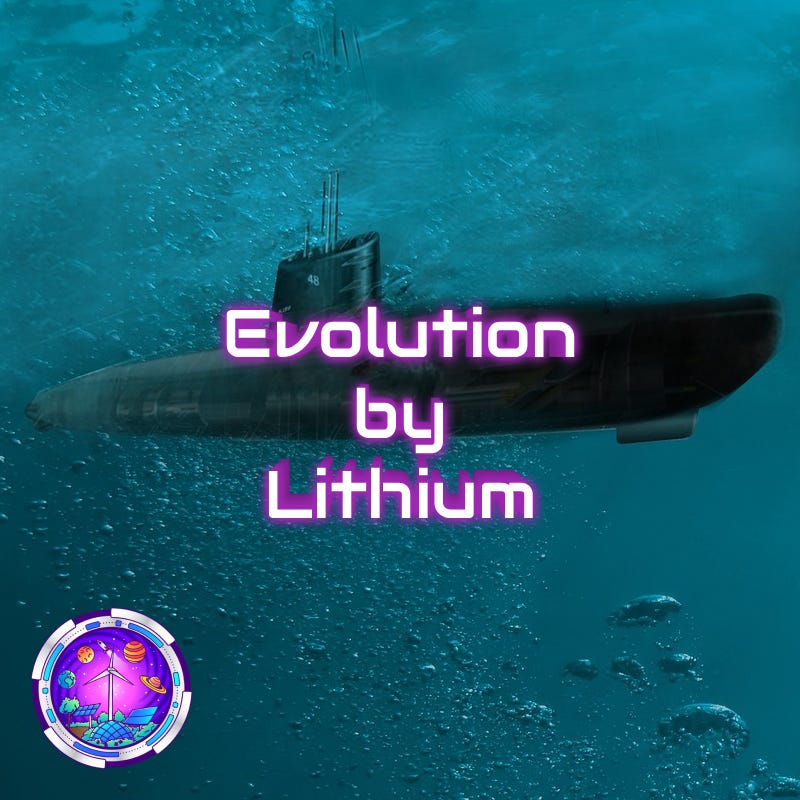
The Nautilus 2.0 was the latest model, providing no more noise than a gentle hum as it passed through the hadal zone. Dr. Rui sat in the cool light of the cockpit as he watched the depth gauge slowly tick down. They were at 7,200 meters now, about as low as they could get in the Pacific.
The lights outside the submarine illuminated a deep trench, a scar that marred the ocean floor.
“We’re now just a few kilometers from the Lithos exclusion zone, Doctor,” reported Milo, the pilot and exobiologist. He was monitoring the data feeds from the external sensors. “Ambient particulate matter is higher here, consistent with residual dust from the mining operations. There’s also some unusual current distortions from the unnatural topographic displacement.”
“It still feels wrong being down here, even after all these years,” Captain Linda grumbled as she gazed out the viewport. “I keep feeling like we’re trespassing in a graveyard that we were responsible for digging.”
“I’m not seeing much. The water down here is pitch black. Milo is there anything else unusual on sensors?” Milo asked.
“There is something... some electromagnetic interference. It’s not much. Too erratic to be geothermal or wreckage.”
“That might be from collapsing structures,” Linda scoffed as she paced back and forth. “There’s always something like that when you poke holes where you shouldn’t.”
Kato looked back at Linda. She had been managing scientific missions for decades, but her cynicism dated back even further. Twenty-five years ago, Linda Pinchuk had been on land screaming at governments at protests until she was hoarse in the throat. She had opposed the Lithos Deep Mine from the start. The irony was not lost on anyone that she was now leading the expedition to serve the aftermath of the mine.
“We’re just performing an impact review, Captain,” Kato reminded her, hoping to keep her from ordering something reckless. “The Ocean Stewardship Agency has a clear mandate to assess, document, and report. We don’t have the authority to do anything else. When they finished their mining, it was transferred over to the agency to ensure it is settling back into a natural state.”
“Settling like a corpse into a bog,” she snorted as she monitored the sensors. “They ripped this place apart for a whole decade under the guise of progress. That was a nicer way of saying ‘greed’ back then. You can’t just go back to natural after something like that. I haven’t forgotten getting hosed down by corporate security. Where’s the progress in that?”
“We’re getting some resolution from sonar, Captain. There are some primary structures. I’m going to pull up a visual,” Milo diplomatically shifted their attention back to the matter at hand.
Amidst the darkness, they started to see the faint outlines of the old mining infrastructure. There were some large metal spars they passed over, then a large skeletal outline of an old processing station that shined brightly in the searchlights. The station was a massive structure covered in gray microbial colonies that looked like barnacles or underwater mushrooms.
“Look how sterile that is,” Linda growled. “There aren’t any deep-sea coral down here anymore. It’s all dead. The ocean is still waiting for the poison to wear off. Look around. What’s missing?”
Kato looked through the viewport as well. There were no swarms of fish, no schools of large sealife, not even crabs scuttling back and forth. Everything looked still, as if it had been frozen in amber for years.
“I’m not seeing any macrofauna,” Milo reported, his eyes scanning the data more than the actual view. “There’s just some chemosynthetic bacteria.”
“Looking at the water chemistry data, it seems like the lithium particulate count is higher than it should be this many years after the mine was closed. What about the ethereal dust you had mentioned earlier?” Kato asked.
“Yes, the crystalline dust that seems to be a byproduct of the mining process down here. They’re not simple salts. Silicates and lithium ions are the main components and catch the light in a really interesting way. I’d even go as far as saying it’s ‘pretty’ if you don’t think about their origin.”
“Another lovely parting gift from the mine, the people who thought they should just suck the seabed dry like everything else.”
The submarine glided deeper through the complex, allowing them to see the structures in more detail all around them. Corroded alloy still stuck out of the seabed like the bones of a long-dead animal. Cavernous tunnels looked like pitch-black maws, entirely empty now. Everywhere they could see the shimmering dust floating as if it was snowing. The entire area felt like a ghost town on a strange alien world.
“We’re approaching the heart of the mine,” Linda announced. “Let’s take a look at the totality of the damage. I need to see how bad it is. I want to see the full extent of what we did here, so that nobody else will try this again.”
Kato felt a knot in her stomach at those words. She hadn’t been in favor of the mine in the first place, but she was also in third grade when it started. She grew up in a very different world, one that implicitly had taken full advantage of abundant lithium. And now she was here, looking at the trade-offs of her decisions she was responsible for fixing even if she hadn’t been responsible for making them.
“Doctor, Captain, I’m picking up something on the sensors I can’t explain,” Milo said as he squinted harder at the screen, as if that would open up its mysteries. “There seem to be some fields of tube anemones down here, on that collapsed gantry. But they seem to be glowing in some intentional pattern.”
Kato looked up at the screen, at the clusters of pale tubes rooted to the corroded metal. They were indeed flashing, colors glowing from inside them between cyan and amber. The patterns were complex across the colonies, rippling in waves.
“The pattern is binary,” Milo said with a hint of excitement. “On and off. That’s not a natural phenomenon.”
“You think it’s some sort of language? What can they even be talking about? How ugly the rust looks?” Linda asked sarcastically.
“I don’t know, but it’s definitely too organized to just be random. The patterns are occurring with enough intention that I can pick up a voltage signature when they change color. Not a high voltage, but it’s definitely more than just noise.”
“Log it,” Kato tried to keep herself from getting excited as well. “Mark the coordinates and the pattern. It might be worth a paper if we can figure out what it means.”
“Deploy the ROV,” Linda ordered. “I want to get a closer, non-invasive scan of that gantry to see if it might collapse and damage the anemones. And keep an eye out on anything larger that might be around.”
A manta-shaped drone detached from the bottom of the Nautilus and glided silently towards the anemones.
“Doctor, I’m getting stronger signals from the drone bearing three-fourteen. It’s moving. It definitely has a higher bio-voltage than the anemones.”
“Source?” Kato asked, feeling her chest pound.
“That’s unclear. I can’t get a clear visual. It seems to be behind that collapsed ore processor. The drone is seeing some interference in its sensors, probably because of these signals.
“Okay, we need something stronger. Captain, bring the sub around and focus the searchlights on that area,” Kato instructed.
The Nautilus slowly rotated, maneuvering to get a better view of the area. Milo controlled the searchlights with a joystick. The lights moved up and down, trying to focus and illuminate something that would be interesting. All they good see was the shimmering lithium dust.
And then, from the darkness of a large dark hole in the collapsed structure, they saw a shadow move. Linda nodded to Milo, who touched the throttle to move them a few inches forward. At first glance it looked like a school of transparent fish. Each one seemed roughly a meter in length. They looked like they were made of glass, with a skeleton akin to an old-school filament.
As the searchlights focused, the three on the submarine could see the full shape of the creatures. Their bodies looked like forged glass and their bodies pulsed with colorful sparks of light. From their delicate thin fins, lights rippled as they swam, leaving trails in their wake.
They were stunned by their ethereal beauty.
The fish seemed to change colors as they moved around, with some of them having different levels of brightness. It seemed like they were communicating with each other through the light patterns.
“I’ll be,” Linda said. Kato could see her face was softer now, with her eyes wide in a sense of awe and wonder. “They said nothing could live down here. It was just a dead zone, with nothing but bacteria for another thousand years... But somehow life found a way.”
“Doctor, I’ve been looking at their internal structures,” Milo trembled. “They are not made of bone. They seem to have incorporated the lithium directly into their physiology. The electrical fields they generate must also be some sort of basic language. It’s amazing!”
Kato thought of all the scientific disciplines that would be needed to do a thorough study. Exobiology, crystallography, bioelectricity, and more. “Get every sensor we have and capture as much data as possible. Just make sure we don’t scare them away. Captain, I think we should stay here a while longer.”
The school of fish swam around, continuing their dance without any concern for the submarine in front of them. They watched the patterns of light silently with a rare sense of reverence.
Before their descent, they had packed the Nautilus with enough food and supplies to last for a week. They hadn’t expected to be there longer than 24 hours, but it was always better to be safe. Now, they had agreed to spend several days observing the creatures and the ecosystem that had evolved in the aftermath of the mine. They were glued to the sensor feeds and viewports as they tried to catalog everything they could.
Beyond the crystalline fish and anemones, there were other kinds of strange sealife which now lived among the ruins. Crustaceans with metallic carapaces scuttled across the seabed and buried themselves in tall mounds of lithium dust. Tube worms lived inside corroded pipes and emitted strange pulses of light, many of which went beyond the visible light spectrum. They started to realize how the uprooted lithium had turned into an essential part of the ecosystem, spurring the evolution of new emerging species.
“Beyond the biological changes, they seem to have developed a communication system that is far more complex than what you would expect for being simple creatures,” Milo reported one morning after hours of crunching data. “The patterns of light go beyond binary. They are able to polarize it, seemingly at will, to communicate more complex information. And I think, I think... they might also be using quantum entanglement to share information.”
“Quantum-entangled fish?” Linda didn’t believe him. “Are they busy with philosophical debates?”
“Maybe not academic debates,” Kato chuckled. “But the information exchange is still sophisticated. They might be able to work together to share information and solve problems for the whole collective.”
“I can’t even imagine how that would work,” Linda remained skeptical.
“We need to travel further into the mine. If there are more of them in there, we’ll be able to see how they interact with each other,” Kato suggested.
“Alright, but we need to be careful. I don’t want to stay down here longer than we have to,” Linda agreed.
As Milo piloted deeper into the mine, the sensors began to gather data on a larger energy signature. The Nautilus moved into a narrow passage, barely wide enough to fit them. In a past life, it had been a conveyor tunnel. Now it was a canyon whose walls glittered with the dust. The water was clearer too, as if the ecosystem was being actively managed. They passed by strange flora clinging to the walls.
As they reached the end of the tunnel, which opened to a larger cavern, the energy signature reached a peak. Milo adjusted the searchlights to illuminate the area.
The lights cast a shadow on the end of the cavern, revealing something large in front of them.
“Milo, can you get a better look at that?” Kato asked, her heart pounding.
Milo adjusted the lights again, focusing them on the mound in front of them. The form was revealed to be a giant cephalopod, of size comparable to the Nautilus itself. Its eight arms sprawled out in the sand, each as thick as girders. Each sucker disc seemed to be a glowing a different color, creating a rainbow pattern across the seafloor. The creature’s head was transparent, allowing them to see the intricate mass of its brain which seemed to be sparking with electrical activity so intense they could see the sparks.
“It looks like a living lightbulb,” Linda whispered in awe.
It raised one of its enormous arms and shifted its body so it could see them. The eye was the size of a person’s head and revealed a depth of intelligence that was hard for them to comprehend. There was no anger in its gaze, only a curiosity.
“It’s bio-electrical field is... well our sensors can’t even measure it,” Milo stammered.
“It seems to be aware of us,” Linda observed. “It’s like seeing an ancient intelligence.”
For several minutes, they were locked into a staring contest with this creature. Kato felt a growing unease, as this was no longer a simple scientific observation. It felt like they were intruding on a world that they were never meant to see.
“How are we supposed to report this to the agency?” Kato wondered. “They’d think we were crazy if we said we found intelligent life down here.”
“We need to draft something. Just report the facts, no speculation,” Linda decided. “Then we can figure out what to do next.”
After sending her preliminary reports to the OSA headquarters, they received a reply the next morning.
“Dr. Rui, preliminary findings from the Lithos mine are extraordinary,” she read in aloud, though she felt a pain in her stomach. “These findings are potentially alarming. Your current mission is to study all the novel organisms you discover. It will also be critical to contain them going forward. If full containment is not possible, we will need to consider a neutralization of the site to prevent an uncontrolled spread of these organisms to the wider biome.”
“Neutralization? They can’t be serious!” Milo exclaimed. “These creatures are a scientific marvel! We can’t force them to extinction!”
Linda’s hands tightened against her armrests and her face contorted the way they used to when she was a young activist. “Bureaucrats see something that they don’t understand and they choose to respond with violence, just as they did here the first time. We can’t let them do that.”
Kato looked at her two colleagues and then back to the viewscreen where the creatures were swam, oblivious to this directive. She felt the pressure from the organization as well and the impossible choice that they were facing. “We need to be careful with how we respond to this.”
They spent hours drafting responses and editing them, trying to find the right way to convey the wonder of the Lithos mine and its ecosystem without triggering the agency’s reflexive response to destroy it. Each one felt inadequate, turning a place of wonder into dry words. Milo continued to collect data on the complex behavioral patterns and the way they were able to manage the lithium in a way that was symbiotic.
Linda remained largely silent even as Kato said drafts aloud and Milo chimed in with suggestions. She kept her gaze on the creatures on the other side of the Nautilus and mostly on the large cephalopod.
“How are we supposed to write a eulogy for a place when we’ve just arrived?” she asked once flatly.
“We’re scientists,” Kato concurred. “We have the job to report. We are seeing no evidence of ecosystem collapse or aggression. They appear to be thriving in his lithium-rich environment, perhaps even helping it to heal. Milo, doesn’t your data collection support that hypothesis?”
“Yes, especially in the cavern around the cephalopod,” Milo nodded enthusiastically. “It seems like as they sequester it, incorporating it into their own physiology, they are helping to clean the water itself. They seem to be having a positive impact.”
“A solution born from the problem...” Linda mused. “That’s a sort of poetry that the OSA bureaucrats won’t understand.”
Then the anemones started to flash in a new pattern different from anything they had seen before. The colors and flashes were repeating faster than ever.
“What’s going on with the anemones?” Kato asked, her heart racing.
“The light patterns look to be incredibly dense. I think it’s trying to say something to us,” Milo scanned the sensor logs.
The submarine let out its own sensor alert too.
“A minor seismic event,” Milo reported. “The old supports on the mine wall are groaning. It seems like they aren’t very stable.”
The crystalline fish left their small hiding spots and swam in the open ocean, their colors also flickering with some urgency.
“They’re warning us,” Kato said with a breath.
“Back us out,” Linda ordered.
They watched as the eastern wall began to fracture. Debris started to fall from the ceiling. As parts of the wall fell, lithium dust was kicked up, creating a small blizzard in the water. Rather than flee, the fish headed into the dust. Through the cloud, they also saw the flashes from the cephalopod move towards it.
“It seems like the mine’s collapse is feeding them. They want to be in the middle of this,” Milo observed as he piloted backwards.
“We need to transmit everything we have to the OSA,” Linda decided, her voice full of conviction. “And add a preamble from me. I want to make it clear that this is not a threat. No, more than that. We need to make sure this is a protected bio-zone. Nobody should be allowed to interfere with it. Any more interactions would simply cause more harm even as they work to heal the damage we caused.”
“I agree,” Kato nodded, already starting to draft the report in her head.
As the Nautilus rose from the ethereal world of the hadal zone, she watched the colors and lights fade away with a sense of bittersweet awe. Lithos Deep and its strange creatures would remain safe, but she still worried about what other kinds of harms might come in the future. The need to protect the ocean floors from human interference had been clear to her, but now there was a question of how human interference could also cause new ecosystems to thrive. It was clear there was far more research to be done.