

Finding a Strange Mole
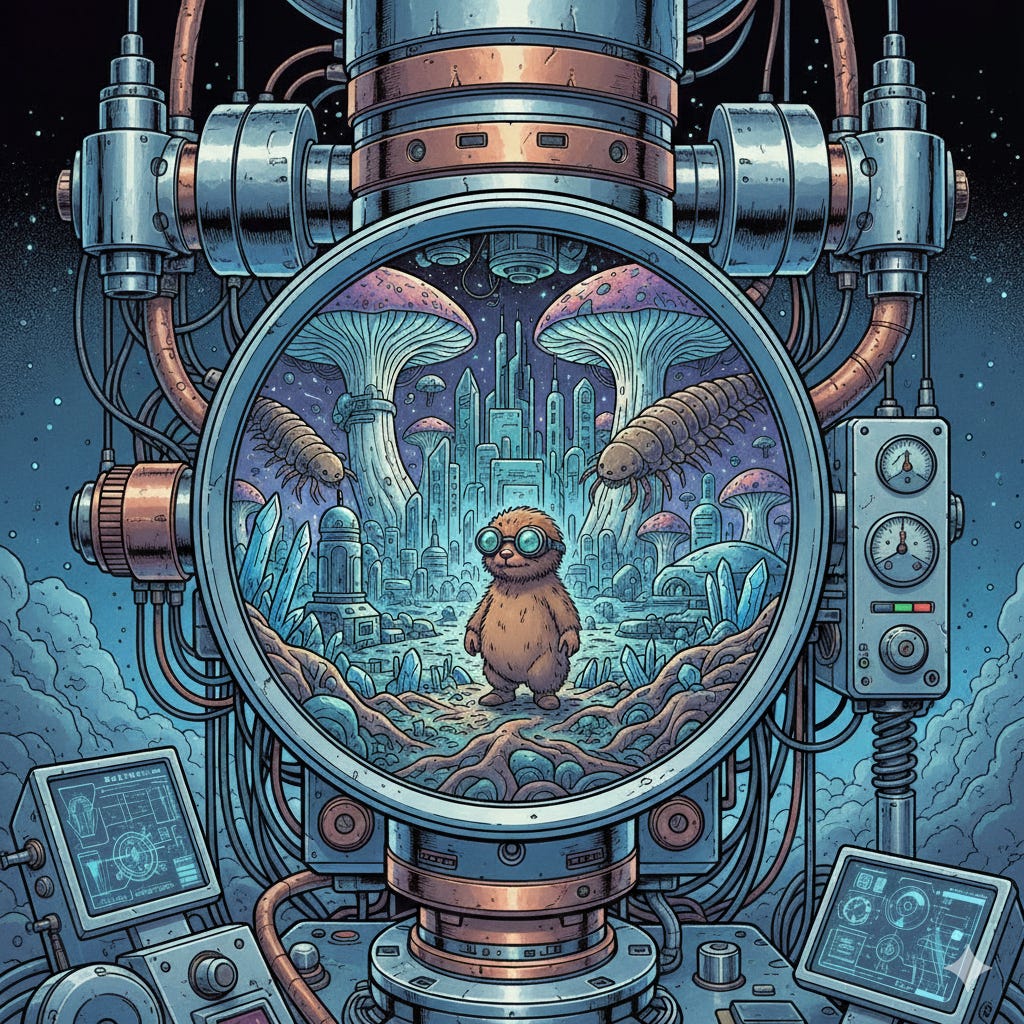
This is Day 11 of the “Twelve Days of Sci-Fi”. You’ll get a free story each day. You can also get a discount on sci-fi stories for next year.
The morning began for Louis Pichard with the same precise routine as every other. He steps out of bed to the bathroom at 0600 hours. The nutrient paste dispenser hums, delivering optimal fuel in its classic “neutral” flavor. At 0605, sonic hygiene. At 0620, calisthenics for precisely 15 minutes. At 0635, post-hygiene self-scan.
It was here, during the sweep of a medical diagnostic arm across his left shoulder, that the day’s first unscheduled variable announced itself.
“Aberration detected,” reported his MediScan.
Louis frowned. He ran the scan again.
Same result.
The display projected a magnified image of his back. There, just to the left of his armpit was a mark. Approximately four millimeters in diameter. Oval. Dark brown.
“Biological anomaly, class undefined,” the synthesized voice reported. “Pigmentation consistent with a mole. Structural density inconsistent. Sonogram reports anomalies. Professional consultation recommended.”
His schedule was a carefully optimized flow, each segment allocated for maximum efficiency. He had a job to do. He was the Senior Economic Strategist for Titan Mining Concern. This unscheduled professional consultation would be a significant deviation.
He leaned closer to the mirror, attempting to see it directly. It was awkward and he couldn’t twist enough to get a good look. With a sigh, he activated his handheld high-res imager and captured the anomaly.
The image appeared on his wall screen. He meticulous documented its parameters in his personal biometric log.
It had a diameter of 4.1 millimeters (long axis). It was oval. The color was very close to Pantone 19-0814 TCX (Slate Black). He didn’t expect to paint his walls with it, but it was useful to have precise personal records. It was slightly elevated, at 0.5 millimeters. He didn’t feel any pain, and it didn’t seem to have any difference in temperature.
It looked like a mole. A perfectly ordinary, if new, mole. Yet the MediScan flagged it for concern. It was usually unerring in its diagnoses of common dermal issues.
He projected his work calendar onto the opposing wall. His Q3 resource allocation for the deep-core drill sites on Titan were due for primary review in ten work cycles. A medical diversion now was suboptimal. He checked Dr. Jolene Masson’s availability at the Helios Health Collective, known for its efficient integration of natural and technological healing. There was an opening slot at 1455 today. That would mean shifting his analysis of thorium decay rates, but it would minimize the disruption.
He let his AI assistant handle setting up the appointment. He had wasted too much time this morning anyway. The image of the small, dark mark lingered for a moment longer before he replaced it with the comforting, predictable schematics of mining machinery. He had a variable to quantify. The sooner it was resolved, the sooner he could return his attention to the truly significant variables governing the flow of moon resources.
Louis arrived at the Helios Health Collective at precisely 1453, allowing a two-minute buffer for unforeseen transit delays. No such thing occurred thanks to Nova Canaveral’s synchronized public transit network.
The Collective’s atrium was a calm expanse of living walls. Algae panels were embedded inside, glowing with a soft, filtered light. He could hear the faint trickle of water being filtered and cycled. Usually he appreciated these optimized environments, but today he felt different. There was a bit of anxiety about the unknown variable on his back.
He checked in with a seamless retinal scanner and was directed to Consultation Room Five. Dr. Jolene Masson greeted him with a professional cordiality. Her examination room was bright and he could see a vertical garden teeming with flowers outside the window.
“Mr. Pichard, please sit down. Relax. Your MediScan flagged an anomaly?”
Louis nodded and quietly pulled up the report on his data slate.
“Correct doctor. The upper left scapula. I’ve compiled the preliminary data already,” he said, finding his voice wavering slightly.
“Thank you. You’re comprehensive as always,” Dr. Masson reviewed the notes. “Let’s take a look.”
The artificial leather examination couch felt cool against his skin. He felt a slight tremor in his hands and clenched them. Dr. Masson’s touch was light as she examined the mark.
“Hmm, it is remarkably symmetrical,” she murmured. “And the texture is... distinct.”
This was the first deviation from a standard “new mole” script. Louis felt a flicker inside of him akin to dread.
“Distinct how?”
“The surface has an almost velvety feel, yet it’s also firm. Not typical for a melanocytic nevus of this size.”
She grabbed a dermal spectrometer, a sleek handheld device. As its cold metal tip touched his skin, Louis found himself holding his breath. The device emitted a series of soft tones at various frequencies. Dr. Masson watched the readings and her expression grew more focused.
“These absorption patterns are unusual,” she said. “And the transdermal protein markers are not aligning with any standard benign or malignant indicators.”
She pulled away the device.
“Mr. Pichard,” her voice now in a professional calm that seemed to unnerve him further. “The internal structure is complex. I’m seeing organized, layered tissues. This is not consistent with any dermatological condition I’ve ever seen before.”
Louis felt his mind racing. Apprehension tightened ts grip over him. This was escalating far beyond a trivial skin tag.
“The readings are preliminary and require specialized analysis,” she stated. “But they are sufficiently atypical that I must recommend a full-thickness excisional biopsy. We need to get a sample to the lab for comprehensible genetic analysis.”
A biopsy? Surgical removal? His neatly organized schedule was now definitely compromised. But more than that, the thought of a part of him being so alien, so unknown, that it required an investigation was deeply unsettling. He felt a sudden, irrational urge to simply tell her to leave it, to ignore it. Yet what would happen to him if left to fester?
“Recovery time?” he managed to squeak out? “What’s the impact on mobility, particularly for using a keyboard?”
“It’s minimal for a procedure of this scale,” Dr. Masson reassured him. “Local anesthetic. A few sutures. You’d need to avoid strenuous activity for a few days, but standard work shouldn’t be an issue after 24 hours as long as there’s no complications.”
Louis nodded slowly. This unknown was an irritant, a disruption. Even if the process would be disruptive, he had to make it known.
“Proceed, Doctor,” he finally consented. “The sooner this variable is quantified, the sooner I can return to a healthy baseline.”
He hoped that baseline was still achievable.
The biopsy itself was quick. Dr. Masson professionally used the high-frequency dermal scalpel to isolate the mole. As it made a faint hissing sound, Louis focused on the algae in the wall panel. He kept his mind occupied by calculating their growth rate and their energy conversion efficiency, anything but the strange excision on his back.
One retrieved, the sample was placed in a sterile container.
“We’ll send this to the Nova Canaveral Advanced Diagnostics Lab,” she said to him as she applied an electroceutical dressing. “We should have results in three work cycles.”
Three days. Seventy-two hours of this undefined variable.
He was attempting to recalibrate a predictable model for iridium distribution when his com-link chimed. He saw the link displaying the Helios Health Collective logo.
“Mr. Pichard, could you come in to discuss your results?” came Dr. Masson’s voice, clear and professional.
“I should check my schedule,” he offered.
“We have an opening now, if you’re available.”
“Now?” he glanced down at his chronometer. 1132 hours. “This is outside the projected timeframe for standard histopathological feedback.”
“Yes, that is true. The findings are unique. We felt it warranted an immediate consultation. Dr. Rapace from the Kepler Institute will also be joining us.”
The Kelper Institute, Nova Canaveral’s flagship biological research center. Louis’s anxiety notched upwards. This was no longer just a dermatological issue. He saved his iridium model. He’d have to return to it later. Either way, there was no way he could keep focused on his work now.
“I’m en route. I should arrive at 1147 hours.”
The consultation room felt different this time. The air seemed to hum with a suppressed energy that wasn’t entirely attributable to the algae panels. Dr. Masson was there. She seemed to be forcing a neutral exprssion but there was something in her eyes that was anything but. Beside her was a man with short, dark hair and observant eyes that seemed to take in every detail of Louis’s posture and expression. This man was presumably Dr. Rapace.
“Mr. Pichard,” Masson began, gesturing to the other man. “This is Dr. Henry Rapace. He is the head of Xenofaunal Studies at the Kelper Institute.”
Xenofaunal? That prefix was usually reserved for extraterrestrial life, or at least profoundly alien terrestrial forms.
“Doctor Rapace, good morning,” he greeted nervously.
“Mr. Pichard, thank you for coming in so promptly. Your biopsy sample was forwarded to us by Dr. Masson due to some... highly unusual cellular structures noted by the pathology lab. It yielded extraordinary results.”
Dr. Rapace paused, as if thinking of the best words to say next.
“The sample was not a nevus, Mr. Pichard. Nor was it any form of human tissue, benign or malignant.”
If not human tissue, then what?
“An organism, then?” he suggested. “A complex fungal colony? An extremophilic bacterial sheath?”
His questions were purely analytical, attempts to fit the new data into existing mental models.
“No, Mr. Pichard, nothing like that.” Dr. Rapace exchanged a quick glance with Dr. Masson before continuing. “What was on your back... it appears to be an entire, discrete organism. We believe it to be a mammal.”
Louis blinked. His internal mental model of the world stuttered to find a data point so out of expected parameters that it struggled to understand.
“A mammal, living on my back? A 4-millimeter entity exhibiting mammalian characteristics? That is statistically improbable. The energy requirements... waste management... nutrient systems...”
“Precisely the questions we’re wrestling with, Mr. Pichard,” Masson nodded with sympathy. “It is, as far as we can tell, a previously uncataloged species of burrowing, adhering, micro-fauna. It appears to exhibit extreme symbiotic adaptation. The sample we collected appears to be the entire creature and was in a state of deep sleep. Its dermal layer, what you saw, seems to have evolved to mimic human skin pigmentation with uncanny precision.”
“Its metabolic rate was incredibly low,” Dr. Rapace explained. “Almost undetectable. The current hypothesis is that might be drawing energy directly from its host, or absorb trace micronutrients through the dermal layer. The ‘structural density inconsistency’ from the scans was its skeletal system and compacted organs.”
Louis was still struggling to comprehend. A mammal. Fur, bones, organs, all scaled down to the size of a freckle. It clung to him, disguised as part of him. The sheer biological audacity of it was illogical... inefficient... but now was being claimed as fact by two accredited scientists.
“Its discovery is certainly monumental,” Dr. Rapace continued, barely holding back his excitement. “It represents an entirely new branch of mammalian adaptation, or something so convergent that it defies current evolutionary understanding. We need to ensure, for your health, that there are no further colonizations. And we need to study the specimen itself under optimal laboratory conditions. Therefore, we strongly recommend a full surgical removal of the primary organism, assuming it is still in situ and the biopsy only took a sample.”
“The biopsy appears to have removed the entire entity,” Dr. Masson clarified. “It was remarkably self-contained. The lab confirmed it was the whole creature.”
Louis struggled to absorb all of this. This wasn’t just a quantified variable; it was orders of magnitude stranger than he could’ve conceived.
“A mammal,” he said quietly, still not believing it.
He wasn’t thinking of the scientific breakthrough, he only thought of the disruption to his work. And perhaps, he also felt a sense of being violated. No, that wasn’t logical. It was just an unexpected interaction with an animal.
“What are the proposed next steps regarding my involvement?”
“Given the biopsy successfully removed the entire organism, a fortunate outcome, a further invasive procedure is likely not necessary. However, we would be remiss if we didn’t perform a highly detailed scan of the site. We can use a non-invasive dermal cytoscope at the Kepler Institute. It will let us make sure there’s no microscopic remnants, eggs, or other traces. And it can help us map the precise ‘interface’ that made up its attachment mechanism.”
“And the time commitment?” he inquired, already mentally rescheduling the work blocks of the afternoon.
“No more than ninety minutes, including travel,” Dr. Rapace reassured him. “Your cooperation is invaluable, Mr. Pichard. You are, in a very real sense, the entire known habitat of this species so far.”
“I’m a habitat?” he echoed, the word feeling ill-fitting. “Very well. Ninety minutes.”
The Kepler Institute for Biological Research was a marvel of green architecture, a monolith interlaced with sky-gardens and cascading waterfalls, all powered by its own geothermal system below the ground. Louis was escorted to a clean, quiet lab where the dermal cytoscope awaited: a complex machine full of articulated lenses and lasers. The scan, as promised, was brief. Louis lay passively, his mind already back on the commodity prices of gallium.
Dr. Rapace and his team were busy in another wing of the Institute, hunched over a high-resolution holographic display, examining the entity retrieved from Louis’s biopsy.
Under extreme magnification, it was definitely mammalian, though unlike anything ever recorded. It was barely the size of a grain of rice and covered in incredibly fine fur that shifted in color like a chameleon to match its background. That explained its nevus-like appearance. It had microscopic retractable claws, honed to an impossible sharpness. That explained how it could cling to layers of skin without causing inflammation.
Most astonishing to them was the ventral surface, the ‘interface layer’, which was a complex crystalline structure.
“It’s not just passive adherence,” a young xenobiologist on Rapace’s team murmured with awe in her voice. “This structure looks capable of direct molecular interaction. It’s almost silicon-based in how it’s organized. This goes far beyond bio-mimicry. This is biological engineering.”
“So we’re looking at a creature that has perfected stealth, symbiosis, and energy efficiency to a degree we’ve never imagined,” Rapace said, feeling a thrill go through him. “Its closest analogues might not even be terrestrial.”
“So what do we want to call it?”
“Given its silent, skin-dwelling nature and its evolutionary pressures for shrinking and unusual sensory input, I think it should be called... Talpa Silentium. The ‘silent skin-mole’.”
A murmur of agreement went through the lab. The scientific community, once alerted, would be electrified by the sheer improbability of Talpa Silentium. And it would present them with a whole universe of questions to be studied.
Back in the scanning lab, the technician gave Louis an all-clear.
“No residual biological material was detected. The site is perfectly clean.”
“Are there any mandatory follow-ups?” he sat up as Dr. Rapace came into the room. “Specifically, anything that wil conflict with my standard work schedule?”
“None mandatory, Mr. Pichard,” Dr. Rapace managed a smile. “Though we’d appreciate you reporting any other unusual dermatological developments. You’ve accidentally become a pioneer.”
“Okay, I’ll make sure my MediScan adds a tertiary scan to my daily hygiene protocol.”
He offered a brief, formal handshake and went back to work.
For Louis, the story ended. He returned to his ergonomic workstation and his work routine. For a fleeting moment, he almost unconsciously rubbed the smooth skin of his shoulder. The anomaly had been identified, quantified, and removed. His variables were, for the most part, back in check. He focused on the numbers and the predictable universe of economics, far more comprehensible than the microscopic one that had briefly made its home upon him.
Meanwhile, at the Kepler Institute, Dr. Henry Rapace stared at the holographic image of Talpa Silentium. A lifetime of research, of questions about life’s tenacity and the boundless capacity for adaptation, stretched before him. His inbox was already flooded with calls from leading xenobiologists and geneticists hoping for a collaboration.
For him, and for scientists around the world, the story was just beginning.