

From Everest to the Stars (1: A Modest Proposal)
Chapter 1: A Modest Proposal
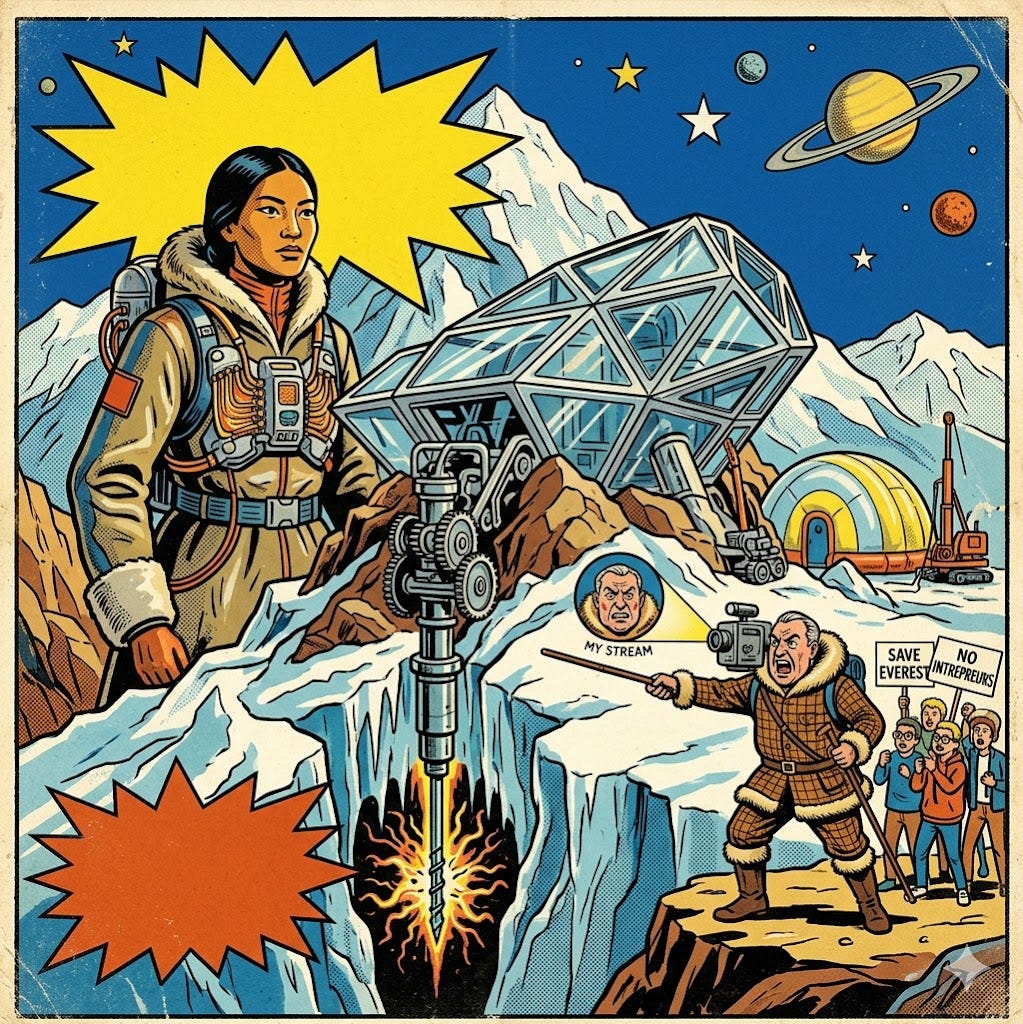
Anija Sherpa could barely register the shrieks of the wind around her as it went through the wide open expanse of Everest’s South Summit. She was bundled up within several layers of coats whose filaments were pulling in warmth from the geothermal cells embedded in her boots. With the HUD on her visor, she found the perfect point to perform her investigation.
She knelt down and rested her hand on the chassis of the deep-core drill boring deep into the rocky terrain.
“The pressure is currently at one-fifty atmospheres,” said Pemba, her apprentice, from the inflatable research dome several meters back.
“The integrity of the ice lens is at ninety percent,” his voice had the nervous excitement he usually had during field operations.
“It might be stable for now, Pemba, but let’s check the seismometers,” Anija grunted. A small puff of condensation escaped her mouth despite the suit’s built-in recycler.
She could see a complex waveform appear on her visor streaming in live data from the self-burying sensors they had deployed the day before. They were state-of-the-art tiny devices which could rest beneath the ice for years, powered by vibrational energy and able to hear the heartbeat of the mountain.
“The planar readings from the lidar are phenomenal, better than the specs claimed. If these bedrock stability tests hold…”
Her voice trailed off as she looked north at the breathtaking summit that seemed to pierce the atmosphere and travel forever upwards into space.
“I’m getting the thermal data now. There’s some fracturing deep down, but the anchoring is going to hold based on what I’m seeing now.”
“They must hold,” Anija said, mores to herself than Pemba.
She tapped on her visor a few times which triggered the drill to begin analyzing the extracted core sample.
“This observatory is going to be a new benefit to the entire public, Pemba. It will give all of us a way to view the sky.”
With her fingers wrapped up in gloves, she traced a faint outline in front of her where the building would one day reside. It would be a modern building. No, one of the future. The materials would be cutting-edge. Strong enough to handle the intensity of the mountain while also looking invisible against the snow and rock. More importantly, it would be entirely Nepalese.
The sky was perfectly clear as Sir Alistair Rothschild made his “final spiritual acclimatization ascent” towards the South Summit. Accompanying him was a stoic Sherpa named Nawang, who was keeping his distance. Alistair didn’t feel alone though, as thousands were watching his climb through his helmet cam.
“Here it is, friends,” he narrated, trying his best to keep his breath. “This is the South Summit. Known by the indigenous people as the gateway to the heavens. Or so I’ve heard. A place of tranquility, just us and natures and…”
He stopped abruptly as his camera captured a small inflatable dome. Near it was a large piece of metallic equipment. He could see footprints from someone who wasn’t him. All of it was ruining his pristine view.
“Chat, are you seeing this?” His face, visible in a small picture-in-picture window, was full of rage. “I can’t believe this intrusion. Here we are, on the most sacred place on Earth! It is the last remaining place untouched by humans, and someone has decided to ruin it.
Slowly he advanced, his persona changing from a travel vlogger to an investigative journalist.
“Look at all this equipment. Heavy machinery? Here? What the hell do they think they’re drilling? This is desecrating the almighty Chomolungma! I always warn how big commercial developers defile our natural spaces under the lie of progress.”
Then the dome opened up and he saw two figures wrapped in heavy coats walking towards the drill.
“Chat, do you see those people? They’re claiming private ownership over this public space. They are compromising this pristine wilderness. They are destroying humanity’s ultimate physical challenge. This is an outrage! I won’t stand for it!”
He dramatically cut the feed. Though the stream ended, his sense of indignation remained.
Several weeks later and several kilometers below, there was a strong tension in the community hall of Namche Bazaar. It had been renovated and expanded recently, blending the traditional Sherpa stonework with new solar panels and LED lighting.
Lakpa Tenzing stood before a packed room. The lights were in his face, making it hard to see anyone past the third row.
“For too long, our relationship with the mountain has been defined just by what others want. From her summit,” his gaze looked over the elders and parents who lived here for generations. He looked at the large number of students from Sagarmatha Technical Institute.
“We have been their guides. We have given them support. But how often do we take the lead? What about the knowledge that we get for ourselves, from our mountain?”
On the projection behind him was a realistic rendering of the proposed observatory slowly rotating against the South Summit.
“This project will provide a high-quality education for our students in all kinds of modern industries. We have worked as tour guides, but that’s not the future we have to accept. Imagine our daughters and sons mapping the furthest edges of the universe without needing to leave our country. It’ll be right here.”
Anija could hear the murmurs of approval as she stood in the back. She felt a sense of pride. The rest of the community understood what she wanted. Rohan, standing by her, was already beginning to think about the positive media he could get out of this community endorsement.
“Think about jobs that don’t depend on the climbing season or the strength of our backs for such a short time. We will provide our future generations with a more resilient future. We aren’t turning our back on traditions. But we will innovate.”
The applause was heartfelt and hopeful. Anija knew there were still many challenges ahead. There was funding to negotiate and logistics still to figure out. Yet it meant a lot knowing she had support.
Sir Alistair was busy inside his sprawling geodesic dome at the Everest Base Camp. He was doomscrolling through the local news and social media feeds. The dome had an array of solar panels on the outside powering his luxurious shelter. Inside was a Persian rug he had acquired and a vibrating chair which was vital for relaxing his aching muscles.
“I can’t believe they’re okay with this,” he fumed. His earlier vlog had caused a firestorm among his followers, but none of that seemed to dissuade the officials.
“This is just vandalism disguised as science and I won’t stand for this. Giles, what are we going to do about this?”
Giles was his PR assistant, a slender man who regularly had his face buried in his phone.
“Sir Alistair, I’ve been reading their environmental impact assessments. They look quite good. With modern designs, they won’t be affecting the footprint.”
“That’s all greenwashing,” Alistair said with a scoff. “I have all their equipment on video. Something of that size can’t be considered a minimal impact. I have fifteen thousand followers all demanding we take action.”
“I guess we need more information.”
“No. The time for study is over. If they’re rushing this through, then so must we. Mobilize the followers with a new campaign. Get a statement from the major mountaineering federations. Get that video from the stream and come up with a bunch of clips. Reach out to the World Heritage Fund too.”
“That’ll take all day.”
“And that’s the best use of your time anyway.”
“You’re not going to the next base camp today?”
“No. We’ve got more important things now. I am going to call Zennifer. Her followers would be interested in my evidence and won’t want the sacredness of the mountain to be damaged.”
He looked out of his dome at the pure white tundra around him. This was a beautiful place that he knew he needed to save.
“This is a fight for the soul of Everest,” he affirmed.