

Greetings from the Meat Fair
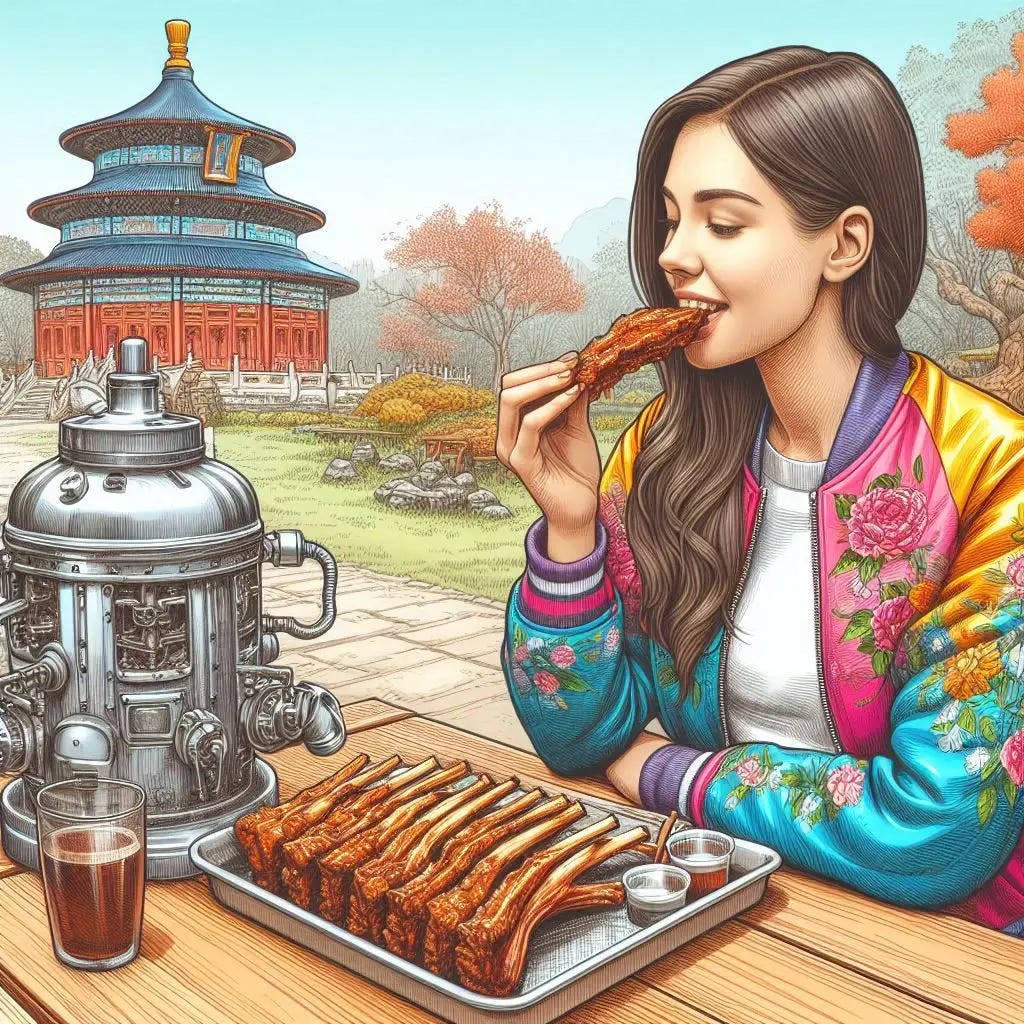
Nova stepped out of the car and onto the slightly uneven bricks of Foundry Square.
Foundry Square had a changing history: weathered brick behemoths of Greengale's collapsed industrial past were now the foundations for gleaming arrays of photovoltaic panels that angled towards the bright sun. Their tall, multi-paned windows glowed with the purple-white intensity of full-spectrum LEDs nurturing crops indoors.
Between these buildings was the buzzing Harvest Fair. Homemade stalls showed both dazzling glass structures and plain tables piled high with heirloom tomatoes.
Robinson, dressed in colorful layers that subtly signaled she was a 'visiting expert', smoothed her jacket and scanned the scene carefully. She had accepted the invitation to judge Greengale's "Cultivar Cup" mostly out of a culinary curiosity, tinged with skepticism.
This decentralized, garage-scale cellular agriculture was a far cry from the professional restaurants where she made her name.
"Mrs. Robinson, I'm so happy to meet you in person," beamed a round-faced man in a practical tweed jacket.
"Mayor Fletcher. Welcome to Greengale. We are absolutely thrilled to have you here. Your cooking influencer videos have made you a famed person around here."
"Mayor, thank you for the invitation," she offered him a polite smile and shook his hand. "This is quite the gathering."
"Isn't it?" Fletcher gestured around the square. "Thirty years ago, this place was rust and weeds. Now? Now it's a symbol of the future. We didn't wait for some coastal conglomerate to save us. We went on a path of reconstruction with smarts and our own initiative.
"And the Cultivar Cup is our crown jewel," he said, leaning in. "Forget million-dollar big-star restaurants for a moment. This, right here, is where the real passion is. Folks tinkering in their own garages, innovating, using technology to make something better, something personal."
Robinson nodded slowly to his earnestness.
"The democratization of advanced biotechnology certainly presents... interesting possibilities..."
And potential pitfalls, she added silently. Control, consistency, scaling were all immense challenges.
"Yes, possibilities!" Fletcher clapped his hands together. "And our contestants today are our pioneers. You'll see tradition, pure invention, everything. Are you ready?"
"Lead the way, Mayor," she said amicably.
The first stall had charming decor, with a checkered tablecloth and a stainless-steel bioreactor humming quietly on top. An elderly woman with bright eyes and flour across her apron gave a warm smile.
"Anna Dotsenko," the Mayor announced with pride. "One of our originals. Anna, this is the one and only Nova Robinson."
"It really is a pleasure. I'm such a big fan," Anna said.
She gestured towards the thick, glistening slices of meat arranged on a platter with a rich marbled texture.
"These are my Harmony Blend Ribs."
Robinson leaned closer and took in the rich aroma.
"Harmony Blend? The Mayor mentioned unique approaches. What cell lines are you working with here, Ms. Dotsenko?"
"Ah, that's the heart of it, dear," Anna’s smile widened. "Not one line, but two working together. It combines 'Prairie Angus' bovine cells and a wonderful 'Berkshire Black' porcine line. They're co-cultured."
She tapped a readout on her bioreactor. Robinson didn't know what the numbers meant.
"It took me over a year to perfect the staged nutrient cycle and the scaffolding to let them grow harmoniously. Precise timing over their growth was key. Then, I introduce my grandmother's spice blend into the core of the culture during its final maturation. It blends both flavor profiles in just the right way."
"Maintaining parity between two cell lines can be tough. Have you had any issues with differential adhesion to the scaffold?"
"Yes, initially!" Anna confirmed, wiping her hands on her apron. "The bovine cells were little bullies, growing too fast. I had to make some changes to the growth factors and tweaked the scaffold coating just for them. It took some doing, like getting two stubborn children to share."
Robinson accepted a sample on a bamboo fork. The aroma was rich, smoke, familiar yet somehow new. She took a bite. The texture was remarkable -- a distinct layering, a firm chew of beef, a tenderness of pork. The flavors melded seamlessly, with savory depth meeting a subtle sweetness, all unified by a complex spice blend which resonated deep within the tissue.
"Fascinating," Robinson murmured. "The beef and pork interplay is unexpected. A true example of synergy."
A significant technical achievement, to produce a stable co-culture at this scale, she thought to herself.
Next was Akiya’s stall, which featured minimalist white surfaces and cyan light filtering from integrated algae tanks. Geometric shapes, cubes with a faint citrusy scent, were presented on dark iron platters.
Akiya, young and vibrating with anxiousness, bounced on the balls on his feet when he saw her approach.
"Mrs. Robinson, it's a huge honor! I'm Akiya Mako! Welcome to bio-artistry!"
"Akiya, hello," Robinson acknowledged, feeling overwhelmed by his enthusiasm. "Your entry certainly stands out visually. Can you explain your technique here?"
"It's a fully immersive sensory experience!" he blurted out. "Forget just replicating meat like merely replacing cows. We can create new things! This dish uses a mushroom scaffold to hold the meat in a structured way. It contains flavors driven by bio-enhanced 'shrooms to double the umami taste. Plus yuzu and piney notes derived from algal nutrient bath during the late-stage perfusion. It's about micro-gastronomy!"
"Your flavor profile, the yuzu and pine, is an unconventional combination. What led you to target those specific VOCs?"
"It's about sensory dissonance!" Akiya explained eagerly. "I'm challenging expectations. The citrus brightness pulls you in, the resinous pine note forces you to pause. It's like walking through a forest after a light rain. Food should be an immersive experience."
Robinson took a plate with some hesitation. She knew she was obligated to eat it, no matter how strange the iridescent cube looked.
She popped it into her mouth. The texture was the first surprise -- a yielding exterior gave way to a burst of liquid flavor. Then there was a subtle pleasant chewy core. The taste was unlike anything she'd experienced before. There was bright citrus, resinous pine, and a deep savory flavor that lingered on her tongue. It wasn't meat as she knew it, yet it was undeniably complex.
"Radical," she stated, making a note on her slate. "You've certainly pushed the boundaries of food engineering."
"You're tasting the sodium alginate salts. They're holding the concentrated yuzu essence. The mushrooms provide the macro-structure while the alginate gives the surprise. Like a cellular caviar!"
Exceptional creativity and grasp of cutting-edge bio-modification. I don't know if this is really 'meat' but it's undeniably innovative. High marks for that.
Finally, they arrived at Alain’s stall. He had polished steel machinery with clear readouts displaying 100% energy efficiency.
On an elegant ceramic plate was a large, perfectly formed piece of cultured meat replicating the signature fat-capped cut of Brazilian Picanha. Alain was expertly slicing thin pieces from it and placing toothpicks in each slice.
"Mrs. Robinson," Alain greeted her with a friendly nod. "I'm Alain Gardener. Welcome."
Nova noticed his accent, a soft blend of Portuguese and Midwestern. She took a deep breath and noticed the rich aroma of garlic and seared fat.
"Mr. Gardener, that's an ambitious choice," she replied. "Replicating that specific fat cap is notoriously difficult."
"It requires patience," he gave a small smile. "It's precise, targeted adipogenesis to draw out the rich flavor."
"And what flavor is that?"
"The tempero. My seasoning blend isn't added on at the top. Garlic and salt molecules are added directly into the initial scaffolding over time, as the muscle fibers grow. This flavor builds all the way through."
"Bringing this specific piece of your Brazilian heritage here, recreating it with technology... Was that your motivation?"
"It's the taste of family and celebrations back home. If this technology can preserve those memories while making it sustainable for my children and grandchildren, then it's worthwhile. It's not just replicating meat, it's replicating connection."
He also described getting his nutrients from locally processed agricultural side-streams. "Sustainability isn't just efficiency. It's about respecting the traditions."
Robinson grabbed one of the slices. The aroma was intensely savory. The first bite was a revelation. The fat cap was perfectly rendered and amazingly tendered. Each taste had flavorful meat with a satisfying chew. The seasoning was not a hint scattered across the surface but a deep, resonant flavor that seemed present in every fiber.
"Remarkable," she was genuinely impressed. "The intramuscular flavor is flawless. And the fat cap's texture has extraordinary fidelity."
This is a masterful replication of a complex, culturally significant cut. Deep infusion of seasoning is sophisticated.
"You've captured the essence of Picanha beautifully, Mr. Thorne."
Stepping back, Robinson surveyed the three distinct stalls with the various flavors mingling on her palate. There were three remarkable achievements and three different philosophies borne from Greengale's unique community spirit. She began to understand her decision would not be easy.
Her thoughts were mixed as she walked around Foundry Square, watching families examine hydroponic vegetable modules and tinkerers showing off homebrewed farm tools. The vibrant energy that Mayor Fletcher had boasted about was undeniable.
How was she supposed to weigh such disparate forms of excellence? Akiya Mako represented the bleeding edge of biotechnology to invent entirely new sensory experiences. Their work was brilliant, provocative, and a glimpse into the potential future. Then there was Alain, embodying replication of culture. His Picanha wasn't just muscle and fat; it was memory and sustainable cultivation.
And Anna... Anna was the most surprising, not merely preserving tradition but synthesizing something novel from it. The co-culturing of distinct species, balanced and perfected, was a feat of profound technical understanding with a deep culinary intuition. It respected the past while boldly stepping into the future. It was something that could only exist because of this technology. It felt complete.
Mayor Fletcher bustled onto a small riser near the old, repurposed foundry smokestack base. He tapped a microphone.
"Alright folks, settle down now! Settle down! This is the moment we've all been waiting for. Mrs. Robinson has tasted the future, right here in Greengale!"
A cheerful ripple of laughter passed through the crowd.
"Robinson, if you'd do us the honor?"
Robinson ascended the riser and adjusted the microphone downwards. She looked out at her chefs and their expectant faces.
"Thank you, Mayor," she said, pausing to clear her throat. "I must confess, judging this competition was significantly more challenging than I anticipated. The level of innovation, skill, and passion displayed by all the contestants was truly remarkable. It speaks volumes about the ingenuity thriving here in Greengale.
"We saw radical artistry that pushed the very definition of food. We saw the meticulous, sustainable replication of cherished cultural traditions. And we saw the skillful synthesis of heritage and science to create something entirely new.
"Each approach represents vital progress in cellular agriculture. However, a choice had to be made. The Greengale Cultivar Cup for this year goes to an entry that demonstrated not only exceptional technical mastery, but also achieved a remarkable harmony between tradition and innovation."
A hush fell over the crowd.
"The winner is Anna Dotsenko and her 'Harmony Blend Ribs'."
Applause swept through the square. Anna blinked, her hand flew to her chest in surprise, and a wide smile spread across her face. Mayor Fletcher beamed and clapped enthusiastically.
"Anna’s co-culturing technique and flavor integration represent a truly unique achievement, a synthesis that honors the past while forging a new path," Robinson elaborated. "But the excellence didn't stop there. I would be remiss not to acknowledge the other outstanding entries."
She turned slightly.
"A special commendation for Pushing the Boundaries goes to Akiya. Your work is visionary and challenges us to think differently about food."
"And," Robinson continued, turning towards Alain, "A special commendation for Excellence in Sustainability goes to Alain. Your Picanha was technically superb but also a great example of how this technology can preserve heritage."
The applause swelled as Anna made her way to the riser and was helped up by the mayor. She grinned and shook her head in happy disbelief.
Robinson stepped back to observe the scene: the community celebrating one of its own, the respectful nods between competitors, and the shared journey to the future. Fletcher had called it "science by the people, for the people". Perhaps he was right. Here, in this revitalized heartland town, something genuinely exciting was being cultivated. And it tasted like progress.