

Charlotte looked around the board room at the other stern faces. A holographic display was flickering in the middle of a vast chromesteel table displaying a sentiment-metrics chart. It had become a waterfall of red since Friday. Next to that chart was a second, showing the stock of Skyblue Records ($SKYBLU). It pulsed ominously as it fell deeper with each refresh.
"I wish you weren't here with me, but I had called this meeting to discuss our ongoing crisis." Charlotte remarked, just as tired as everyone else. "Once we finish our discussion we can go sleep and come back right after for a happy Monday."
"As you can see, the fallout from the Marty Eriksen incident has been substantial to say the least. We're already down by nine percent. Our brand partners are calling us right now to invoke their morality clauses. Needless to say, his tour is going to have to be put on pause. That's a big hit to Q2 revenue."
"Is the story even true?" muttered a board member at the other end of the table.
"It doesn't matter," Charlotte acknowledged. "The accusation is more real than any search for fact-finding. People see what they saw: a blurry photo, a fifteen-year-old influencer, and a social media storm. Now a $30 million asset is compromised. And this is not the first it's happened. Every artist is a liability now."
She swiped the air in front of her, causing the holograph to replaced the souring charts with a logo labeled "Project Chimera".
"So I have really assembled the board today to propose our solution to this ongoing vulnerability problem," she announced with a practiced confidence. "We need to represent a new generation, a new paradigm, of artists. We use fully synthetic entities powered by deep learning. We get to decide their look and sound. The music is generated programmatically based on our existing corpus of hit songs. It will hold interviews in any language, expanding our global reach. And it will have a flawless social media personality."
Charlotte looked across the table at the stunned, reluctant faces of the board.
"We need to own the means of production, from beginning to end. We can no longer depend on unreliable humans who get photographed with the wrong person in a Tijuana club. A virtual star we control can be sassy, or edgy, but they won't rape anybody. It is perfect. More importantly, it is profitable."
Twenty miles south, Ty Martinez walked up to a small stage at sat on a stool. He felt a bead of sweat roll down his temple. His nerves were racing. He closed his eyes, taking in a whiff of jasmine and tried to relax.
He looked out at the cheering crowd of the warehouse in the outskirts of the Barrio Logan. He knew that everyone was waiting for her.
Arleen had her back turned and was finishing tuning her instrument, a sort of living cello. Its body had been grown from a giant gourd and its strings were thin like spider silk.
"Okay," she whispered to him. "I'm ready now."
He started to pluck his guitar, setting up the song. His foot tapped on a drum pedal which whacked a mycelial head and let out a regular whoof. Arleen joined in, dancing her bow across the strings to draw out a pleasant harmony.
And then she started to sing.
Her voice was raw, cracking with emotion and full of soul. She sang a handwritten song about reclaiming the city, finding life in the abandoned spaces and growing a future out of the soil.
When they finished playing together, Ty was speechless. There was something there. He'd signed countless artists over the years, each of them more famous than the last. But her... it felt like a storm of feelings all cascading against one another. This was what music was supposed to be.
"That was amazing," he told her, his voice full of a passion he'd thought left long ago. "I have to show them this recording. Charlotte, the board, everyone. You're the future."
She met his look with a hopeful smile. Her heart was full of excitement.
Monday morning, Ty rode down the elevator from the executive suite on the fiftieth floor. He felt like a ghost. He had promised that she would get a shot, but that had been shattered by the cold reception he had just received. He had played the recording. He argued with them, feeling energized that he would stake his whole reputation on this new artist.
Charlotte listened patiently. She complimented the heart of Arleen's music. But then she just showed the presentation for Project Chimera. The board's vote was unanimous.
Arleen was sitting in the reception area at the bottom of the tower with a small coffee in her hands. When she saw him, there was a hopeful smile on her face and it made him sick with guilt.
"So, did they love it?" she asked, practically bouncing out of her seat.
Ty couldn't meet her gaze. He stared at the foam art in her milky drink.
"They didn't love it," her dejected tone felt devastating.
"Not exactly."
"So what?"
"There's been a... they called it a 'strategic pivot'," the phrase sounded awful. "Given recent controversies, the label is restructuring how they bring in new talent."
"A pivot?" Arleen didn't understand the corporate jargon. "Ty, what does that mean?"
"It means they're not signing anyone," he looked up at the pain in her eyes. "At least, not for a while. They're not looking for any organic talent."
"Organic," she repeated.
"They listened to your song. They liked it. But they aren't looking for good music, they are seeing risk. They just see musicians as variables out of their control. Marty Eriksen... that really spooked them. Your talent isn't in question. It's your humanity."
"But music is human."
"Not to them. Not anymore."
Somehow that hurt even more. She could understand if her music wasn't good enough. She could practice. She could learn. But to be rejected because she was too human felt confusing and strange.
By the end of the week AURA took the world by storm. A team of graphic artists blended a thousand faces together until they found a perfectly impossible set of band members who were pan-ethnic, androgynous, and flawless. Motion-capture actors danced and had their movements smoothed by algorithms into perfect motions that could be performed endlessly. The band was made of five digital humans who were all different but shared an ineffable sameness. Their pitch was perfect yet lacked depth.
A terabyte of music waveforms were processed each second, including Beethoven, K-Pop, and gospel to understand how music worked at the millisecond-level. It used all that data to organize AURA's debut single called "Kiss in the City Park". The synths and pulsing drum line was engineered to meet everyone's musical tastes. The lyrics were designed to be vague and relatable, taking a common event and making it feel specific to each listener.
Ads appeared everywhere, in the subway, on social media, and on the sides of buildings. Their song played on every radio station and was injected into everyone's music feeds. AURA was everywhere.
Arleen watched AURA's perfect faces as she walked down the streets of Barrio Logan. She could hear the hollow notes coming out of passing cars. She watched as so many people became instantly captivated by this synthetic pop star. It was the fame she that she could've had. She didn't know if she deserved it, but AURA certainly didn't. What she felt wasn't quite envy, but something defiant.
"Kiss in the City Park" became the song of the summer. AURA was an inescapable triumph as far as Skyblue was concerned. It played everywhere, just generic enough to fit in anywhere. People couldn't help but hear it. The numbers of plays went up.
Arleen watched the anthem take hold of culture with a strange detachment. She looked at the empty looks in AURA's synthetic eyes as they posted short videos for followers every morning, feeding the endless stream of corporate-approved content. She knew she couldn't beat the machine by competing on its own level. She needed to offer an alternative, to remind people about the soul that music could provide.
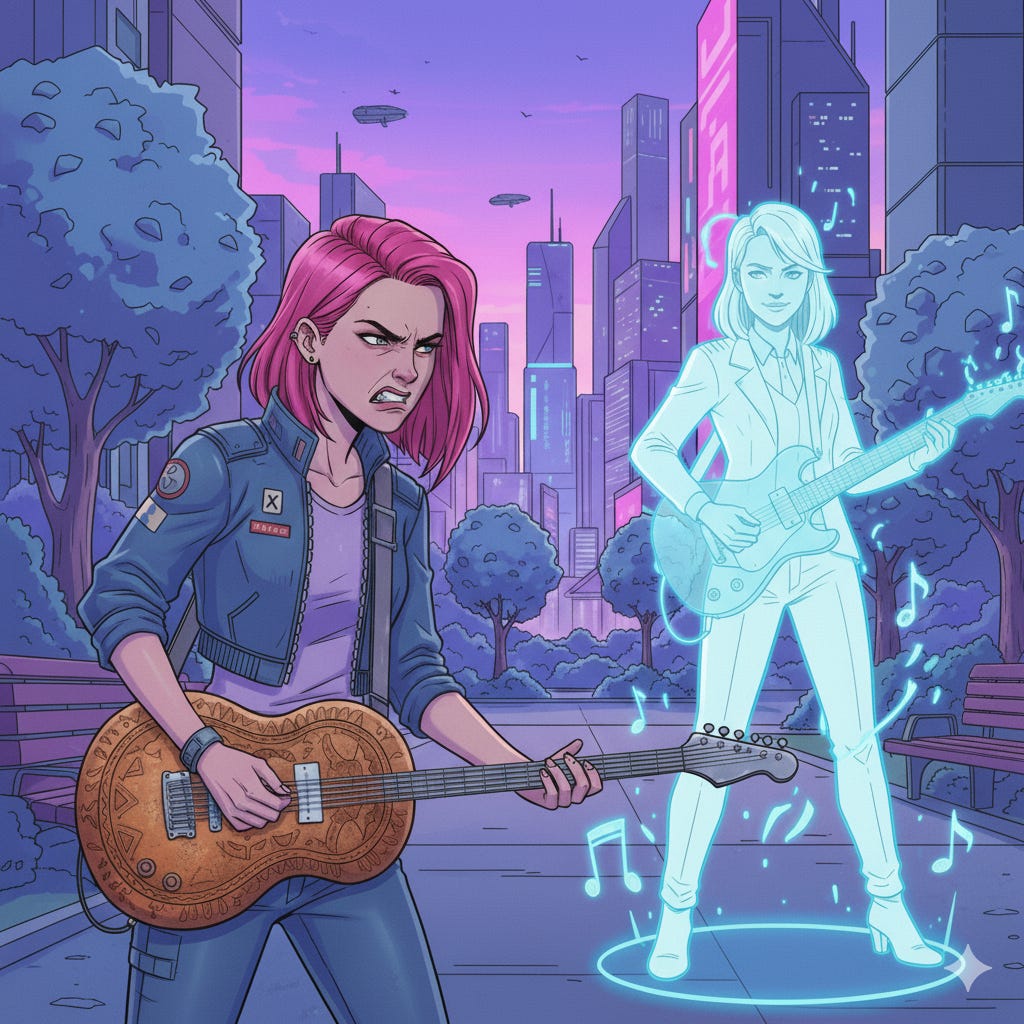
She spent those summer months working on something new. A slime mold was genetically engineered to move in the direction of specific audio frequencies. She incubated and fed it, allowing it to grow as big as she could. On a moonless night, she released it across the paths of Balboa Park.
A few days later, as the sun set behind Point Loma, AURA was scheduled to perform a "live" concert made of holographs in the city's central plaza. But she brought her cello to Balboa Park, to a small patch of grass near the dog park, and began playing.
As she did, the slime mold began glowing and moving. Passersby stopped as they watched the dirt trails seem to dance. The slime mold pulsed as it migrated away from the dirt and surrounded Arleen in a wide circle. She stood in the center only playing her gourd-cello. She hadn't advertised with flash ads, just a few flyers with a simple message: "Experience how music makes you feel alive".
A coastal fog rolled in as her song progressed, refracting the bioluminescent light. The entire sight was unexpected yet compellingly ethereal. Her voice cracked on a high note, an imperfect moment that reminded her listeners that she was a real person.
Quickly her impromptu concert went viral. People from the stale AURA concert saw the link being shared. A growing stream of people left the plaza and walked to the park.
Hundreds of people stood and sat in the grass in a mesmerized state. They felt part of a living moment.
When the last note faded, the crowd let out a loud explosion of applause and cheers.
Although this success was meaningful for the people that night, Charlotte Lee was not dissuaded from her approach. She commissioned a report to develop "authentic digital personalities". But Ty took his lunch break to watch a replay of the stream with a proud smile on his face.
Arleen woke the next morning with dozens of emails from independent labels, other artists, and people asking her for what song she was going to write next. As she rolled out of the bed of her small, chaotic studio, she took their support seriously. She was a small-time artist. She wasn't going to change the world. But she could build her own future.