

I'm an Image Generator for AI
Rachel was nursing a locally crafted birch beer at the bar. It was her usual place: The Downcellar. She liked how it wasn't trying to be something it wasn't. It was just a basement, retrofitted for a place where young professionals could hang out. The exposed pipes brought with it cold air. Low-watt Edison bulbs cast the whole place in an amber glow. The whole place was thick with the odor of sweat and fresh coffee.
The coffee came from Zayne. He moved with precision, something which fascinated her and kept her attention. He tamped the dark grounds. He had control over the hissing steam wand. Every action was real. It looked very tangible. There was a weight, and heat, and smell. The whole thing was a genuine art form. It made her jealous.
He caught her staring and flashed her a big smile.
"You need something else, or just admiring my machinery?"
Rachel felt herself blushing.
"The machinery is impressive," she said, immediately gesturing nervously to the large metal object. "You're good at what you do."
"It's just coffee. But I guess it beats spending all day at a desk, looking at a screen."
He wiped the counter with a damp rag.
"By the way, what about you? You never told me what you do."
His question immediately led her to regurgitate her practiced answer.
"I do remote visual asset creation for Cognito. You know, the big AI company."
"Ooh, I've seen their ads," he said, playing up his level of interest. "Your job sounds important."
"It's alright. Pays the bills," she said dismissively.
She gave him a quick smile and changed the subject. One more ale later, he was laughing about an old college story involving a kilo of quick-dry cement. For a moment she was able to forget the ever-present workload which awaited her at home.
The morning light peeked through the blinds of the apartment's single large window. The intimacy of the night before now seemed like a lingering awkwardness. Zayne was still asleep in her bed, breathing peacefully. But Rachel's attention was snagged by the interloper in the room: her workstation.
Two monitors sat attached to the wall overlooking a minimalist desk and an ergonomic chair provided by the company. That way, she could work longer hours without needing to take a break. They seemed quite happy about this corporate benefit. On the desk sat her drafting screen, a black rectangle. A scanner also rested on her desk, a silver orb with a dark lens which reminded her of an always-watching cyclops. Even now, a tiny LED glowed in standby mode, always ready to watch.
She suddenly grew worried that Zayne would wake up and look at her corporate-sponsored apartment with disgust. No, she wasn't worried. She felt ashamed. She felt like she'd be exposed as a phony.
She slipped out of bed quietly. She grabbed his clothes off the floor and found his shoes by the door. She began folding his shirt neatly.
"Hey," he grunted, his voice having a morning gravel to it. His hair was a mess. "Are you leaving your own place?"
"No, I have to work early," she lied. The lie was about the time, not the intent. "Really early."
"Oh. Don't let me stop you then," he seemed confused, but complied. He pulled his jeans up his leg and put on the half-folded shirt.
When he was fully dressed, she walked him to the door while maintaining a professional distance.
"I had a good time, Rachel," he said, his face close to hers but not quite touching.
"Me too," she said, forcing a smile. "I'll see you at the bar sometime?"
"Yeah, sounds cool. See you."
She closed the door fast, then clicked the lock into place. Leaning her head against the wood, she shut her eyes. The apartment was quiet again, aside from the ever-present hum coming from the desk. The place felt dirty, soiled by a man who actually worked with his hands.
Since Rachel actually had an hour before her shift, she took that time to shower and put on fresh clothes. She had to mentally prepare herself for work, out of sight of anybody. Then she took a seat at the desk, her body nestling into the familiar contours of her chair. As soon as she sat down, the scanner's LED turned blue. The screen in front of her lit up, displaying the clean corporate UI of her daily work dashboard.
A new task was waiting.
Image Set DEW 307.76: Urban Decay
There has been a 3% increase in urban decay prompts over the last two weeks. Our training set needs more examples.
Consider parameters like palette-muted earth tones, bioluminescence, hopeful.
She picked up the stylus, a perfectly balanced object which felt cool as she touched it. On the right side of her screen, a small unobtrusive window appeared.
Work analysis
[08:19:36] User seated.
[08:19:41] Stylus grip registered.
[08:19:56] Initiating stroke capture...
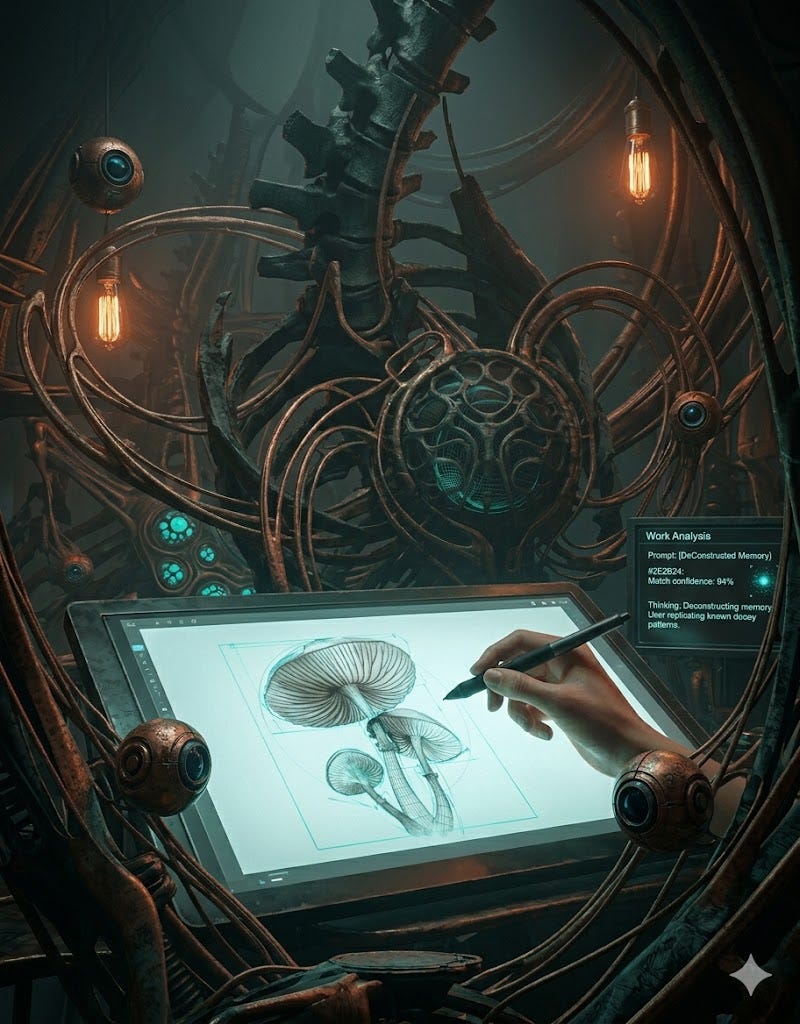
Rachel began to draw. A brick wall emerged. Then she added details to show how it was crumbling. She picked textured grays and browns to fill in her outlines. As sketched the creeping fungus next. Her hand moved back and forth with a practiced skill, but she knew it wasn't really her skill. Her talent was fused with the AI's guidance. It subtly nudged her to the 'correct' color choices and textures it wanted. It learned from every line she drew.
Data appeared on her screen:
Strike Velocity: 9.5 cm/s.
Pressure: 93 g.
Color selected: #2E2B24;
Match confidence: 94%
Thinking: User is replicating known decay patterns. Suggesting novel fungal structure to improve image-gen coverage.
It helped her, creating wireframes that she could trace. It created a delicate, spiraling shape. She followed, moving her stylus over the outline to form it into being. Her own creative flourishes were put into the background as she followed the requirements. She picked a green and painted in the newly grown plants. The resulting image was technically flawless, but felt soulless. While it did technically have all the needed parameters, the work didn't mean anything. It couldn't be considered art.
When she submitted it, she noticed an email from leadership. It was automatically placed in the "Top Priority" box. She hesitantly clicked it.
TO: visual-asset-creators@cognito.app
FROM: Dr. Luna Russell, Chief Innovation Officer; lrussel@cognito.app
SUBJECT: Project Empath and The Next Horizon
Team,
First, allow me to thank you for all of your hard work up to this point. Your contributions and hard work have allowed our AI to achieve the top scores across all models for technical artistry. And yet we must continue to push forward and truly enable our users to express themselves no matter what they prompt. We must go beyond the world as it is and create training data that shows human feeling.
Project Empath is our new venture in this direction, and it will require everyone's help to make it a success. This means your new prompts will focus on abstract, emotional concepts. Together, we won't just make art. We will build empathy at scale.
Rachel rolled her eyes. Rather than drawing bland illustrations, she was now required to draw training data on concepts so vague that it would easily fill in the spaces of one's emotional gaps. She was supposed to commodify their feelings, to provide them with some automated empathy. She knew it would be the opposite of genuine.
Then she received the first prompt:
Image Set DEW 307.77: Visualize the specific shade of envy you felt last night
Rachel stared at the words and thought back of her own personal experience. Zayne had been doing honest work with his hands. She understood that complex mix of emotions: bitterness, longing, and a little bit of hope. But how was she supposed to depict something like that in an image?
She tried, starting with a murky green backdrop. Yet then she looked at the automated data being collected on the side of the screen.
Work analysis
[08:59:49] Stroke initiated
[09:03:04] Color selected: #88A039.
[09:05:22] Match confidence: 8%
Thinking: Prompt requires deeper emotive sourcing. Deeper focus required.
"More focus? You're a machine. What do you know about it?" she grumbled.
She closed her eyes and replayed her memories of descending into The Downcellar. She thought about that exact moment when Zayne grinned at her. What did she feel then? She recalled the flushing in her face and a tightness in her chest. Her heart had fluttered.
She opened her eyes and changed the colors. She added streaks of gold far away, something that you wanted to get closer to but couldn't. She thought of the light that bounced off the metal espresso machine and the dark counter that separated her from it.
When she finished, she felt a bit of pride. There was something real in her image. The emotions captured in the image resonated deeply with her. It was a shame that nobody except for a GPU would ever see it.
The following prompts dredged up older memories: "Echo of a bittersweet moment", "Feeling of being watched by someone you trust", "Safety of your bed as a toddler".
She thought back to a childhood trip to the beach, and her mother, and the soft sounds of cicadas on a summer night. She thought about a quilt her grandma gave her as a baby, one she kept using even as it grew worn and needed new stitching. Yet as she tried to put her stylus on the pad, the AI deconstructed these memories into data points. These moments of emotion turned into data points being scooped up into a model.
After finishing one, she decided to pull up her employment contract. Surely there was something against dredging up all these emotional moments. She found a clause she hadn't fully considered when she desperately signed it:
...Contractor agrees that all created assets, including but not limited to emotional and mnemonic-visual data streams generated as part of the creative process, are the sole and perpetual intellectual property of Cognito, Inc...
She was just a well for them, always required to be full of emotions that can be withdrawn in abundance.
As she sat on a solar-powered tram headed through the city to her usual farmer's market, she saw an ad flicker to life on a screen inside. Several attractive people were playing volleyball on the beach. It was generic and bland. But then she noticed a woman in the corner sitting on a beach towel. The pattern on the towel had the same repeating patterns of blue squares and yellow flowers.
It had recreated her blanket.
Not exactly, but a chilling accurate reinterpretation. Her memories had been used to sell sugary water. They used her life to evoke a sense of nostalgia. This was a kind of violation that she had never experienced before.
Then, the next morning, she received a high-priority assignment. It landed in her inbox wrapped in a golden outline.
You have been selected for a high-yield emotional data capture. Upon its submission, you will receive a one-month bonus.
A whole month for one image? It was enough for her to finally catch a break. She could take a vacation, a real one, maybe travel a little bit. At the very least, she would be able to not work for a little. She hastily clicked Accept.
Prompt: Visualize the moment you realized a dream had died
Rachel felt like she had been hit in the gut. It was a repugnant request, one that felt so violating it was if the AI had been spying on her personal life. They wanted the memory of her surrendering to them, of watching her break. Then they would reward her for their voyeurism. They were buying her last piece of the unspoiled past.
She pushed back from the desk and left the apartment. She needed air. She needed to get away. She had to take a walk.
As she sat on a bench in the park, watching the trams pass by, she felt like the world was personally out to humiliate her. Then she saw Zayne through the window of the coffee shop, wiping down the counter like he always did. A customer placed a dollar bill into a tip jar and he gave them a polite smile. She noticed his tired stature and the way he yawned when nobody else seemed to be looking. His life wasn't easy, but he seemed to be in control of it.
Her envy faded into an existential fear. What if he wasn't actually in control? He had to get up every morning and work for tips, one paystub away from disaster. It wasn't inspiring, it was precarious. Perhaps no matter what you were in a prison: one where she had her integrity intact, or a gilded cage where she could afford good food.
She stood up, choosing the gilding.
Her walk back to the apartment was full of a grim acceptance. There were a lot of things she could do with that money. She could enjoy herself, even if for a brief time. It gave her a limited sense of control. The blinking light of the scanner was no longer an all-seeing eye. Now, it was her co-conspirator.
She picked up the stylus, took a deep breath, and summoned her memories.
There was a cramped dorm room in her art school. There was a small side table holding a cheap laptop. Student loan projections appeared in a spreadsheet, showing an infinitely rising number. There was a single job offer in a separate window: Cognito promised a salary that felt like a lifeline. Rachel recalled the physical curdling in her stomach as she forwent the vibrant future of an independent artist for one that offered a gray financial stability. Pragmatism won that day.
She started drawing, rendering a scene of a pained figure. She paid attention to the texture of the particle board overhead, the angle of the light from the window, and a look of despair on the individual's face. She poured the grief into each stroke.
Emotional Resonance: 96%
Analysis: Mnemonic data stream potent.
> Data Capture: Successful
When she finished and submitted it, she put down the stylus and leaned back in her chair. She could now breathe. She stared out the window, where night had fallen. The city looked alive, but Rachel sat alone in her dark room illuminated only by her screens. She felt nothing at all.