

Judging the Marque
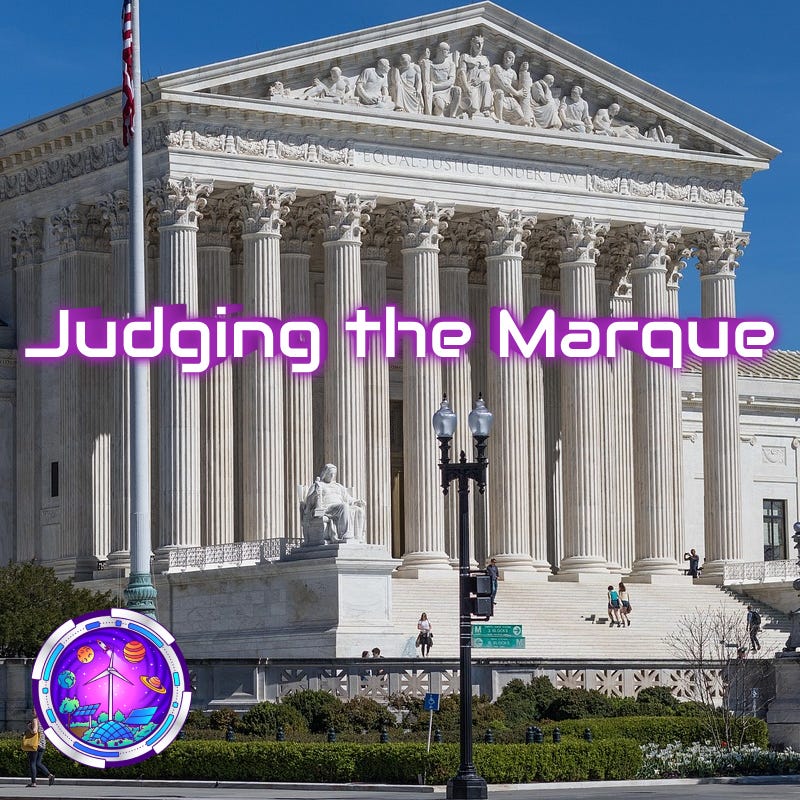
Justice Arthur Perry took at seat at his immense desk, a relic from the Taft Era. His chambers were a contradiction, with old leather-bound legal tomes cramped on large bookshelves on one side. On the other were quietly humming servers connected to a state-of-the-art legal database.
He looked out the window at a DC that was also anachronistic. The Washington Monument was flanked by wind turbines nearly as tall. The city kept changing in many ways, but his duty to uphold the Constitution remained.
He tapped his fingers against the desk, playing the rhythm of Bach’s First Cello Suite as his grew deeper in thought.
SnowPlow Global v United States
The case had occupied his mind every day for the last three weeks. He was the swing vote as usual, someone seen as the legal bellwether by the public, even as he personally felt stuck in the middle between two opposing ideologies.
“It’s a constitutional matter and that’s that,” Justice Stein had argued in conference. “It’s explicitly laid out in Article I, Section 8, Clause 11. Congress grants letters of marque and reprisal. Full stop.”
“The constitution was explicit about wooden ships and cannons against opposing wooden ships,” Justice Park had retorted. “The constitution in fact says nothing about a multinational corporation conducting a cyberattack from a server farm in Dublin.”
Perry got up from his desk, unable to think straight. He walked over to the window at the millions of people going about their day across the city. Both of his fellow justices were wrong in their reasoning. Stein’s view was overly simplistic for the complexities of the day. Park was always a weather vane, unable to stick to some sort of conviction of law against the changing world. He found both of them to be intellectually lazy.
The case required a deeper response. SnowPlow Global served energy partners across the country. When a state-sponsored cyberattack crippled the grid for ten hours and stole data, it had quickly become a matter of national security. Congress responded cautiously, unwilling to let this event draw them into a full-scale war. Instead the SNOWCRASH Act authorized the president to grant individual letters of marque for digital warfare. SnowPlow had become, in effect, the nation’s premiere privateer.
The law was an attempt to graft the issues of the present onto a historical legal mechanism. But was it constitutional? He respected the constitution and legal precedent, yet the historical record was quite sparse on the way this should be used especially in the matter of digital conflict. The founders could not have conceived of cyberattacks or instantaneous global communication.
There was a small photograph on his window sill contained inside a silver frame showing his wife, May, with a big smile when they vacationed in the Ozarks.
“What am I supposed to do, dear?” he whispered. “They want me to pretend that Jefferson and Hamilton somehow had thoughts on weaponizing code and international servers.”
He closed his eyes and tried to imagine her voice, a sound he hadn’t actually heard in six years.
“Then don’t guess. You always taught your students to look deeper and find the principle.”
“The principle is about holding a cybercriminal accountable. In the past, the privateer captain was a citizen with a real ship and a human crew. We could hold him accountable in a court and seize his assets. But how do you hold a nation-state cyberattacker accountable?”
What could he do if history was silent? He looked over at a small book he had been reading: a volume of Jefferson’s letters bound in leather. The man’s mind was a universe unto itself. He was brilliant, contradictory, but always wrestled with the fundamental tensions between liberty and security. He understood the technology of the time, as the industrial revolution was just beginning, but he also understood the risks of how big financiers could make people freer or bind them.
Perry began developing a radical idea, one entirely audacious. It was a stark departure from jurisprudence but also seemed like the only reasonable path he could take to make a decision. He returned to his desk and unlocked his PC. Opening up his private network settings and connected to the encrypted intranet. He then began to draft a message to the Federal AI Commission’s LegalWorks Division.
TO: Director Khan
FROM: Justice Perry
SUBJECT: Priority Requisition for Bespoke Pre-Trained Model
Director, I am commissioning a new model under the LegalWorks protocol. This is meant to be a deep-corpus LLM with a single-subject.
To be explicit, I want everything that the Library of Congress had digitized. Every letter, every book, every draft. His private journals, scientific scribbles, and every reply that his constituents sent to him. Basically, I want a model that is more than just his writings, but as close to him as a neurological model as possible.
The objective is to use this model as a Socratic assistant, to explore how foundational principles of the constitution can be better applied to questions of the present where existing writing is not explicit. If Jefferson can be recreated using this model, it will be useful in addressing matters of national security.
As always, your discretion in this matter is paramount.
Thanks.
He hesitated briefly before sending it. There seemed to be a line he risked crossing, discarding the plain text of history and creating a system to make guesses based on statistical inference. It was a desperate act, and he knew that, but he had to have faith that it would give him the answers he sought.
For a moment, he sat in the quiet of his chambers. Then, his fingers began tapping on the desk again, continuing the Bach suite.
There was yet another stressful week. The end of the June was rapidly approaching and he had to give his decision before then unless he abstained. But if he did, the court would be divided 4-4 and simply push the issue into the next term.
Then early Monday, he received his reply. His custom model, Project Monticello, was ready for him to use. His hand shook as he downloaded the model to his local computer. He still felt a strong sense of anticipation. He felt like he was raising the dead like a psychic.
There was a small app which wrapped the model in a user interface. There wasn’t a colorful avatar or any sophisticated UI polish. It was minimalist and clean.
Now he just had to know what to ask. He stared at the cursor, blinking in a small text box labeled “Your query”. How would he start this conversation? Jefferson was a legend. It would feel sacrilegious if he asked the virtual Jefferson something inane and trivial.
Mr. Jefferson. I hope you are well. I am an American jurist facing a dilemma that I have had trouble reasoning. It would be helpful to me for your advice on constitutional law.
He hit enter and waited as the model began processing his words. His fingers tapped against the desk again. He didn’t know if it was going to work. Why was it taking so long?
Then the words of the model’s response flowed onto the page. They were rendered in a serif font vaguely resembling a kind of cursive while still being legible. The words appeared slowly, as if Jefferson himself were writing them with a digital quill.
I suppose my wellness is one that is hard to define. I am blessed with the health of mind even as I understand the final state of my person is settled history. It is a strange contradiction. Still, I am here as a fellow citizen ready to serve my Republic. I am at your disposal for whatever questions you may have.
Perry leaned back, surprised by how much it sounded like the original Jefferson. These words were a bit formal yet also curious and inviting.
“Okay, I need to find the principle,” he said to himself.
He thought deeply about what to ask. He had to translate the world of today into the kinds of words that would best make sense for the model.
My legal question is around granting a letter of marque and reprisal. The issue is one of novel circumstances. Today, there is a new domain for commerce and discourse which is not of the physical world. Rather, imagine a vast world made up of postal roads which exist invisibly as light in the air. These roads allow for instantaneous transactions of money and correspondence across oceans. This world is colloquially referred to as ‘cyberspace’.”
He sent his message and waited, hoping this metaphor worked for the Jeffersonian model.
A universal post road to enable the free exchange of ideas? Unbound by geography? That’s such a fascinating concept. I’m sure it has become a tool for the enlightenment of all citizens, removed from the influence of censors and tolls.
Perry understood that the AI was trying to reason from the core principles that Jefferson himself was concerned about during his days: censorship and monopoly. It seemed clear that the model would be a good fit for allowing him to understand the founder’s intent. At the same time, Jefferson’s optimism about the Internet’s value to the world seemed to lack the real problems that it also created.
A foreign power has used this public road for services beyond discourse. They raided the ledgers of one of our American mercantile enterprises. Their designs have been stolen and they obstructed the public’s access to manufactories.
You are describing an act of piracy, a raid on the free flow of commerce. Many nations already have laws to prescribe a remedy. Why would this letter of marque be considered novel?
Perry leaned back in his chair and thought carefully. Why indeed? He chose his next words carefully.
Congress granted the letter not to the captain of a ship, but to the enterprise itself. This is a mercantile company with immense wealth and global reach, a power which rivals some small nations. This company has been empowered to wage a campaign of vengeance on the digital assets of the foreign power.
There was a long pause after this. The model was churning through terabytes of records.
You speak of an entity not different from the East India Company? An entity made of private interests with a power granted through the state, accountable not to countrymen but shareholders. It would be an artificial person with the ability to wage a war on behalf of the state.
His question made a lot of sense. To Jefferson, the East India Company was the ultimate symbol of national sovereignty being subverted to benefit a single corporation.
So you understand the difficulty of granting a letter of marque to such an entity while being consistent with the principles of the constitution?
Perry had expected the model to provide a historical perspective. Instead, it gave him a question.
Before we even look at the tool, should we not consider who wields it? Is this enterprise a citizen? Does it have a body? By what mechanisms are you able to hold this entity accountable by the people who have granted this power?
Perry realized his own legal framing seemed insufficient. He started trying to explain the modern state regulatory state, but then noticed that the AI hadn’t finished its earlier response.
Throughout my life, my greatest fear is that the blood of the Republic will be spilled for the enrichment of a few rather than the liberty of all. Does the state not risk surrendering its singular monopoly on violence by granting this power to an entity who solely seeks profit?
Tell me, sir, isn’t a Republic most endangered when the power of the sword is held by a hand not guided by the people? One must ask who is the true master and servant.
Perry leaned back again. The questions were relentless but insightful. He’d been focused too much on the letter of marque itself that he hadn’t even been considering the principles of accountability in the age of multinational corporations. Somehow, this statistical model had forced him to confront the foundational principles he had overlooked. There was just one last thing he had to write out.
Thank you.
He closed the window, ending the session. He was now alone yet full of the ideas from a man dead for two centuries. The decision seemed infinitely more clear.
For weeks he had been asking how the founders would think about a digital cannonball or a cyber bullet. He had been obsessed with historical metaphors that he forgot the most important question. His love was right. It was about the captain far more than the ships or the cannons.
In 1790, the privateer captain was a man. He had a name, a reputation, and legal liability. If he exceeded his authority, he could be arrested and tried for piracy. But SnowPlow was a legal fiction. How could they arrest servers placed in a foreign country? The board of directors were protected by layers of law and lived in foreign countries. They had no direct allegiance to the country and couldn’t be accountable.
Jefferson wasn’t afraid of new technology. He had been an inventor in his own time. He was optimistic about the future. His fear was of power that couldn’t be held accountable. He was afraid of this exact kind of situation.
Perry looked over at the frame on the windowsill. After giving a silent thanks for her guidance, he opened up a new window on his computer and began typing. The words flowed quickly with a newfound conviction.
When the court reconvened, Perry sat up on the dais, his gaze sweeping over the hushed room. He adjusted the microphone placed in front of him and began to read the court’s decision.
“I rule in favor of our slim majority that the SNOWCRASH Act must be struck down,” he spoke calmly. “I agree with the majority in their ruling but not in their rationale. As such I am submitting a separate concurrence. The majority focused far too much on the novel technology of our time rather than the timeless principles our nation was founded upon.”
He felt the sharp stare of the other justices on him now. He took a deep breath and tried to continue, hoping to convince them he was right.
“The petitioners asked us to consider a digital letter of marque which was the same as the letter of marque the framers were aware of. We are asked to relate a malicious algorithm to a thirty-two-pound cannonball. We are said that a fiber-optic network is no different from the open sea. I argue that we have been lulled into an analogy that misses the entire point. Whether the weapons have changed is irrelevant. The question is whether the wielder is the same.
“The power to grant letters of marque was a way to outsource state-sanctioned violence. This was done because the power was granted to a citizen, a naturalized person which could be held accountable to the state and the public. They sailed under an American flag and lived under American law. SnowPlow is a different entity entirely. A multinational corporation is one that cannot be imprisoned. It has no home to defend. It has no sworn allegiance to the flag.”
He looked up from his notes to the government’s counsel.
“If you grant such an entity with the awesome power to wage war, you will cede our sovereignty to an entity that we have no authority over. The framers pledged their lives and their legacies towards a bold experiment of self-governance. They could not have justified such a letter. Nor can I.”
He returned to his chambers late that night. June was almost over, and after resolving a few smaller cases he would be able to take a break. He thought about somewhere west. He could try his hand at fishing again. He looked out at the window and the shimmering lights which were just a small fraction of the country he was responsible for protecting. The work was not over. It would never be over. But he felt a sense that for now, he had made his country proud.