

Luna Public Radio
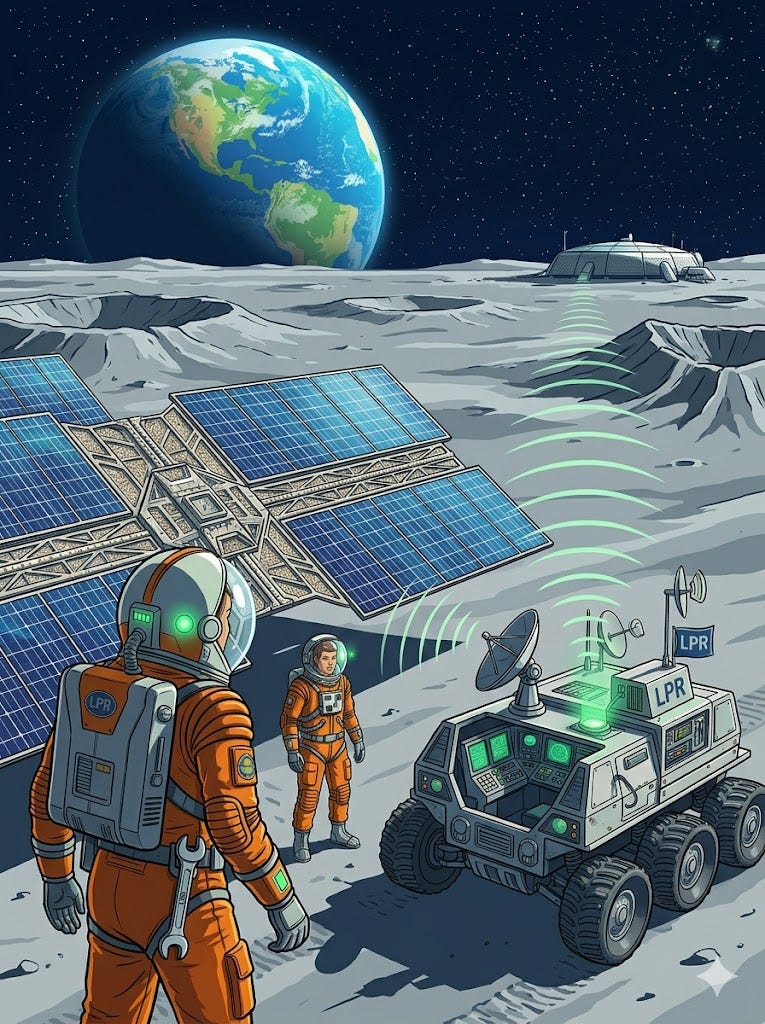
Zoey threw her body into the wrench one last time with all the energy she could muster. She felt the sound of the wrench clicking not through the vacuum but through the vibrations in her bones all the way through her EVA suit. Thankfully, her effort paid off. The bolt finally seated into the solar array. A green light appeared on the corner of her suit’s HUD, confirming the connection was active.
She put the wrench back into her toolbox and looked across the barren rim of Shackleton Crater. She could see a dull gray landscape stretching out in every direction. Her orange suit was the only pop of color in an otherwise monochromatic world. She turned back to her lunar rover and hobbled back to the driver’s seat.
Now that the array was fixed, she could start her long journey back to the habitat. The sun was low on the horizon, causing long shadows to stretch across the regolith. Her HUD showed the temperature starting to drop rapidly. Even with her suit, the battery was only rated for a few hours, and that would drain faster if she used the built-in heater.
This was her 114th night on her solitary mission. There were less than seventy left before her rotation ended. She was on the back-half now and that gave her something to look forward to, as the loneliness was hitting her harder than she ever expected. The Internet was a joke out here. Data packets took forever to load on the slow connection that serviced every habitat with one sat link. Real-time calls were impossible due to the 2.56-second round trip delay for the fastest fiber optic connections to communicate between Luna and Earth. Personal matters were shelved to low-priority queues so that mission reports and diagnostics could get through.
The only real connection she had with other people was through the local airwaves. When she turned on the rover, she tapped the console to turn on the radio.
The voice of Greg Shepherd, a warm baritone that felt like sitting down in front of a cozy fireplace with a cup of hot coffee, started to speak through the rover speakers through her helmet’s local comms system.
“Welcome back to Luna Public Radio,” Greg greeted each listener with his smooth voice. “And welcome back to this edition of ‘All Things Considered’. If you’re just joining in, I am your host, Greg Shepherd. We are leaving the pressurized habitats and traveling about a century back in time, and about 384,000 kilometers away. Our story starts in a small workshop in rural Vermont, where a man named Willy Poole still practices the art of handcrafting guitars from wood, not pulp printers.”
Zoey could hear the crisp rhythmic sound of a hand plane as it cut into wood. She put the car onto autopilot and closed her eyes. The sound was so real she could almost smell the sawdust falling to the ground in the workshop. She thought back to her own grandfather’s garage and all his weekend woodworking projects.
“When Willy plays one of his guitars, you can hear the forest it came from,” Greg continued over the background sounds of the woodworking. “You can hear the light creak of the wood bending. You can hear the wood breathing as a light whisper. He says every guitar has its own origin story that needs to be told.”
There was a single plucked guitar string, a deep C-note that dug an earworm into her head. She could think back to her childhood when she lay in the grass and soaked up the warm sunlight on her face. The sound of the guitar felt alive, a field of life and growth. Meanwhile, the rover kept moving across the empty lunar landscape.
The end of the segment came with a final small acoustic instrumental that caused her to let out a breath she hadn’t realized she was holding.
“A remarkable story,” Greg continued. “It speaks to a deeper need for connecting with the world around us. And I’m joined by my next guest, Amber Porter, the Executive Director of Off-World Broadcasting for NPR. Amber, welcome to the show.”
“Thank you, Greg. I agree that was a beautiful story,” her voice had a banal tone of a corporate executive. Zoey could tell that Amber was forcing enthusiasm. “You’re right that these stories do more than just entertain our lunar colonists. They are a lifeline. We’ve seen our narrative programs have led to a significant decrease in reports of isolation stress. We are committed to providing more content like this, as our mission is to connect our listeners back to our shared humanity.”
“That’s why I joined this service,” Greg added. “I recognized that even so far from Earth we still need ways to feel connected.”
“Yes, and given the Internet struggles we have here, our local radio network is the best way to do that. We have a lot of exciting programming in the works.”
“And you’re here to talk about another exciting announcement, aren’t you, Amber?” Greg asked.
“Yes. We are greenlighting a new program called Sol Public Radio as a new network of radio stations we will be placing in tandem with local colonies across the solar system. We will be broadcasting on Mars, the asteroid belt, and even Europa. We want to make sure that you feel connected to the rest of humanity no matter where you are.”
“I know our listeners will be thrilled to hear that,” Greg replied. “I’m sure we’ll look forward to hearing more about that in the coming months too.”
“I always feel proud to be a part of this mission, and I hope we can continue to do this for many years to come,” Amber said.
Zoey could now see the habitat rising on the horizon. She turned off the radio and turned her attention back to the rover’s controls. She had to agree with Amber. As humanity spread across the solar system, the biggest challenge they would be facing was how to stay connected. Other things like power and logistics were solvable, but the ability to spread a story across the vacuum of space felt far more valuable to keep her upbeat and looking forward to the next day.