

Preserving Institutional Knowledge
Chris placed his final personal effect, a small 20-sided die he used for fidgeting, into a small mycelium box. Placing it inside give him a sense of finality. His hand rested on the now empty desk surface. After three years, he was finally leaving. He felt a trepidation but also an excitement for what he would do next.
The offer from Kilowatt Homes was too good to pass up. A bump in salary and a title of ‘Senior Systems Architect’ would give a large boost to his career. The company was also focused more in the direction he wanted, in finishing the transition to all-electric, all-renewable energy.
He took one last look at his workspace. Mycelium Synthetics hadn’t been a terrible place, but there just weren’t enough opportunities for advancement. Leaving was the smart thing to do. He didn’t want to end up like his father, stuck somewhere for decades without a path forward, a loyal cog who worked until he was ground down.
A soft, three-note chime came out of the desk. He looked at the interface, which glowed in bright orange through the translucent plastic of the desk’s surface.
Event starts in ten minutes: Final Offboarding Consultation
He knew it was his exit interview, that final awkward conversation of corporate platitudes where it was too late to convince you to stay and yet you had to be too polite to burn bridges. He’d just thank them for the time, deflect any probing questions, and then kill time until he could actually leave. Simple enough.
He was confused by the location. He thought it would be in a normal meeting room, or perhaps somewhere on the HR floor, but the event was set for the Archives. He didn’t even know the company had archives.
Chris picked up his backpack and slung it over his shoulder. The box was tucked under his arm and he began his walk away from the buildings of the main campus. The Archives were located in a part of the campus that felt eerily quiet. Nobody was busy in collaboration rooms. He didn’t see anybody in the long hallways either. The hallway went on for a while until it ended at a door made from brushed metal.
The words The Archives were etched into the metal in a simple, sans-serif font. There wasn’t even a corporate logo. It reminded him of entering a vault.
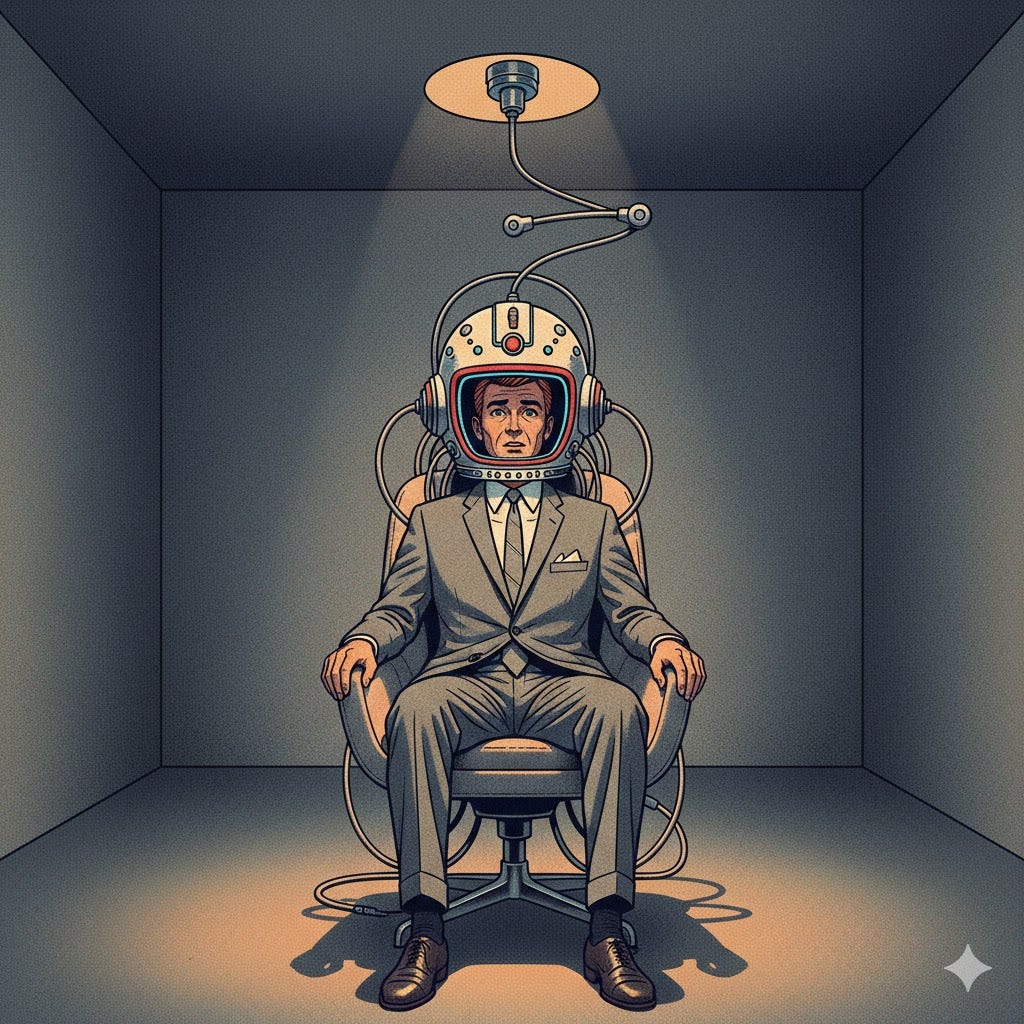
Before he could touch the door, it opened with a quiet hiss. He looked in and was surprised this wasn’t an office. There was a soft light which seemed to creep in from the walls. There wasn’t a desk, but there were two chairs in the center that faced each other.
A woman came out of nowhere, catching him off-guard. She looked middle-aged as her gray hair was pulled back into a careful knot that matched an unflattering gray tunic.
“Hi, I’m Chris,” he said, taking off his backpack and placing it against the wall. He felt oddly out of place. “I’m here for my offboarding.”
The woman didn’t offer a smile. She simply looked up at him with her eyes that were widened through her thin glasses. She lifted her middle finger and used it to adjust the glasses on the bridge of her nose.
“Mr. Fischer, please have a seat,” she said with a sort of kindly authority, like she was an aunt. “My name is Milana. I am the corporate librarian.”
“I didn’t know we had one,” he placed his box near the bag and took a seat. He looked around at the strange room and wondered what she’d talk to him about.
“Before there was the idea of human resources, there were librarians. We are the custodians of knowledge, to ensure continuity across the company. The goal for this meeting is to do a knowledge transfer, to ensure the integrity of the collective’s intellectual assets are stored securely in our archives to remain there after you leave.”
“Knowledge transfer?” he asked, feeling off-guard by her corporate jargon. “I already uploaded my project files and wrote up transition guides for everything. My terminal was just wiped, so there’s nothing left.”
“I’m not talking about data on ephemeral computers. I’m talking about the data you’ve stored in there,” she tapped a finger on her temple slowly.
“I’m sorry, I think there’s been a misunderstanding,” he clenched his hands nervously. “You mean you want a debrief. A conversation.”
“A conversation is one way to do this transfer, but it’s not very efficient,” she replied. “It’s prone to omissions and biases. So we’ve got another way. It’s a bit more direct... more thorough. Your terminal was wiped, but we also need to de-provision your cognitive access to proprietary corporate institutional knowledge.”
Chris swallowed hard. His mind was his greatest asset. He tried to think through what she was talking about.
“De-provisioning my cognitive access. You’re talking about my memories. My mind.”
“Not everything, just the part that the corporation cares about,” she corrected in a calm tone. “Your personal skills are your own: the methodologies of system design and programming language and all that is your personal career toolkit. But when you used those in our institution, that is our cognitive property.”
She started pacing around the room. The soft-soled shoes around her feet allowed her to walk without making a peep.
“The schematics for mycelium shoes, for instance. The energy consumption metrics for the solar farm in the southwest. The personal conversations between you and your manager. None of that is your private property. It is institutional knowledge. It was generated using corporate resources on corporate time.”
Chris felt a surge of anger. This was the kind of corporate oppression he resented, the kind that had slowly consumed his father.
“My experience belongs to me,” he shot back quickly. “The things I learned, the mistakes I made, my successes, that’s everything that I earned. That’s what led me to my new job at Kilowatt.”
“The Memory Accords are quite clear on ownership over corporate assets of all kinds,” she said, her voice remaining calm in the face of Chris’s accusations.
“To hell with the system,” he growled as he rose. “I don’t consent to this. I think our meeting has ended.”
He turned towards the door, feeling his heart pumping in his chest. He reached the door and pushed it, expecting to open. But nothing happened.
He pressed it harder. He heard a quiet click from the doorframe. The lock had just engaged.
“You consented to this years ago when you signed your employment contract,” she replied, still maddeningly calm. “Your final offboarding is not optional.”
“You can’t do this!” he spun around.
“It’s already being done.”
A soft whirring sound came from his chair. Hidden seams opened up, revealing soft fabric bands on each side, what looked like luxury restraints.
He looked around the small room, hoping to find an escape or some sort of weakness he could exploit, but there wasn’t anything. The only thing in the room was Milana, standing by his chair.
“Don’t make this difficult, Mr. Fischer. This operation is painless. You won’t even feel it.”
He didn’t want to surrender like his father.
A panel slid open from the ceiling. A large chrome device descended, attached to a delicate arm. It was a white helmet with colorful LEDs lining the front like a halo.
A primal fear spread throughout his body. He slammed his shoulder into the door. He clawed at it. He wanted to do anything to get out of this room.
Milana triggered something which caused a low, resonant hum to fill the room. It was a low frequency that he could barely hear, but he could hear. His body quickly grew heavy. He could feel the vibrations through his bones. He immediately found himself stumbling. He caught himself against the back of the chair, but lacked the strength to move.
The helmet descended further. Chris found he could barely keep his eyes open. Milana placed the helmet over his head. He was powerless to protest.
He felt a strange coolness pricking his skin, like a thousand small needles were poking his skull. Still, as she promised, there wasn’t any pain. There was just the strange sensation of vulnerability as his mind was being opened up for inspection.
He closed his eyes and tried to fight back. He thought about the mycelium shoes, his greatest success at the company. He kept the picture in his head, trying to burn it into his brain. He saw the faces of his team: the sharp Putali, Abdur and his constant sardonic humor, and the late nights he spent with Brooke. He held onto the memory of that first influencer review, when they got a ten out of ten score. That was when he knew he had stumbled onto a brilliant idea, and he had the potential for something greater.
Then he felt a sudden disorientation in his own head. These thoughts were being probed and indexed. He fought for Putali’s face and the sound of Abdur’s laugh. But the images started to grow blurry and he lost the details. He could still remember the feeling of camaraderie, but their identities and their personalities had been surgically excised.
The memory of the success, the joy of success, remained. Yet the puzzle itself: the data, the context, the reason for the joy was all gone now. All that remained was a phantom ache of an accomplishment that was no longer his. He was helpless as his career accomplishments were tagged and removed.
Chris was helped by Milana into the chair as his body and mind felt dull and slow. As the helmet was finally lifted off, his hand went up to his head as a slow ache began to grow. His head hurt. The room seemed too bright. It was like he had woken up after just a few hours of sleep.
He looked up to see a woman smiling at him. When had she come in here? He squinted but couldn’t recognize her.
“There we are,” she said kindly. “We’re all finished with the offboarding. On behalf of everyone here, I want to say best wishes to you and your new role at Kilowatt. It sounds like you have a bright future ahead of you.”
He looked at his seat. There was a vague feeling of being scared, of being restrained, but there wasn’t any rational reason for this. There weren’t any restraints. There wasn’t any reason to think he was in any danger, physical or otherwise. He thought that there was something pulled off his head, but he couldn’t see anything like that in the room. The room was just a peaceful, if clinical, lounge.
“Sorry,” he shook his head. “I must’ve zoned out. It was a long week.”
He couldn’t remember the end of their conversation. As he racked his brain, he couldn’t remember the conversation at all. He glanced at his watch and realized he’d been in the room for nearly two hours. It was a blank spot in his memory, evidently the offboarding process was that dry.
“It’s fine. The offboarding can be a bit draining. A lot of boring questions,” she extended a hand and politely helped him out of the chair. Her grip was stronger than he assumed “Take care, Mr. Fischer.”
He picked up his bag and box laying in the corner. He felt a bit unsteady, and his headache was still there.
“You too,” he replied habitually.
He stepped out of the Archives and back towards the main campus. The world felt wrong. He felt a strange sense of being lost. How could that be? Hadn’t he worked here for several years? Why was he consulting the map on his phone for how to leave?
He just needed to get out of here. Work had taken a lot from him, and he had to remain focused on starting his new life. The managers at Kilowatt had been very impressed by him and his work on... on that big project.
He paused on the sidewalk and employees parted around him.
What was that project?
He closed his eyes. He concentrated. But there wasn’t an answer. It felt like it was on the tip of his tongue. He remembered the feeling of the breakthrough. He remembered the satisfaction of the work. He could recall writing all the verification models. But the name of the project was drawing a blank.
He tried to think about the team. He remembered one was a data analyst. One was a junior programmer. And one was a designer. He knew he had to manage them. He knew there were debates over the project and that he helped mediate them. But he couldn’t picture their faces or hear their voices. They were like ghosts.
He shook his head. This was just burnout. Work was stressful. He was just compartmentalizing. All of that could be shed from his head as he prepared for a new job.
Still, as he departed from the corporate campus for the last time, he couldn’t help but feel like the job had taken something more away from him than just a few years of his labor.