

Republic of Moscow: Statehood by Unicode
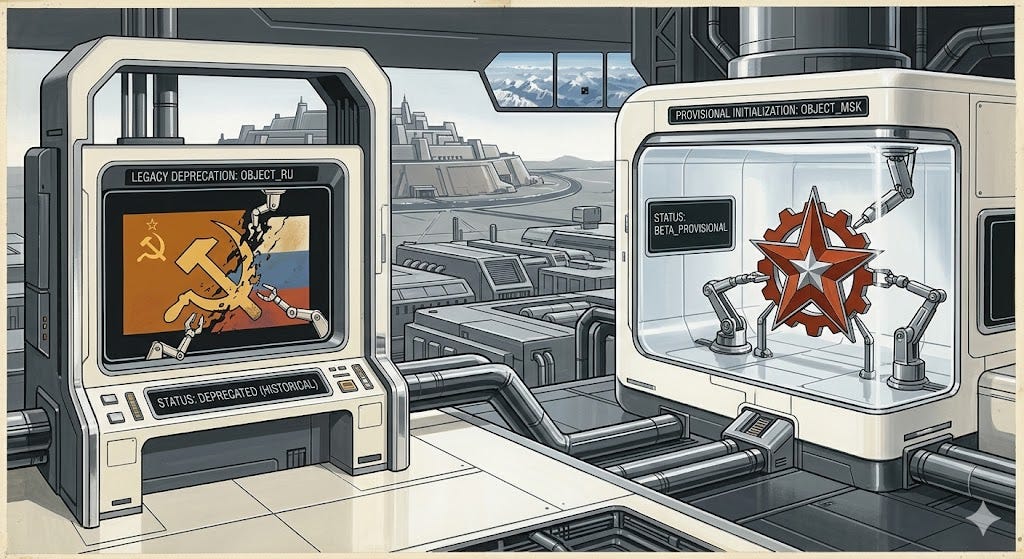
The air in the hotel room was too calm for Oksana. It was too sterile. It even smelled a tad like lemon. She couldn’t feel relaxed even as the window, a large OLED panel, played a long loop of the drone flying over the Alps. Her attention was fixed on the one tiny dead pixel that threw off the otherwise picturesque scene.
She reached into her pocket and touched her silver cigarette case. The urge was starting to go from a mild prick to a painful drilling in her forehead. She almost pulled it out when she realized where she was: California. If she lit one here, it’d trigger the smoke alarm and they’d get kicked out. She pinched the bridge of her nose, suppressing the urge to scream.
“Look at the color spaces here,” Timur sat on the bed, surrounded by phones and other gadgets. “The brick-red color we chose looks like blood on the iPhone 26... but that color is also rendered as pink on the knock-off I picked up in the Urals. We can’t have pink on our flag.”
“Our flag isn’t pink. It’s red.”
“But the screen is what matters! We need to show the world that we’re legitimate.”
“The colors are not as important as government legitimacy. Half the world still sees as as a temporary border glitch, not a real nation.”
“A glitch is exactly the point,” Tim tapped on a color wheel on his tablet and flicked through several shades. “Look, government recognition does not matter if people don’t think we are real. We need to look like we’re just like every other country in the eye of the public.”
He seemed happy with this new color and picked up the tablet. Oksana could see the aggressive geometric design of their flag in a deep red and polished silver. It was a modern design which was a clean divorce from the heavy imperial tricolor that Oksana had saluted all her life.
Yet it was gone now. Everything turned upside down faster than anyone could’ve predicted. She thought back to her grandparents, who had gone through something similar in their lifetime. The provisional government needed stability, not cheap digital tricks.
“That looks like a corporate logo,” Oksana said flatly.
“It is supposed to be the Singapore of the North,” Tim countered, full of youthful fervor.
Oksana walked over to the minibar and opened the door. It was full with bottles of kombucha and matcha. Of course, it’s California. She found a single bottle of water in the back.
She cracked the seal and took a sip of the cool water. The Singapore of the North was the slogan everyone kept telling themselves, a way to get foreign investors and tourists to trust their plan. While the Federation had dissolved into twelve smaller states all feuding with each other, tussling in the oil fields for the last remaining reserves, Moscow had taken a smarter approach. They sealed the Ring Road, fortified their infrastructure, and hired the best bureaucrats they could.
While their small, burgeoning country did not have the same material resources, they had data. They had the banking sector. They had the nuclear codes, although the silos themselves were located far away. Yet legally they were still seen as a No Man’s Land, able to trade with their fellow states but a ghost to the rest of the world.
“Did you review the deprecated list?” she asked as she leaned against the edge of the table.
The water had an odd taste to it. She checked the label and saw it contained minerals. Americans were odd people. She remembered the start of the crisis, when they had to boil their water to get rid of unwanted contaminants. Here they were, adding them intentionally.
When Tim looked up at her, his high energy evaporated. He returned to the same terrified boy who learned to program on an old stolen laptop in an air raid shelter during the Winter of Barriers.
“I put the ‘RU’ code in the slidedeck,” he confirmed in a whisper. “It’s slide 14. ‘Legacy Decommissioning’.”
“It’s important. If nothing else, we need them to accept that the superpower is gone. Deleted.”
“We are asking them to clear their cache,” he insisted. “As long as that tricolor flag emoji remains in that standard Unicode library, the illusion persists. The people still thinks it’s real. The irredentists in the Volga Confederation still wave that flag to rally the militias. It’s not a silly thing. That symbol tells people not to expect any closure.”
She admired his youthful optimism, something she had lost over decades of oppression and cynicism. Boy, she really wanted a cigarette at that moment.
“What about the United Nations vote? Nobody is sitting in the Russian seat. They’re deadlocked. Europe is still waiting for the gas pipeline ownership to clear up before making any moves. China seems more interested in possessing Siberia than a real future for us.”
“The UN was always going to be the slow path. But if the Unicode Consortium validates us with our own flag, we will exist on every keyboard on every phone around the world. Billions of people. That matters far more for legitimacy than what some bureaucrats say.”
She placed the bottle back in the fridge, now half-empty.
“Show me how it is going to look on low-res displays.”
Tim tapped on the tablet and zoomed in far onto a small 16x16 pixel icon. Each pixel block was massive. It looked like red and silver paint thrown onto a wall. Entirely abstract and meaningless.
“See how it projects integrity?” he boasted.
“It looks like a... who was it? A Polack?”
“You mean Pollock? The splatter guy?”
“Perhaps that is his name.”
“That’s good. He is recognized as a great artist. We’ll be recognized too.”
“Pack your tablet, Timur. We must not shear the bear before it is dead, but we can at least measure it for its coffin.”
“Very ominous. That sounds like the kind of saying a grandmother would say.”
“We need to convince a committee that our country is real. The committee is made up of the people who design fonts for our phones. Ominous is not the right word.”
She opened the door and gestured for Tim to step out. The hallway smelled of lavender. The odor was too strong for her.
The conference room felt too clean and minimalist for Oksana. Even the whiteboards seemed to have been freshly wiped. The table was made of some sort of bamboo composite that left a sticky residue on her fingers. She rested her hands on it despite how it felt. She wanted to look presentable, with a professional posture.
Across the table were the high priests of the modern world: three men and two women in hoodies and fleeces. They had identical hydro-flasks in front of them, with some logo she wasn’t familiar with. Post-it Notes were placed across the wall with references to things like “glyph variants”, “endianness”, and “ZWJ sequences”. These were the holy words of their trade.
“We’re super excited to have you guys here,” said Kevin as he leaned back in one of the ergonomic mesh chairs. He spoke with the typical California friendliness granted to everyone, even strangers. He was wrapped in a large, puffy vest that Oksana couldn’t help but see as a large squid wrapped around his torso.
“We have looked at the ticket, and that’s why you’ve been invited to come here in person to pitch us. So please, walk us through your story.”
Tim stood up with such energy he seemed to be shaking. He adjusted his glasses and connected his tablet to the holograph projector in the room. Immediately the slidedeck turned into a projection on the wall, extending out in three dimensions.
“I want to first thank you for having us,” Tim began, speaking way too quickly. He was a technician, not a public speaker, and that was clear by the way he stood and talked.
“We are proposing a new flag glyph for the Moscow Republic... I mean the Republic of Mos... I mean... I’ll just get into it. The red is #B22222, the color of brick-red. We find that when paired with the silver, it retains high contrast and clarity on low-end and high-end devices.”
“Sure, we see the technical details in your report. That’s really not in contention. We are more concerned about namespace collision.”
Oksana knew that Tim’s presentation needed help. He needed to slow down and breathe. She really wanted a cigarette.
“Your proposal is to replace the `RU` flag. But that’s already a reserved character. We would break backwards compatibility over the last three decades of digital history. Every tweet. Every line of text. It’ll all be semantically different.”
“We are asking for a system patch,” Oksana clarified, her voice low but still able to cut through the soft hum of the room.
“Oksana, I get the geopolitical complexity,” Kevin gave her a smile, one that communicated nothing. “We understand how tragic it must be to go through this dissolution and the uncertainty.”
No they didn’t understand. How could they? They lived in an air-conditioned paradise. The biggest political challenge they experience was when someone proposed to build a new sports stadium.
“...But the Consortium prefers stability over drastic changes. We have a big responsibility to preserve the integrity of text.”
“But the Russian Federation is over.”
“Yes, but what is next? We have heard of stabilization in the Ural Republic. The Volga Confederation has just started printing its own currency. But what happens if the Federation comes back in a few years. It would be a problem for emoji maintainers to go back and forth. We don’t want to flip the switch twice. It creates a lot of legacy junk.”
“Legacy junk...” Oksana repeated.
“Exactly,” added a woman, whose long hair had purple highlights. “It’s safer to leave the RU emoji intact until the map settles. Maybe in a decade we can revisit it. Until then, we recommend you use the ‘world map’ glyph. It’s generic enough to include the region without the stigma of the Russian flag.”
“But you’ve updated flags before,” Tim countered. “You changed the Syrian flag when the government changed. You added more stars to the US flag.”
“In those cases, there was official recognition of government change. Syria remained Syria. The dissolution of one country into many does raise significant questions of who should be the proper inheritor of the `RU` flag, if any,”
Oksana looked over at Tim and then stood up. Tim quickly sat down.
“You talk about concepts like stability and backwards compatibility. You are worried about broken images in digital documents. Tim, send me a text. Right now.”
“Oksana?”
“Send me a text.”
Tim reached down on his tablet and began typing a quick text. From the wall projection, everyone could see what he was sending.
Sender: MinTsifra_Official
Message: Status Update [ ☒ ]
Oksana pointed at the tofu that was now sitting on the wall. The tofu was a universal symbol for a character that the system did not recognize. It was an empty square, like a void.
“When I write emails to my daughter, she sees this. When we send out bank transfers to other countries, they see this. When diplomats and bureaucrats reach our airports, they see this.”
“That’s just a rendering error. If you installed a custom font...” Kevin muttered nervously.
“It’s far more than a font package, Mr. Albright,” Oksana interrupted forcefully. “You ask us ‘what if the Federation returns?’ That is to you an academic question, something of abstract debate. But I affirm to you now that the Federation is just a ghost now. The body is being buried. It cannot return. But you still deny us our existence by holding on hope to the past.”
She reached over to grab Tim’s tablet and zoomed in deeper on the void.
“I spent twenty years in the service of that tricolor flag. I watched it lowered over the Kremlin for the last time. It was a dark night. It was snowing. I guarantee to you, Kevin, that the old world has ended. We are not looking for a vanity plate. We are asking for you to recognize that twenty million people are not living in a ‘legacy system’ but in a very real reality.”
She put the tablet down in front of Tim. He didn’t touch it. The room was silent, with a heavy tension. Kevin shifted uncomfortably in his chair. He looked down at his smartwatch and tapped it a few times.
“The backwards compatibility issue is still valid,” he said, his voice softer now. “Maybe we can propose marking `RU` as ‘historically deprecated’ for archival purposes. It wouldn’t be a full deletion, but a recognition that it no longer needs to appear in emoji keyboards.”
“What about the new sequence?” Oksana asked.
“We will grant provisional candidate status. Let the individual companies start drafting their designs. We can probably get preliminary updates in beta channels soon.”
Oksana swallowed hard. This is the moment she’d been waiting for since 2035 began. She looked down at the phone in front of her, with the empty box sitting there in a notification. Maybe it wouldn’t look like that much longer.
“Provisional is great!” Tim exclaimed.
“It is acceptable,” she concurred.
They left the room and went on a long walk across the corporate park. The sun was shining with an intensity Oksana rarely experienced. She was about to zip up her jacket, but there was no need. The weather was warm enough.
She sat down on a bench with a small awning overhead. The solar panels powered small phone chargers embedded in the armchairs.
“They already sent the approval. Look at the commit log,” he turned the screen towards her.
Diff 18.0.4: Deprecate OBJ_RU (Legacy). Initialize OBJ_MSK (Provisional). Status: Beta.
She looked at the wall of text but didn’t really understand what the technical words meant.
“Provisional sounds like a medical diagnosis. Like the patient is in a provisional condition,” she remarked, not happy about the word.
“It’s a matter of continuous deployment, Oksana. Nothing goes into main before there’s beta testing,” Tim explained calmly. He looked more drained by the high-stress presentation than she was. “But we got the matter accepted. By the end of the week, the update will reach developer betas. In three months, it’ll be released to the public.”
Oksana looked out at the various employees drifting between the glass cubes with cups of coffee and colorful teas, talking into earpieces about things like ‘impact’ and ‘deliverables’. They seemed too immersed in their own lives to appreciate that a superpower had just been archived.
She patted her pocket, found the cigarette case, then put her hand back. “By the time we land back in Sheremetyevo, our passports will be considered vintage artifacts.”
“It’s going to be a hard change,” Tim rubbed the back of his neck.
“Stop, you don’t need to sell it anymore. The matter has been closed.”
“I guess it just feels like we didn’t do much. It was more of a meeting than storming the Winter Palace.”
“Most of the time, that’s what life is. You can’t storm palaces every day. You need to make sure the paperwork is filled out correctly.”
A robotic lawnmower passed by, colliding with the sidewalk curb. It reversed a few centimeters, then turned. It was not very smart. It just followed a simple loop of rules. Moscow was like that now, a city going through its own motions to try keeping its own grass cut.
“When my grandfather was alive, I used to play with his medal a lot,” Tim said. “It was heavy. Real bronze. He got it as an award for defending the motherland.”
“And?”
“What have I accomplished? I just convinced a guy named Kevin that the flag on that medal needs a footnote next to its picture.”
Oksana reached over and squeezed his shoulder.
“Not every hero uses force. You won’t need to explain to your children anymore why their country is a 404 error and tofu. History can be heavy. We carry the burden so they don’t have to.”
She looked down at her phone. The battery was at 12% and continuing to fall. The modem wasn’t optimized for the foreign 6G towers.
“Send the message again,” she told him.
Tim pulled out his tablet again and unlocked it. He opened the messaging app and typed in a new message.
Mission accomplished. Awaiting deployment.
Then he switched to the emoji keyboard. He scrolled past the faces, the animals, and the various generic shapes. Then he reached the Flags section.
The flag wasn’t there. Not officially. But he had built a custom keyboard app that allowed him to use custom sequences. He had already added the emoji into the system font. He tapped on it, appending it to the message.
When he hit send, a server farm in Colorado received a packet, bounced it around a few stops, then downloaded to a the phone sitting less than a meter away.
Oksana stared at the screen. The tofu block was still there, but she knew in a few days it would change. She would know that the bear was finally dead. The empire was gone.
“Our Uber is four minutes away,” Tim broke her thoughts. “The guy’s name is Chad... He is in a Tesla Model Y.”
“Very good,” she stood up and smoothed the wrinkles of her suit. “It is time to go home. I think I have earned a drink. Something very strong and bitter.”
They reached the curb and stared at the progress bar of a car approaching on a map, waiting to be picked up and transported into the new world.