

SolarFlare Strikes
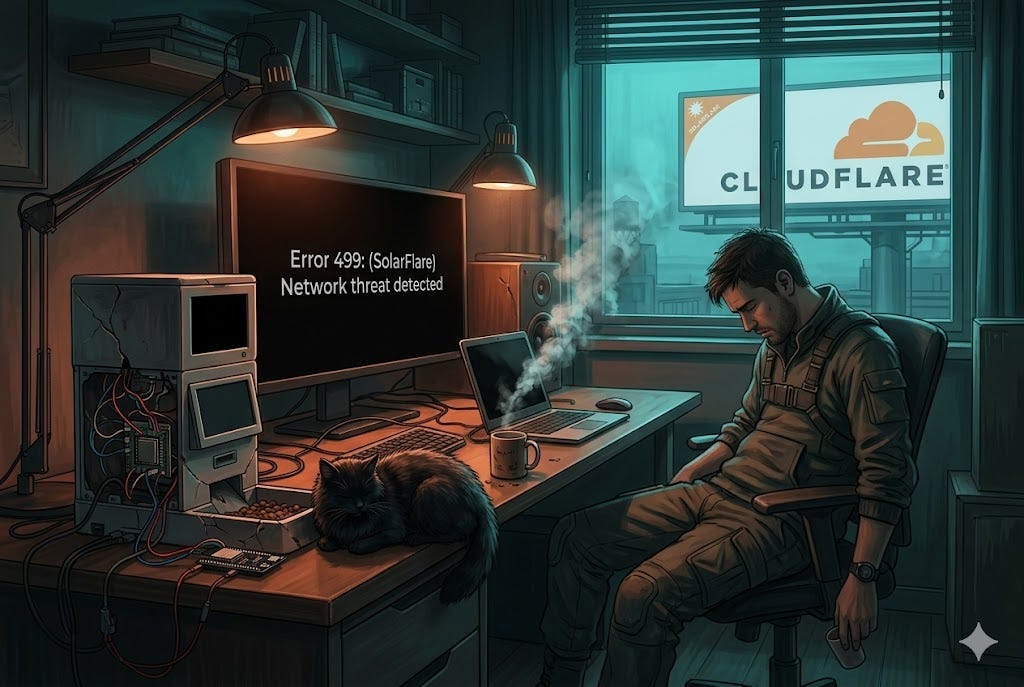
The rent was astronomical. The space was tiny. There wasn’t even AC to deal with the heat of his computer. But the latency to the main Google backbone was under five milliseconds. Priorities.
Russell took a sip from his coffee mug and immediately spit it out. It was a day old. He had forgotten to make a fresh pot. He had been so occupied with his project that every other task had just been pushed aside.
On the desk beside his laptop was an automated cat feeder cracked open with wires and an ESP32 development board amateurly soldered inside. His fluffy black cat, Java, was curled up next to it, completely uninterested.
“Hey there, Java, you’ll get your optimal dietary intake soon,” he promised, scratching behind her ears.
He couldn’t figure out where in the stack the problem lay. He had overengineered the whole thing. It didn’t just dispense kibble based on the time of day. It could check the real-time spot prices of various fish on the global commodities market, use image data from a camera feed above the litterbox, and a dozen other APIs to adjust the portion size and product being delivered. The whole thing was unoptimized, lacked any caching, and frequently chained API calls that hammered servers worldwide.
He saw an email notification on the side of his screen from CloudFlare. The subject line read: “Introducing SolarFlare™ by CloudFlare: A New Era in Network Security.”
He didn’t pay any attention to it, just dismissing it and getting back to adding print statements at every step to see where things might be failing. Of course, it could be failing at multiple steps, requiring even greater engineering time to fix.
He ran the script again and saw that the cod market API was timing out again. If he added some sort of caching layer, it might help, but it would mean the data wouldn’t be literally real-time. He sighed and typed a comment:
# TODO: Add some damn caching here, you idiot
He ran the API call in an isolated script again to see if it would work this time. That way he could be able to double check the API response and make sure he was using the correct fields and data types.
However, before the HTTP request completed, he began to hear a high-pitched whine coming from the guts of his computer. Each of the fans started to spin up to their maximum RPM. So much wind was being generated that the dust bunnies under his desk began to flee.
A new notification on the side of his computer warned of an abnormally high internal temperature.
“What the hell?” he asked aloud. Java hopped off the desk, her nap disturbed by the noise.
His console started to spit out a series of error messages with low-level memory access violations. It didn’t make any sense to him until he saw the final line:
Error 499: (SolarFlare) Network threat detected
“What?” Russell muttered, rubbing his eyes. “Did CloudFlare just... what?”
Before he could terminate the script, his entire internet connection dropped. The Wi-Fi icon on his taskbar changed to a yellow triangle with an exclamation mark.
Next, his external monitor went black and forcibly disconnected. He tried tapping on his keyboard, but that seemed to be unresponsive as well.
Then, every window on his laptop shut down one by one until the only thing remaining was an empty desktop. No apps, no files, not even a taskbar.
The final sound was a surprising pop from inside his laptop and the stench of ozone and something burning. His motherboard was just fried.
He hurriedly pulled out his phone and checked that email. It explained that SolarFlare was a new proactive network security tool to fight back against the rise of threat actors. Rather than just blocking malicious traffic, it would actively seek out and disable sources of network degradation. He realized that he had been a hapless victim of an overzealous security protocol.
Java then meowed at him. Whether automatically or by hand, she was hungry.