

The Artemis Riots
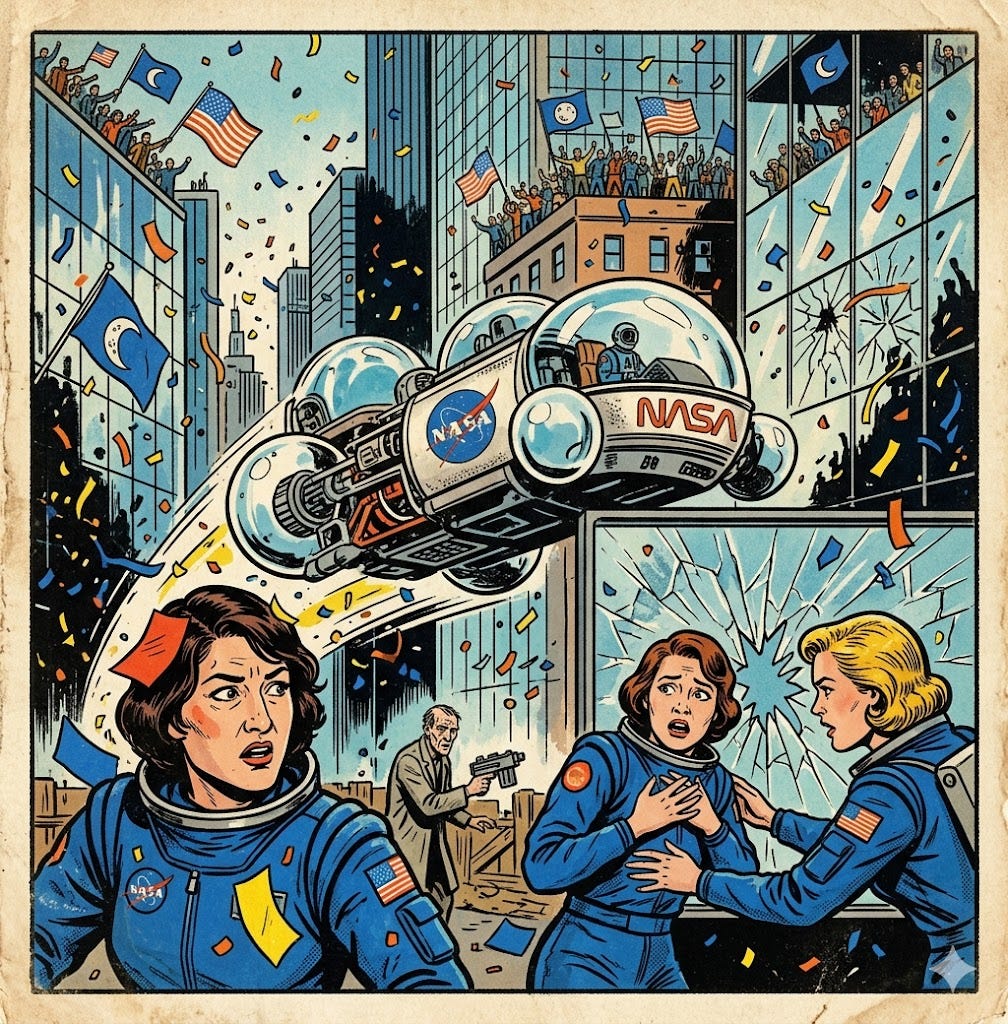
It wasn’t snowing. It was July in New York. Yet as Christina looked up at the shredded paper and glittering Mylar, and she heard the physical wave of applause coming on either side of their electric vehicle, she felt a warm welcome home.
A million people were watching her from the street and crammed in the glass towers that turned Lower Manhattan into a canyon. After six months in orbit around the planet’s singular moon, the onslaught of loud noise felt overwhelming. Still, she was Commander Koch. She was the first woman to step on the lunar surface. She had to give them a performance.
Joslin sat next to her and waved energetically at the crowd with both of her hands. She was drinking in all their praise.
“I can’t believe so many people are here,” Joslin shouted over the din. “They get it.”
She pushed a stray brown hair from away from her eyes and instinctively twitched her fingers near the bridge of her nose. It was a habit she picked up in college, to push her glasses up, but that habit remained even after her orbital corrective surgery two years ago.
“They get to spend a few hours not working,” Major Knoll retorted with cynicism to Joslin’s wonder. “Hot dog vendors are handing out free food. It’s a party, but don’t mistake that for the world changing.”
Maddison listened and clutched the vehicle’s seats carefully. She looked out at the crowd, the rooftops, and the security standing around. She was a pilot and an engineer and these situational instincts had made her successful even though she didn’t know how to turn them off.
Christina’s own gaze was fixed on the thousands of flags being waved in the wind. Stars and stripes were everywhere, from people’s hands to the edge of windows. From 238,000 miles away, there hadn’t been anything close to this. There was only one flag on the moon and it was dusty. They had to go out of their way on a high-profile mission to brush off the dirt and take photos.
There weren’t borders on the moon, or walls, or a canyon full of people. There was just the glowing blue marble with a beauty that she could not describe. They had taken photos. In fact it seemed like every magazine in every newsstand had one of her photos on the cover. For Christina, this Overview Effect had fractured her life, creating a permanent shift in her whole identity. She clasped her hands together, trying to stay calm amidst the excitement.
The vehicle slowed down as it came to a small, temporary stage that had been erected near City Hall. The Mayor stepped forward with his signature grin and finely trimmed beard on his face. In his hands was a comically oversized key. The roar of the crowd had only grown louder.
“Commander Koch, Dr. Spencer, Major Knoll,” the Mayor began, his voice carried by a nano-microphone wirelessly connected to speakers down the street. “I want to congratulate your return on behalf of the eight million New Yorkers who have been watching your lunar journey with great enthusiasm. And on behalf of a proud, united nation...”
Christina stopped paying attention after he said united. The word felt hollow to her. She looked out at the faces pressed against the barricades. They seemed joyful, proud, and maybe something more intense, more feral.
And then she saw as one man hopped over. He looked to be in his late forties, with a pale face that seemed to lack sunlight. His eyes locked with her and she saw not joy but an existential terror.
“You’re not them! You’re not! We know what you really are!” he screeched, his unamplified voice cutting off the mayor.
Maddison had already shifted and reached for Joslin. Christina’s own training took over too. She saw the gun; a simple, semi-automatic pistol. It looked like a cheap toy, but one that was simultaneously a threat.
Christina flinched as she heard the *crack* of the shot echo. The crowd’s cheers suddenly transformed into screams.
She looked up and saw a small, dark hole appear in the thick bulletproof glass panel directly behind her head. The sunlight filtering through it made the new crystal fractures look like a diamond.
The mayor’s oversized key clattered down on the stage.
The barricades had fallen to the ground and she saw people running towards her, away from her, and in every direction. NYPD officers were overwhelmed by the sudden chaos. She looked over at her friends and neither of them seemed to be harmed. Hurriedly she pulled Joslin down beneath the back seats.
“Get us out of here!” she yelled at the driver.
“We can’t get anywhere,” the driver opened the door and got out. “There are too many people on the road. Come on.”
Suddenly three Secret Service agents appeared around them, manifesting out of seemingly nowhere. They grabbed her harshly and dragged her out. Joslin was pulled out next.
“We need to get out of here,” Maddison said, taking control of the situation.
An agent blocked her view as she was briskly led away from the car. The lingering confetti on her skin now felt like sandpaper. Although she could no longer see them, she could still hear their terrified footsteps. The shooter had faded into the crowd, swallowed up by the chaos he created.
The hotel suite had an uncomfortable silence. The space was pressurized, creating a sealed isolation from the world for the VIPs who had enough wealth to afford this level of security. They were now fifty stories up in a hotel with panoramic views of a city that, an hour ago, had tried to kill them.
Confetti still clung to Christina’s royal blue NASA flight suit. She was staring at her own petrified reflection in the window’s glass. She was supposed to be a hero, Commander Koch, but now she had a small red paper stuck in her dark hair like it was colorful ash. She felt like a fraud.
Joslin was curled up on the white sofa with her knees drawn to her chest, shivering despite the room’s sophisticated temperature control. She couldn’t turn her face away from the massive flatscreen TV on the wall playing the same gruesome attack with occasional breaks for pundits to get in their two cents. Given the number of people who were there, the broadcasters could play an endless selection of angles of people screaming and being trampled. The pundits were busy weaving new realities in real-time. “Was it a foreign power?... A lone wolf?.... The mayor’s security crisis...”
“Turn it off. It’s just noise and empty speculation,” Maddison said flatly. She was staring in front of the mirror, carefully picking confetti off her suit one by one. Each colorful scrap was placed into an empty water glass like dead butterflies.
“They’re saying his gun jammed after the first shot,” Joslin said, her voice tinny and weak. “It was a cheap 3D-printed ghost gun. After firing it, the casing cracked. If he had tried a second time it would’ve exploded in his hand.”
“Well, I’m glad we’re alive because of shoddy engineering,” Maddison spat out, finishing her cleanup and grabbing a nearby barstool to sit in. “That really restores my faith in humanity.”
Suddenly a sharp knock caused all three of them to jump nervously. Christina turned from the window.
“Come in,” she said.
A middle-aged woman entered in a crisp navy-blue suit. The short tie around her neck was a perfect match. Her hair was brown, but turning silver.
“My name is Special Agent Quesada, with the FBI.”
She paused and pulled a badge out of her pocket. Christina stared at it closely before giving back an accepting nod.
“We have the shooter in custody. His name is Walter Higgins, a 48-year old man from Staten Island. He is a machinist.”
“Was he alone?” Christina asked coolly. This was a mission debrief. That was she had to tell herself.
“Sort of,” Quesada reached into her pocket and pulled out her phone. She unfolded it and tapped on the screen. “He wasn’t following a foreign state, or was part of a terror cell. He was part of a web of conspiracy theories though.”
“So he wasn’t a lone wolf?”
“We don’t anticipate any other risk to you,” she noted with an unconvincing reassurance. “Are you familiar with the conspiracists chatting about ‘Selene Replacement’?”
“That’s insane,” Maddison snorted. “That’s bottom-of-the-barrel garbage for trolls who live in their basements all day. Nobody actually believes in that.”
“They do,” Quesada acknowledged solemnly. “They believe it as much as people used to believe in vengeful gods. This is their religious truth.”
“Wait, what is this conspiracy?” Christina wondered.
Quesada turned her screen to see a bunch of small boxes of text all connected with white lines in what seemed to be some sort of digital corkboard.
“The Selene Replacement has been passed around in some online forums. We’ve been monitoring them. Their core belief is that the original Artemis 3 crew, you all, never actually returned. They have various explanations. Either you were killed, or captured, or somehow got stuck up there. In your place... well they have even more explanations for that.”
“So the government is full of lizard people?”
“Or clones. Or synthetics. They can be quite creative.”
“A shadowy cabal is installing us as part of a global takeover,” Maddison finished.
Christina stared at the screen with a deepening frown. “That man was trying to murder us because he thought we were space people?”
“That’s the simple way of putting it,” Quesada swiped across the screen from one edge to the other to display a new image of Christina standing on the moon holding a new sensor array. One of their missions was to install this and allow it to broadcast surface data back to Houston.
Yet this photo had been marked up. Her face, covered in a helmet, had been circled in red. There was a lens flare near her helmet, as the bright sun was not filtered through the Earth atmosphere. There was a caption underneath.
PROOF OF NON-HUMAN: THE ENTITY CANNOT HIDE ITS ENERGY SIGNATURE
“That’s just a camera artifact,” Christina whispered, struggling to comprehend their arguments. “Joslin hadn’t calibrated the camera properly yet. That was the second day. We were still learning...”
“I thought... I thought it would be like a phone,” Joslin stammered from the couch.
“But to people like Higgins, it was all the proof they needed,” Quesada countered. She swiped on the screen again and played a video of Maddison from a press conference.
“I remember that. It was before the launch.”
Maddison read the caption aloud: “Synthetic vocal processor lag. Note the delay as the entity accesses vocabulary database. The real Knoll would not hesitate.”
“Your father just had a stroke. You spent all night in the hospital. Who cares if you stumbled some technical jargon,” Christina sympathized.
“Son of a bitch,” Maddison breathed with fury.
“They don’t care about context,” Quesada replied dismissively. “They only care about how to fit into the narrative.”
Quesada walked slowly to Joslin, who was still shaking from shock. “They are thorough. They dig into everything.”
She swiped her finger once more.
“You should see this birth certificate,” Quesada passed the screen over to Joslin.
“That’s my daughter’s, Ava.”
“There is a discrepancy between the country record and hospital announcement in the time of birth.”
“It was a holiday. They were short-staffed,” Joslin murmured.
“Let me read the caption. ‘The imposter fabricated the backstory. This daughter is just a psychological anchor to make the clone seem human. She isn’t even real.’”
“Agent Quesada, is my family safe?” Joslin asked, her eyes now welling with tears.
“We have already assigned a full protection detail to your husband and daughter. Once we identified the shooter’s motive, we made sure they were safe,” Quesada reassured.
Joslin stared silently at the agent for a long time before nodding. She grabbed a pillow and buried her head in it.
Christina rubbed her temples. The global unity they had tried to inspire, the new perspective they had received of their planet, had all seemed futile. The three of them had seen a singular, beautiful world without borders. She was realizing that people were far harder to reach than with a personal testimony and reason.
Quesada hopped up from the couch and placed the phone, now folded, back into her pocket.
“The SWAT team didn’t meet any resistance at Higgins’ home. No firefight. He was just sitting on the porch with a lukewarm coffee.”
She paused, letting them picture that pathetic image.
“His house was covered in printouts from forums and crude charts. He seemed to blame your mission for everything, from stock market fluctuations to shipping delays. He had six monitors running in his living room, each one a live feed of social media channels celebrating what he did.”
“I can’t believe he’s proud of it,” Christina said with venom.
“He didn’t even succeed,” Maddison added.
“Maddison! He could’ve killed someone!” Christina admonished.
“He didn’t though,” Maddison shrugged.
“He thinks he is a hero,” Quesada confirmed. “He was calm during interrogation. He cooperated fully. He called his action a ‘diagnostic test’. If one of you had been shot, God forbid, and you either bled green, or dissolved into dust, or short-circuited, he would’ve taken that as proof he saved the world. He was quite disappointed when he realized you were all safe. He called it ‘an inconclusive data point’.”
Quesada’s disgust was clear in the way she quoted him.
“He was unrepentant.”
“What’s the next step then? You figure out who else is involved? Who’s funding it?”
“You might find this hard to grasp, but there isn’t anyone else. We’ve been searching his financial records and scanning his hard drives and there’s nobody else. Not really. He was laid off from a job in the Navy Yard a decade ago. Wife left him. He has barely ventured outside in the last year. He found an echo chamber online that give him a modicum of purpose and he radicalized himself.”
With a final look at the three, and a grim nod, Quesada opened the door and disappeared into the hallway. For a long time, the three of them didn’t speak. The television continued to play its cycle of violent imagery on mute.
“So...” Maddison broke the silence with a bitter laugh. “We just spent the last six months on another celestial body, surviving through math perfected by hundreds of brilliant people, trusting our lives to advanced technology, and we were nearly taken out by a lonely gun with a plastic gun? God, I need a drink.”
She walked over to the minibar, moving stiffly.
“I just can’t understand it,” Joslin trembled. “We went to another world. We brought back samples. We setup broadcast stations. You can see them through a telescope. Isn’t that supposed to mean something?”
“They look at the data, and the images, and they don’t see a miracle,” Christina remarked with disappointment.
“It’s a complete system failure of the human mind.”
Maddison grabbed a beer, a coffee stout, and cracked the can open with a loud hiss.
“You know, if a system failed on the Orion, we could diagnose it. We had all the schematics and tools. Or maybe we could eject it and replace it. There were processes and rules we could follow,” Maddison paused to take a long sip. “Oh that’s good and cold. How do you fix society? Where are their schematics?”
“They don’t exist,” Joslin’s voice cracked as tears fell down her face. “We were supposed to be the Overview Effect and talk about how we were all one people. He took that away from us. He stole our meaning. The overview doesn’t matter if nobody is willing to look up.”
Christina thought back to that moment that the engine cut-off as their lander stopped on the dusty surface. When the dust finally settled, she looked out through the viewport at Earth.
She didn’t see traffic, or drones firing missiles at each other, or petty arguments between neighbors. It was a bright jewel that seemed to glow blue against an infinite black void. White clouds swirled dynamically. She felt a connection in that moment not just to her colleagues, or her country, but to every person who was alive then and had even lived. Emotions had nearly overwhelmed her in a way she could only describe as religious.
“If only everyone could’ve seen it. It would change everything.”
But now her view was of the busy city below, with endless traffic and conflict. They had wanted to deliver a message of unity from half a million miles away, but the hardest part of their journey would be the last few feet from the stage to the crowd.