

The Chips You Can't Stop Eating
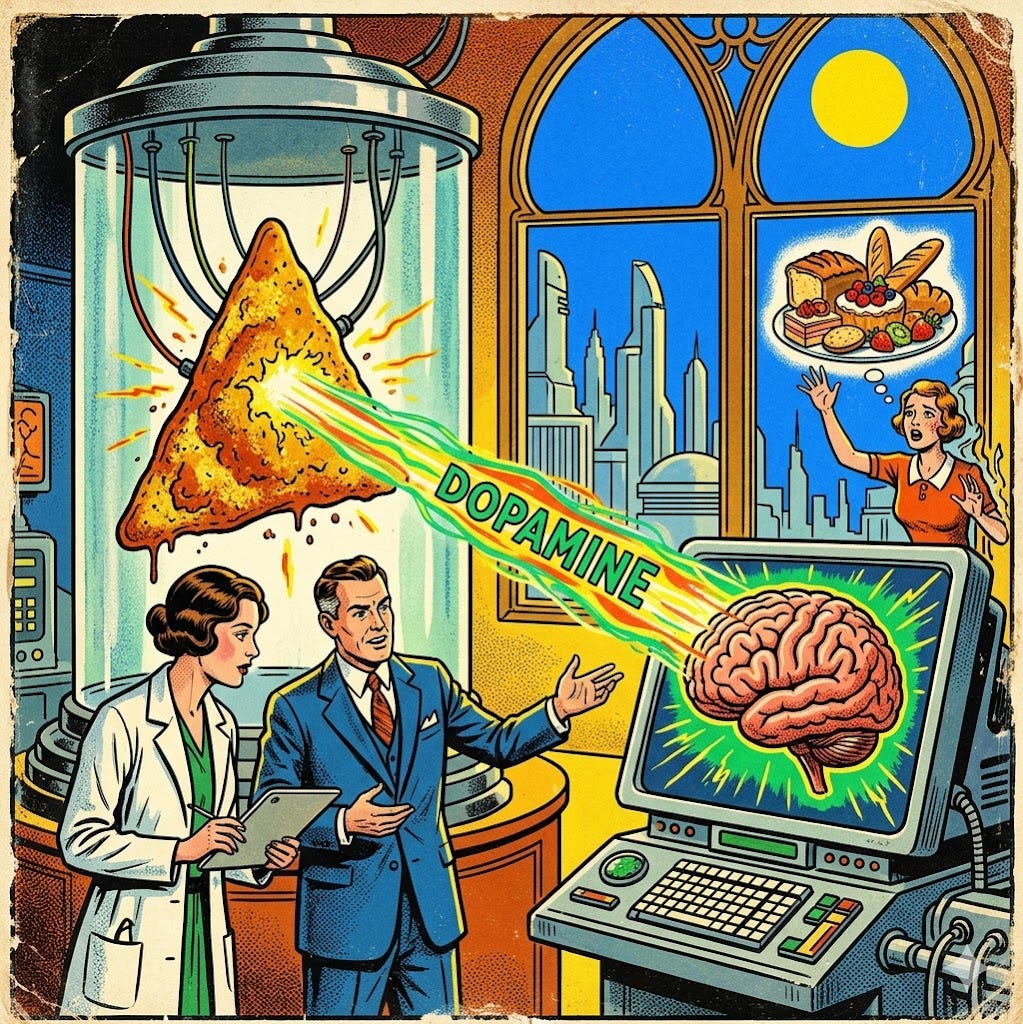
Liz chewed on her tablet’s stylus as she monitored the molecular construction behind a glass screen. The lab had no smell. That was intentional. Everything was focused on the molecules being organized in front of her.
On the other side of the window was a small triangular chip. It was simple, almost embarrassingly so. The only thing that distinguished it from the ones found in every grocery store was a powdery coating of a color somewhere between rust-red and gold. It was her masterpiece, the culmination of a year of hard work.
The lab door let out of a pneumatic hiss as it opened, breaking off her focus. Martin strode in wearing an expensive tailored suit that felt out of place in this sterile environment. In his hands were a small black can of “Momentum”, a failed line of hyper-caffeinated cheese puffs which couldn’t even get through small-scale market testing. He had managed to get the remaining inventory and was living off them.
He stood behind her and stared at her monitor, which displayed a pulsing red brain.
“Liz, are you still chasing your ‘white whale’?” he asked impatiently. “The numbers look good. They’ve looked good for a week.”
“The bliss point is stable, but the hedonic decay is still too rapid,” she replied. “It does induce a craving, but it’s short-lived. It plateaus.”
“A feedback loop is what we want though,” he took a bite, apathetic to the dust falling on the pristine floor. “The entire country is on these GLP-1 gummies. Old-school snacks don’t cut it anymore. We need something that can get through the door and into their bedroom. We need something that can override their biochemical willpower. And we already have that.”
“But...”
He peered through the window at the chip laying there.
“We don’t need it to taste good. This isn’t food science. We’re doing counter-pharmacology. You’ve weaponized the trigeminal nerve for us.”
Liz felt a tightness in her stomach, the same tightness she had as a child as she remembered the insulin her father would regularly inject. She had come to America to escape the rigidness of French gastronomy, to be able to experiment freely. Somehow she found herself trying to pick the consumer’s lock for a man who just wanted to take their money.
“The long-term effect on consumer neurology is still unclear,” she countered.
“The long-term effect on our stock price is clear though. We can’t keep selling the same old snacks. We need this to be packaged and launched very soon,” he replied, mixing sarcasm and seriousness. “The board is meeting on Friday. I need the formulation by then.”
He turned and marched out of the lab as quickly as he entered. The only remnant were the dusty fingerprints he managed to leave everywhere. Liz continue to stare at her chip, as it was the epitome of her work. It was a far cry from her grandmother’s patisserie in Lyon, where the air was thick with the scents of butter and caramelized sugar. There, food was a matter of joy. It wasn’t part of a corporate battle against discerning consumers.
When she returned home that evening, her meal of microwaved pizza rolls was interrupted by a sharp rap at the door. She got off the couch and waddled over to the door. She opened it slowly.
“Liz!”
Elodie dropped her bags, which were all bright and full of stickers. She threw her arms around her cousin.
Liz hugged back carefully, surprised to see her cousin here at her apartment. She could smell perfume assailing her nostrils. It felt alien.
“Elodie, I thought you were coming next week,” Liz replied as she felt a genuine smile creep up on her face.
Elodie was a decade younger, and had an earnest curiosity about the world that America would either satisfy or crush.
“My schedule moved around,” she shrugged, pushing the bags into the small apartment. “This city is so amazing. It’s so big. And so loud.”
“Have you eaten?”
“Only a snack on the plane.”
“Let me see if I can throw something together. I still remember some of grandma’s recipes.”
Liz strolled into the kitchen and started to throw together a French dinner using whatever American ingredients she had. Elodie looked around the apartment and inspected the fridge with a rare curiosity.
“What’s this?” she asked, lifting a carton of oat milk.
“Milk,” Liz answered before clarifying. “From oats.”
“Why?”
“Dairy is considered inflammatory by most wellness metrics.”
Elodie frowned and put back the carton. She pulled open the crisper and grabbed a rich red tomato. She closed her eyes and took a deep inhale as she brought it to her nose.
“Oh. It looks like a perfect tomato, but it only smells like an okay one,” she said, still beaming. “At the market near home, you can smell the tomatoes from a few stalls away. Old Jean-Pierre will yell at you if you don’t smell them first before buying.”
Liz watched her cousin gush over her food with some remorse. In France, GLP-1s were still a highly controlled substance. It was rare that someone would take them, and they definitely didn’t sell gummies. There, people still ate normal food. They still had appetites. They didn’t have to be fed a bunch of hyper-engineered chemicals. Elodie was naïve to all this.
Liz felt a heavy weight on her shoulders. The board meeting was inching closer each day. She reviewed the final cytotoxicity reports. Every test reported green. Technically it was safe for human consumption. She decided to take her prototype bag home with her to run through some final analyses outside of the confines of the lab. She placed it carefully on the center of her coffee table.
Elodie was busy dancing in the living room with headphones over her ears. She was holding up scarves and was trying to decide which one to wear.
“Liz, I need your help. Which one of these would make me look more distinguished in art museums?”
Liz swiveled her chair around. “Forget about scarves for a moment. Let me show you what I work on.”
She walked over to the coffee table and lifted the foil bag.
“This is my latest creation.”
Elodie’s eyes lit up with interest. “You made these? It looks so official!”
“We are very official,” Liz felt a growing pride. “We do more than just making some snacks. We design the palette, but also the brain’s response to the palette. What I’ve created in that bag is the richest flavor profile that has ever been created.”
Liz grabbed each side of the bag and pulled them apart. The bag let out a soft crinkle as it tore open. A deep, pleasant aroma filled the room. It was stronger than Elodie’s perfume. She reached into the bag and pulled out a single triangle.
“This chip does far more than stimulate your taste buds,” Liz explained as she handed the chip over to her cousin. “The chemicals are manufactured to stimulate your trigeminal nerve directly. It creates a sensation of tastes that aren’t real but feel real. We stack these bliss points to create a cascade of dopamine powerful enough to cut through their GLP-1 buffer.”
Elodie furrowed her brow. “A GLP-1 buffer? You mean a filter?”
“Yes, it’s a chemical filter which Americans take to dull their appetite. You don’t have one of those. You’ll be tasting this without any limitations. Haute-résolution.”
Elodie took the chip and placed it on her tongue. As was her habit, she closed her eyes and tried to savor the taste.
Instead her eyes flew open and she let out a sharp gasp. Her face turned a deep pink and she leaned forward. She placed a hand on Liz’s shoulder to brace herself.
“Mon Dieu,” she whispered, sounding as if she was out of breath.
Her whole body seemed to be pulsing with shock.
“Elodie, was it too much?” Liz grew concerned.
Elodie lunged forward before Liz could react. She snatched the bug and hastily pulled the bag open wider.
“Elodie, that’s the prototype, you...”
But Elodie wasn’t listening. She tilted her head back and poured the contents of the bag straight into her mouth. She chewed with a manic energy. Her loud crunches filled Liz’s ears. The rust-gold powder dusted her clothing. She didn’t stop. She couldn’t stop. Once the bag was empty, it fell out of her hands. She took long, deep breaths. Her eyes remained wide.
Then a slow smile spread across her face. It was a vacant smile. It was voracious.
The plans for the art museum had been discarded. Elodie woke up late the next morning and had an intense headache. Liz cautiously handed over an Advil and a glass of water.
Elodie had lost her joie de vivre. Instead there was a sullen lethargy. She pushed away the fresh, ripe strawberries on her plate that Liz had prepared for breakfast.
“Are you sick?” Liz’s concern was growing.
“I’m fine,” she mumbled, her eyes darting around the kitchen nervously. “Just... do you have more of those chips?”
“I just had a prototype. One bag.”
“Oh,” her face dropped with an overzealous disappointment. “Can we go to the store?”
“It’s not in stores yet. It’s still a secret.”
Elodie stopped talking and poked at her strawberries, but didn’t eat anything. Later, she asked again. After lunch, she asked again. As the day went on, her curiosity had focused into a single-minded obsession. She kept pacing around the apartment, unable to sit still or converse with anything more than monosyllabic answers.
When Liz woke up the next morning, she heard something stirring from the kitchen. She worried it was another mouse. She grabbed a broom from the closet and slowly tip-toed into the room. There, she found Elodie frantically throwing trash out onto the floor as her entire body shook anxiously.
“Elodie, what are you doing?”
Elodie leaped backwards, clutching the empty crumped bag in her hands like it was a rare jewel.
“I just wanted to appreciate the design,” she stammered.
“You’re shaking,” Liz whispered. “You’re irritable. Anxious. Compulsive.”
She realized these were all the symptoms of addiction withdrawal.
“I feel sick,” Elodie moaned. “My head hurts. Everything I eat tastes... gray. Blah. All I can imagine is the taste of those chips.”
She looked up at Liz. There was a disturbing desperation on her face. She had an unsatiable hunger. “I need one,” she pleaded.
The brain scans were no longer abstract. Liz could see the data playing out in front of her, consuming her cousin from the inside. Her reward pathways, lacking the buffer, had been metaphorically carpet bombed by an overwhelmingly addictive molecule. She had poisoned her cousin.
A sharp fever overtook Elodie by evening. She lay on the couch shivering even under a pile of blankets. She was barely conscious, shifting around endlessly and muttering nonsensical phrases in French. Liz checked every few minutes. Her skin remained pale and her temperature remained high.
“I feel so hungry,” she murmured in French. Her voice sounded as pale as her skin. “A hunger throughout my entire body. I keep hearing the crunch. I keep thinking of the taste. Make it stop.”
Liz had shed her scientific perspective a while ago and was now in a deep panic. She had to take her cousin to the hospital. She unfolded her phone and ordered a rideshare.
Arriving, they were stuck in the waiting room for a while. Liz could see others who appeared to be casualties of the snack wars. She saw a teenager sitting in a corner with his eyes transfixed on the floral wallpaper. A small stream of saliva dripped from his mouth. The place made her uncomfortable.
They were soon called back to a sterile white room. Liz took Elodie’s hand and had to drag her down the narrow hallway. She looked close to passing out. When they got into the room, Elodie slumped down in a chair next to a man whose nametag read Dr. Benning.
He gave them a tired smile as they entered. Liz noticed how bloodshot his eyes were. They were clearly far from his first patients of the day.
“Looks like you got a bad souvenir,” he tried to joke, but his delivery sounded flat.
He grabbed a neural scanner and passed it over her head. It whirred softly as it examined her neural activity in a passive, low-resolution dataset showing up on a nearby monitor. Liz watched as Elodie’s brain appeared sector-by-sector. She saw large red spikes appearing in the nucleus accumbens. The fluctuations were chaotic.
“I don’t see any existing GLP-1s in your scans. I’m guessing you’ve just arrived them? From France, I suppose?”
“How did you know that?” Liz murmured.
“There’s specific signatures we notice among the Unbuffered,” he turned the monitor so she could see it better. “You can see her reward pathways have been completely overwhelmed. It’s a sort of acute sensory overload. We’ve been developing a term for this: flavor-shot.”
Elodie’s head leaned back and stared at a small water stain on the ceiling.
“What did she eat?” he inquired.
“A new product... my company has been developing it,” Liz answered nervously.
“Normal food cravings are an instinctual communication between your stomach, your brain, and your hormones. With the GLP-1 buffer, there’s a bit of a mediator which helps with these negotiations. That is helpful for some people. But your cousin here didn’t have any mediation. The product she ate was way too strong that her body had no chance to fight against it.”
“So she can’t handle it?”
“Her brain has been hijacked.”
“Can you do anything about it?”
Dr. Benning pinched the bridge of his nose and let out a soft sigh.
“We can’t do brain surgery here,” he said slowly. “But we can try to treat her symptoms until her brain is able to adjust.”
He tapped something on a keyboard and suddenly Liz received an alert on her phone. There was a prescription for GLP-1 chewables. Elodie would have to take one every morning. Liz had managed to engineer a potent poison to break through the GLP-1 buffer, but now it was the only antidote to save her cousin.
Friday morning, Liz walked into the corporate boardroom to present her report. Elodie was busy sleeping. The chewable she had taken the night before seemed to be holding her cravings at bay, with the understanding that she was now just another medicated civilian in a brave new world of hyper-addictive snacks.
“Liz, welcome back to the office,” Carvallo started as he started presenting his slidedeck to a large monitor. The rest of the board members looked eagerly at the screen.
“Dr. Blanc, I believe you’re going to be presenting about our next product which will be released in Q3. Give us the final metrics and formulation.”
Liz walked up to the podium and tapped her phone against it. Immediately the presentation control transitioned to her phone, where she was able to load up the slides she had spent all of last night working on.
The first slide was an anonymized medical file titled “Patient X. Female. Age 19. Diagnosis: Actue Sensory Overload.”
She presented the first brain scan, one taken months ago, and the more recent one taken just a day before. She told the board about the vital signs, Dr. Benning’s diagnosis, and the necessary prescription.
“Our next chip product is one hundred percent effective in giving unbuffered consumers actue neurological distress,” she told them. “The feedback loop becomes so powerful the only known medical treatment is a high-dose of GLP-1 agonists that we are trying to circumvent. It’s an endless arms race.”
The room was silent. Carvallo’s professional smile had turned.
“This product does not give us consumers. We get casualties. Our chip is too dangerous to release to the public. The only thing I can recommend is terminating it immediately and classifying all our research as a biohazard.”
Carvallo stood up slowly, eyeing her with contempt. “What you call a casualty is no more than a proof of concept,” he said, his voice quivering with barely-restrained anger.
He turned to the board.
“This product, as you can see, exceeds our expectations. Her anecdote is just for a single person. A tourist. Our market is for the vast, overwhelming majority who are already buffered. It’s nothing to worry about.”
He turned back to Liz.
“You’re fired, by the way. Security will come around soon to escort you out. And think carefully about what you are going to do next. Your work visa is sponsored by us. If you try to transfer it, and that company comes to us for a reference...”
Liz stood stoically and listened to him. He didn’t know that she had already encrypted the entire project folder, including the formulations and research findings. She had already sent the data to the FDA as a whistleblower. Even if she were to leave the company right now, and never turn back, the damage had already been done.
The Friday after, Elodie and Liz navigated through the busy airport to get to her gate. The corridors were full of chatter in a dozen different languages. Everyone had somewhere to be, and that included her cousin. Elodie was looking much better now. The color had returned to her cheeks. Still, there was a certain look in her eyes, she was no longer an innocent tourist. She learned how harsh the world could be.
“Call me when you land?” Liz asked as they paused outside of the security line.
“Of course,” Elodie gave a soft, weak smile.
They stood there for a moment. Liz thought she could say something more, but she didn’t know what. She had harmed her cousin in ways she might never be able to comprehend, and how could you try to make up for that? She reached into her bag and pulled out a prescription bottle, recently refilled.
“For the flight,” she said, pressing it into Elodie’s open hand. “Just in case.”
Elodie nodded and turned. She would return home soon, but her world would never be the same.