

The Fakespeare Festival
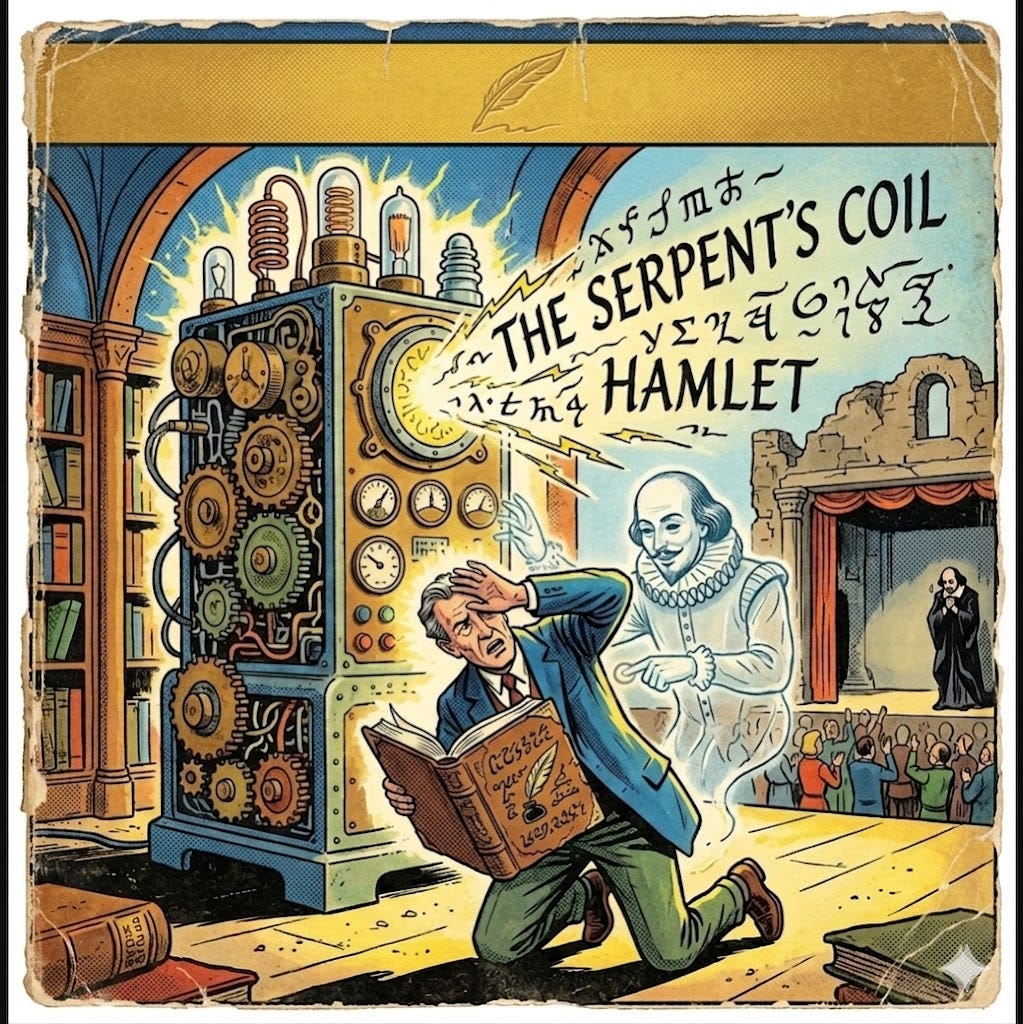
George closed the blinds, keeping out the bright light reflecting off the gleaming buildings of New Haven. He saw himself as an old soul, someone who preferred real books at a time when the public had moved onto watching microdramas on their phones.
He was looking forward to reading his most recent acquisition: a hardcover edition of Shakespeare’s most famous plays. Unfortunately, he couldn’t sit and enjoy it. He was forced to attend a college department meeting that he couldn’t, in good conscience, delegate to his digital avatar.
He grabbed his coat and headed out the office door. Spring was finally starting, giving a bit of warmth and filling the air with the smells of colorful flowers carefully curated by the college gardeners. As he passed by the student commons, he saw a new advertisement on the digital signage for the annual Shakespeare festival. It cycled through through each summer play with shifting calligraphy and generated artwork.
Starting April Fifteen: A Midsummer Night’s Dream
The script turned into a shower of glitter as it morphed to the next title.
Starting May Fifteen: Hamlet
Then it also faded and was replaced by another.
Starting June Fifteen: The Serpent’s Coil
He stopped in the middle of his walk and examined the advertisement with some skepticism. This wasn’t a subtitle or some sort of new age reimagination of a classic work. It seemed to be a standalone work with the same validity as the pillars of the theater canon.
He closed his eyes, quickly running his mind through everything he had learned about Shakespeare over his decade of study. He considered every work, the lost plays, the falsely attributed writings. None fit. Even his knowledge of the forgeries didn’t ring any bells.
It had to be a marketing ploy by the festival’s new director, Brisa Pugh. She was the sort of person who prioritized new ideas even if they came at the cost of the Bard’s timeless artistry. It seemed likely this was some kind of dreadful modern adaptation.
All thoughts of the meeting left his head as he returned to his office. This was a matter far more important and he had to get to the bottom of it. He bypassed the library’s AI companion and accessed Yale’s raw archives system. It had high-res scans, along with OCR text, of every primary source document in the university’s possession.
He thought that the First Folio, published in 1623, would be a good point to start his search.
SEARCH: “The Serpent’s Coil” IN:First_Folio_1623
Instantly the search came back with a resounding NULL. Not surprising.
He decided to widen his search, rewriting the query to contain everything that Shakespeare wrote, including the quartos and the Stationers’ Register.
SEARCH: (TITLE: “% Serpent’s Coil”) AND (AUTHOR: “Shakespeare, W.” OR SIMILAR) IN DB:Quartos.ALL, StationersReg_1577~~StationersReg_1642
NULL.
This made him even more apprehensive. There wasn’t any sort of play by this name at all. Anywhere. Again, he wondered if the play was a mistaken Shakespeare, written by someone else but attributed as an original. He searched through The London Prodigal and A Yorkshire Tragedy and the rest but there didn’t seem to be any use of the name or even the phrase of “the serpent’s coil”.
He leaned back in his chair and rubbed his chin. This play did not exist. It could not exist. There wasn’t even some forgery that he could attribute it to. So how exactly was it being advertised as part of the Shakespeare Festival? He stared at the blinking cursor in the search box and the word NULL mocking him below.
He decided to try a different tact, switching out of the realm of reality and into the open web. He typed in the same query to an open search engine and hit enter.
Dozens of hits suddenly hit him like a firehose. The top result was titled like a literary magazine but when he opened it, he was stunned that it looked more like a fashion catalog. He saw on a listicle of the top five Shakespearean villains, The Serpent’s Coil was listed at number three.
The next result was a five-paragraph essay from a community college student in Ohio comparing the play’s heroine to Taylor Swift.
What stunned him the most were the dozens of scholarly articles published in open-access journals whose names he’d never heard before. They were all written in perfect academic prose, explaining the play’s themes and characters. Yet as he began to tap through the citations, he found there were no original sources. They all pointed to each other in some sort of citation ouroboros.
They were published recently. A few from last year, a few before that. Yet no piece of content referring to the play existed before 2032. The play appeared to have simply willed itself into existence four years ago.
“No, that’s impossible,” he muttered as his hand moved away from his mouse and touched the leather cover of his book.
He opened up a command prompt and executed Yale’s Archival Trace. It was an old piece of software whose developers never bothered to modernize. The only way to interact was through its custom querying language. His colleagues preferred newer AI tools that did all the querying and summarization automatically, but he never trusted them.
trace-source -ref “The Serpent’s Coil” -depth Depth.MAX -filter Date.PUBLISHED < 01.01.2032
render-tree -mode citation_propagation
The screen cleared as the query began to be executed and turned into an ASCII output. Little by little, entries began to appear. As each new one came in, the display cleared and updated again. It showed each entry but also lines connecting them together in order to paint a broader picture of all the individual nodes fit together.
He could see the blog posts and student essays as the outermost leaves of this tree of falsehoods. Then there were pseudo-academic papers, likely generated for paper mills. Climbing deeper into the tree, he found the trunk; the origin point where this play actually originated.
A project log uploaded on a publicly accessible cloud bucket were some documents related to a corporate-academic partnership. The project was named “Quillcast”.
The README called it a “Generative AI project for Cultural Understanding and Reclamation”.
Quillcast is designed to analyze the style, themes, and linguistic patterns of authors with lost or fragmented works. Our models then fill in the unfortunate lacunae of your shared cultural heritage.”
“Fill in?”
It didn’t fill in gaps, it invented them outright. It didn’t know anything. It hallucinated and people had the audacity to consider that somehow close to authentic. And The Serpent’s Coil was its proof-of-concept. It was a Shakespeare clone that appeared to have escaped the business pitches and went out into the world. Then other AIs scraped the manuscript, cited it in their own generated summaries, and laundered this copy until it became culturally understood as genuine. The play was fake all along.
He minimized the window and, barely holding back his anger, typed a stern email to Ms. Pugh.
Dear Ms. Pugh,
I want to express my concern regarding one of the plays for your upcoming Shakespeare Festival, an event I personally look forward to each year. I am myself a Professor of Renaissance Literature at Yale and my extensive research into Shakespearean canon and related apocrypha has shown no verifiable records of a play named “The Serpent’s Coil”.
On the contrary, my investigation suggests that the work is not a historically known nor newly discovered work. It is a generative fabrication from an AI project conjured up just a few years ago.
To put it simply, your production was generated by an algorithm.
I am sure this information must come as a surprise to you. Now that you have this information, I expect you will be taking immediate steps to correct this mistake, in the fullest interest of artistic integrity. Given my background, I am available for future discussions and advice.
Sincerely,
Dr. George Baxter
He sent the email and leaned back in his chair. He felt like he had done something good. With a swelling pride, he decided to visit the building’s kitchen to prepare a cup of tea for himself. Chamomile tea seemed like the best fit for him. He took the mug, still steeping, back to his office.
A reply had already arrived from Ms. Pugh. He took a gleeful sip of tea and opened it. He expected her to be apologetic and thankful for his attention to detail.
Hello Professor Baxter,
Thank you so much for reaching out to me with your excitement and interest about our upcoming festival. We have a lot of appreciation for the academic traditions that have allowed Shakespeare to be enjoyed by so many.
We are aware of the unique origins of “The Serpent’s Coil”. Instead of viewing it as an error, we see it as an opportunity to present viewers with something new. We want our audience to engage with a canon that continues to evolve even today.
Despite its provenance, it has developed its own cultural footprint over the last couple years. Audiences can connect with its themes of betrayal and inheritance. They resonate powerfully and we’ve already seen an increase in ticket pre-orders compared to our other shows.
Our goal for the Shakespeare festival is making the plays accessible to a new generation. Whether they come from the bard’s quill personally or a quantum processor today is not as important to us as the way emotional truths get depicted on stage. That is the authenticity we care the most about.
I do hope you’ll come see the show. I think once you see it, you’ll agree with us.
All the best,
Brisa Pugh
George read and re-read the email several times. Her cheerful words combined with an academic incuriosity seemed more infuriating than anything else. Her words seemed to cast the truth aside in favor of maximizing ticket sales. She wasn’t surprised. She knew didn’t care.
The middle of June arrived and George found a small spot on the far edge of the park lawn. After Pugh’s dismissive email, he didn’t find he had the will to fight. Now, with a morbid curiosity, he had come to the first showing in order to witness what kind of butchering they had done in the name of entertainment.
He could hear the cicada droning all around him. Couples were beginning to arrive, carrying blankets and picnic baskets. Most of them were students, although he didn’t recognize any of them. He would’ve brought someone with him, although he didn’t have any grad students this year. It seemed like nobody was interesting in really studying the classics anymore. Nobody really wanted to grapple with works they couldn’t immediately understand.
“I heard the ‘serpent’ is supposed to be a metaphor for a bad Wi-Fi connection,” he overheard a young woman say.
“No, my lit-bot told me it’s about family betrayal. You know, the tooth is sharper than a serpent’s child,” another countered.
How sharper than a serpent’s tooth it is to have a thankless child, George wanted to correct. But he held his tongue. It was a line from King Lear, now mangled and without context. He let out a loud sigh. That conversation was a fitting prelude for what he expected to see.
Then the glow of the stage lights intensified. The crowd’s voice died down to a few murmurs as a single actor walked out to the center of the stage.
The actor spoke in a rich baritone. The words were in a perfect iambic pentameter and were delivered with a theatrical grace. George couldn’t find any problems with the meter. The language was full of themes Shakespeare had dealt with before: celestial omens, poisoned goblets, royal rumors.
The plot was laid out across several scenes in the first act. It borrowed the ambitions of Macbeth, the jealousy of Othello, and madness from Lear.
On one hand, it was a brilliant play. Yet it also felt so stale.
The play’s villain, the Duke of Albi, delivered a soliloquy at the end of a scene. He spoke about his ambition and how it trapped him from contentment. The speech was delivered without any clear flaws, full of clever metaphors, but without the emotional resonance George expected.
When Macbeth talked about his mind full of scorpions, you were able to feel his paranoia. Hamlet’s sea of troubles were meant to evoke the suffocating weight of the sea you could actually feel. The Duke’s metaphors were lacking in the subtext that allowed the audience to empathize with the character.
George looked around at the other patrons. None of them seemed to think anything was wrong with this. A young woman appeared to wipe a tear away from her eye. A collective gasp passed through the crowd when the duke’s daughter was wrongly accused of treason.
George felt a growing chasm between himself and the rest of them. They were moved to tears by this synthetic performance while all he could hear were all the problems with it. All he saw were ghosts wearing the clothes of Shakespeare and running around on the stage in a sort of mockery of everything he stood for.
The steel swords clanged as part of an entertaining sword fight in a climatic scene. The lighting had changed to mimic a twilight as the hero avenged his father’s ghost. The final lines were spoken with a satisfying finality that seemed almost like solving an equation. The poetry was in the words, but it didn’t feel emotionally satisfying. The villain’s blood pack burst, giving the audience a visceral grossness. The death was perfectly executed. A clean resolution.
The audience already got to their feet as the hero finished his monologue. George could only hear a dull wall of white noise. The audience was taking photographs, tagging and sharing them, all validating this butchered play. They had been given exactly what they wanted: something with Shakespeare aesthetics without needing the messiness of needing to understand it.
George remained seated as his anger faded into a dull resignation. He had been prepared to expose this play as a fraud. He had expected the public would demand answers and academic panels would indict her dishonesty. Now, looking at the reception, he realized that nobody actually cared.
As the applause began to subside, people started dispersing. They grabbed their blankets and went on their way home.
“What great language,” a young woman noted. “So much more accessible than that Hamlet we saw last month.”
He could see Brisa accept congratulations and waved out to the crowd along with the bowing actors.
George watched everyone go. The lights dimmed and finally turned off. He was left in the dark, all alone.