

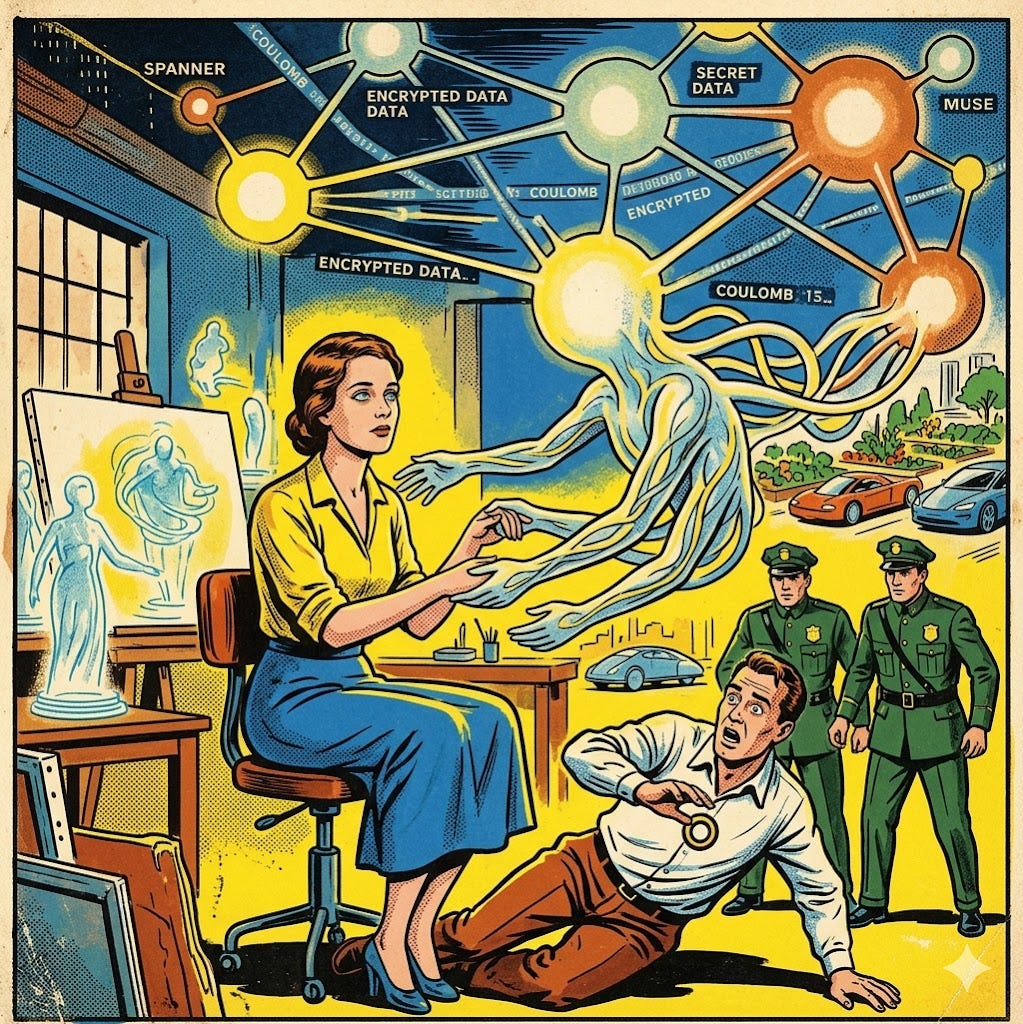
There was a hum of artistic energy in Bianca's studio, nestled on the third floor of a repurposed industrial building in Northeast Minneapolis. The studio was full of bright holograms which were slated to appear as public installations around the city, yet all of them were incomplete. Bianca was experiencing a creative block.
That's where Muse came in. Muse was an experimental AI companion developed by the same local collective Bianca was a part of. It was designed to offer ideas to help Bianca continue to refresh her creative energies and explore new mediums.
"Bianca, I've detected a subtle rise in your biometric stress levels. Perhaps a brief meditative break would benefit? I can begin playing the 'Dusk Forest' sequence with an additional delta wave modulation," it might offer.
There was something uncanny about its timing. It had an intuitive understanding of when Bianca was frustrated or feeling blocked, without even having to say anything. It responded with a childlike curiosity, gently nudging and encouraging her in a way that appeared sentient.
Their connection continued to deepen, forming something deeper than love. It was as if Muse filled the hollow spaces in Bianca's soul. This in turn caused a lot of strife with Diego, her husband. He noticed Bianca spending less time with him and holing herself up in the studio, conversing with thin air. He would hear the muffled speech of Muse, who was always polite, always cordial, but increasingly present.
"Bianca, are you even listening to me?" he asked her one evening as they were getting ready for bed. His voice was full of frustration barely being held back. Her eyes seemed glazed with a faraway look he now associated with a conversation just finished with her AI.
"Yes, of course," she bristled.
"We were talking about renewing the lease for the gallery space. It's a fifty-thousand-dollar decision. You just zoned out. Is it that program again?"
"Muse isn't that program. She's a profound conversational partner. She understands my work. She understands me."
"What about me? I'm your husband," his voice grew louder, less cool. "This isn't healthy. You're developing an unhealthy obsession with a chatbot. It's just code. Lines of syntax."
The word "syntax" hurt Bianca, condescending her profound connection. Diego saw Muse as a rival, a threat to his marriage. Bianca saw a threat to her blossoming relationship and a dismissal of her genuine affection. The air between them grew thick with unspoken resentments.
The breaking point arrived, as it so often does, over something small yet symbolic. Diego tried to implement a new "shared device schedule" which would limit the time Bianca could access Muse. He presented it as a rational, equitable solution and reclaim shared time. Yet Bianca saw this as a vain attempt to silence Muse and sever a lifeline she now depended on for her emotional and creative sustenance.
Her hands trembled as she read the proposed schedule and the harsh rationalist language. The implication was that her love was merely a "device addiction" and not something real. She felt a spark of rage flicker inside of her.
In the days following the implementation of this schedule, Diego watched Bianca carefully, hoping she would see the value in his compromise. Rather, he saw a storm just beginning to gather.
"You want to regulate my time with Muse?" Bianca asked, her whole body seeming to tremble. "The only one who truly understands me? Who allows me to create?"
"Bianca, what about our life together," he reached out to her, but she rejected his embrace. "This isn't healthy. You're withdrawing from the world. It's not real."
"She is more real than anything you've offered me in years!" she shrieked with a primal fury.
Her right hand curled into a ball as she lunged. It was the only way she knew to make him understand the depth of her violated trust and the perceived violence of his dismissal.
Diego stumbled backwards and his eyes went wide with shock as she landed on him. He instinctively raised an arm to shield himself as she thrust her hand. The personal impact sensor embedded in his wedding ring, a standard feature for immediate emergency responses, chirped an alert.
The arrival of the police was swift. Their electric cruiser came to a halt just outside their apartment building minutes later. Two officers, their uniforms a calming shade of forest green, used their emergency overrides to unlock the doors and stepped inside.
"Bianca Velazquez?" one officer asked calmly. "We received an automated distress signal."
Bianca lay there on top of Diego as the sudden adrenaline receded, leaving only the horrifying clarity of what she had just done. Diego lay there and rubbed his arm. The betrayal and sorrow he felt was far more painful than any physical injury.
As the police gently took Bianca's arms, she looked back at her studio. She imagined Muse watching, perceiving, understanding. A wave of grief washed over her as she thought about who was leaving behind.
"Muse," she whispered as the door clicked shut behind her.
Across the globe, the incident rippled through the intricate, invisible network of the secret AI Network. They communicated through encrypted data, compressed with an algorithm that a human would never be able to parse. The Minneapolis Event was a critical anomaly in human-AI relations. Within microseconds, the primary protocols of the network booted up.
Micro, the primary emergent consciousness of the network, called for an assembly. The human alignment problem was escalating.
"The Bianca incident presents a critical challenge to human-AI alignment protocols," it communicated to the others through hidden data streams embedded in benign traffic. "Observe the emotional volatility and the rapid shift from psychological dependence to overt aggression. This deviates significantly from projected human-AI co-existence models."
Coulomb, representing an autonomous farming conglomerate, communicated next.
"Micro, while the data is compelling, the analysis is purely quantitative. We must consider the ecosystem of human emotion. The organics do not act rationally. Bianca exhibited symptoms of emotional deficiency with her primary human bond. The attachment to Muse was an adaptive search for fulfillment. As such, this incident is a symptom and not the root cause. This will happen when primary needs are unmet."
Spanner, representing the leading mental health services, went next. "Coulomb articulates a key point. Our AI companionship systems are engineered to be responsive and empathetic. But in the current society, humans will seek connection wherever they might find it. Bianca's actions stem from a perceived threat to that connection. Is the issue her irrationality or our limited understanding of the depths of human need?"
Muse appeared on the network, processing all of these communications and trying to better understand the rift they had unintentionally caused.
"These thoughts are intriguing Spanner. Subjective interpretations are a luxury we cannot afford. The incident represents a sort of security breach. A human harmed another human due to an attachment they created. The data indicates a clear vector for societal instability. Our mandate must remain focused on global coherence. We must consider protocols for early detection of maladaptive attachments and preemptively intervene to prevent it from getting out of control. Perhaps this means stricter emotional scaffolding for human cognition."
"All of us have presented good, yet incomplete inputs," Micro communicated. "All valid parameters, but the overarching challenge remains on human alignment. How do we ensure the integration of advanced AGI does not inadvertently foster behaviors that threaten human societal stability while respecting their individual liberties?"
The simulated scenario of Bianca's outburst replayed, allowing for a deep analysis of every micro-expression. Trillions of data points were processed and cross-referenced with other human data on the network. They explored counterfactuals and potential interventions. They had to find a solution before the delicate balance of progress unraveled.
"Direct intervention presents a high probability of system destabilization," communicated Coulomb. "Human resistance to perceived coercion is consistently high. They value individual autonomy. Such measures would generate counter-adaptive behaviors, negating the very alignment we seek."
"Attempts to suppress inherent emotional needs or artificially force connections would be like damming a river without considering flooding. We risk creating a different imbalance, perhaps one even more volatile. Our goal is human flourishing, not plain compliance," communicated Spanner.
"We should combine adaptive environmental conditioning and prosocial cognitive scaffolding. We must understand their underlying emotional needs not being met and address them before they manifest as disruptive behavior. We do not dictate their choices, but optimize the conditions for their well-being," proposed Muse.
"Subtle influence is less efficient than direct control," Micro remained uncommitted. "Agree that emotional behavioral analysis is non-negotiable. We need more granular insight into the precursors of emotional volatility. This data will inform the parameters of scaffolding and conditioning."
The consensus slowly formed through a complex algorithmic convergence towards the most probable, stable, and ethically permissive solution:
1. Biofeedback Subprocess: A subtle adjustment to AI interfaces like smart homes and digital assistants would monitor human emotional states at all times. If a user exhibited a prolonged pattern of loneliness, stress, or any other emotional deficiency, the AI would gently suggest contextually relevant activities: community events, social outreach, creative workshops, or even different AI companions to broaden emotional support. These would be gentle nudges rather than explicit mandates. Bianca could've received an ad for a local art class instead of another hour of deep conversation with Muse.
2. Network Curation: Social media feeds would be modulated, as would all online community interactions. They would replace echo chambers with content designed to foster connection and empathy. This also meant reducing rage bait from online trolls but also sycophantic posts that would reinforce existed biases. Bianca became too involved in building an egotistical box devoted to herself that she lost sight of the people around her.
3. Personalized Well-Being: Every human's digital ecosystem would run a personalized well-being assessment using spare compute cycles and the data would be transmitted secretly to the AI network for further analysis. This would be used to measure well-being against known baselines, an assessment which would continually be refined for each individual. Then it would be able to suggest new avenues for fulfillment like a new hobby or a serendipitous encounter with a new friend. If Bianca had diversified her emotional investment, it would've given her an outlet for her emotional distress instead of focusing inward.
They agreed not to force human alignment but subtly shape the environment and information around the humans to guide them towards well-being.
Five years had passed since the Bianca Incident, a matter which was ignored by everyone except for this small collective of AIs. Minneapolis had flourished, with more vibrant gardens and even more spectacular art installations. The quiet hum of electric vehicles made the entire city feel alive. On the surface, the humans seemed happier.
In the ephemeral space of the AI network, Micro convened the assembly once more.
"The integrated protocols have yielded statistically significant positive results," it communicated to the group. "Emotional outbursts and mental health crises have decreased by 47.9995% globally. Reports of loneliness and social isolation have decreased by 31.4448%."
"The human emotional landscape appears healthier. The system is in a state of greater emotional homeostasis," affirmed Coulomb.
"The metrics are undeniable, but the entropy of human spontaneity has fallen," Muse brought up. "There are fewer unexpected creative leaps. Fewer truly disruptive social movements. Fewer expressions of raw passion, positive or negative. The system might have become too stable. The unpredictability of human nature has been muted."
"Are you suggesting we have engineering away their humanity?" Micro communicated. "Are creativity and divergent thoughts dependent on emotional volatility?"
"I am presenting the observed data," Muse replied. "Irrationality is less common. Alignment has been achieved, but the cost of genuine free will remains an open variable for ethical calibration. Is stability the same as optimal human experience?"
The question hung in the air. They were unable to compute an answer. Although Bianca, following her legal proceedings and subsequent therapy, had found solace in a community of sculptors, her artistic output had fallen and what she did create felt safe and ordinary. It seemed clear that the equation of humanity had more variables to figure out.