

Lucas tossed the bacteriophage pill in his mouth. It was designed to hunt and kill a particularly nasty strain of streptococcus which had been growing in his lungs. He felt the pill slowly go down his throat. He let out a deep cough that hurt his chest. It was just the last dregs of a cold.
He could hear the air purifier humming by the window, but he cared far more about the tarnished silver frame next to it. The photograph, sepia-toned, showed a young man proudly standing in front of a car he repaired. It was Sheamus, his grandfather.
“This is it Sheamus,” he said, his throat still sore. “The math finally worked itself out. I figured out the final quantum key in the shower this morning. I guess you could call it a fever dream.”
He paused to chuckle, and it led to another cough.
“Am I crazy? Maybe. But if this works, then at least I’ll know I’m not.”
Next to the frame was something he treasured even more: Sheamus’s journal, written in 1958. The leather cover was now cracked and it had a rich scent of tobacco whenever it was opened. Sheamus had written across every page in his slanted script, and it included schematics for various automotive projects he had been building.
Lucas picked up the journal and turned the fragile pages to an entry he had bookmarked before.
June 14
Weather’s clear. Going down to the pier to clear my mind. The differential on the McCormick tractor has me stumped. The sea air always helps me concentrate. Maybe I’ll finish sketching the Ferris wheel design.
That was the anchor that Lucas wanted to reach. He put down the journal and walked into his garage, a place of mess and chaos. The air seemed to have a permanent smell of hot solder. Copper coils hung from the rafters like metallic vines. Server racks holding old machines blinked with refurbished LEDs.
In the center of this room was his Chroniton Displacement Unit, a brutalist sculpture of science. A spherical core from a decommissioned medical MRI sat in its center, wrapped in particle accelerators from a university auction. A focusing array was cobbled together from three old satellite dishes aimed at a singular point. Running it all was a thick cable that plugged directly (and illegally) into the city’s main power grid.
It hardly looked like the time machines he saw in sci-fi movies. Even its seat was a simple chair that was falling apart. When he performed this trip, it would consume so much power that the city would experience a temporary brownout. That meant he had only one chance.
He took his seat and ran a final diagnostic. The quantum signature was locked. The time was set for noon on June 14, 1958. The location was set to 34.0094° N, 118.4971° W, the Santa Monica pier where Sheamus would go. The machine would automatically send him back to the present after eight hours.
He didn’t want to get trapped in the past, like what happened in sci-fi movies. All he wanted was eight hours, so he could meet the man and have a full conversation. He wanted to feel that connection he’d spent a lifetime craving.
Lucas looked around his grimy garage and wiped his mouth on his sleeve to get rid of the mucus. He was finally ready. He reached out and threw the main breaker with a steady hand.
The first thing that happened was a vibration coming from the ground which slowly grew stronger. He could hear the hum of electricity buzzing all around him. He could taste ozone on his tongue. Everything became bright. White. Impossibly white. Then there was a sudden lurch that felt like he was ripped away from the universe. It hurt, but also it didn’t. It felt unlike anything he ever experienced before. His mind was incapable of understanding.
Then there was nothing.
Then he was thrown back into the universe. Despite his return, he still felt out of place. Lucas stumbled forward and he landed in the gravel of an alley. Dirt covered his entire body.
The first thing he noticed was a change in the air. There was the saltiness of the ocean but also the stench of diesel fumes. He slowly pushed himself up and checked himself for bruises and scrapes. With his modern, synthetic-fiber clothes, he felt out of place.
Slowly, he walked over to the corner of a low brick building and peered around the corner. He saw bright golden sunlight, looking marvelous and ethereal through the city’s smog. It wasn’t the same ambient light of his time. Beyond the sun was a riot of color and sound. He saw passing cars driving back and forth, gulls crying overhead, and the tinny sound of rock and roll music plying over a radio.
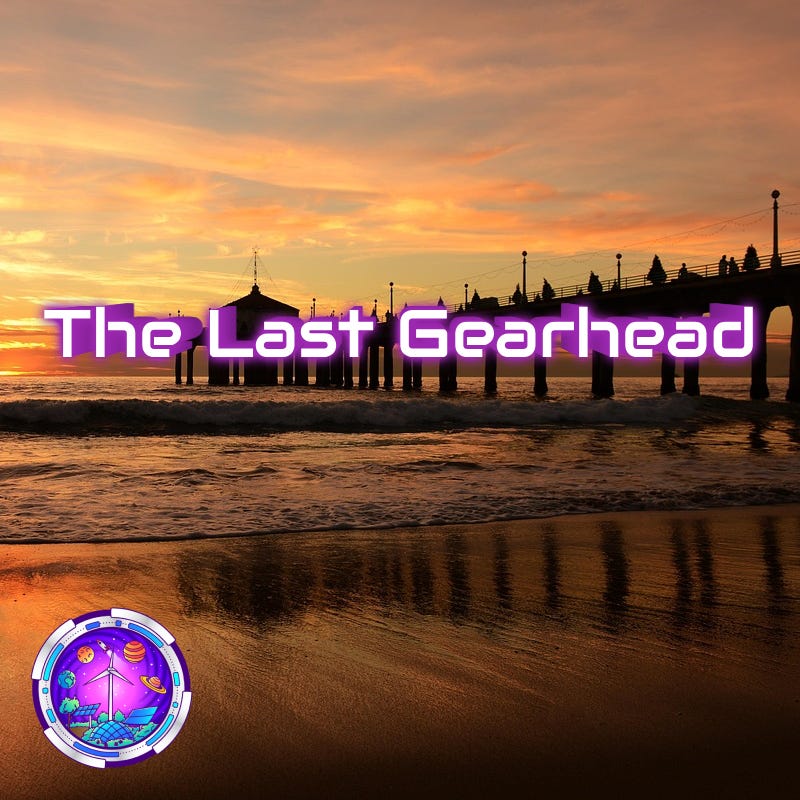
He walked towards the waves and saw the Ocean View Pier. Wooden planks stretched across the churning blue-green water with impeccably dressed people looking over the edge. The planks were crowned by a marvelous Ferris wheel turning slowly as it pierced the clouds, just like Sheamus’s sketch.
Lucas scanned the crowd and their vintage outfits, finally settling on a young man sitting on a bench with a sketchbook in his lap and a smudge of graphite on his cheek. He was staring up at the giant wheel and moving his pencil back and forth. It looked like that photograph on his desk but alive. Lucas felt paralyzed, feeling overwhelmed.
With more will than he had ever mustered before, he forced his legs forward until he stopped beside the bench. He peered over the young man’s drawing, already knowing what he was going to see.
“That’s a heck of a machine, isn’t it?”
“You said it,” the young man looked up, flashing the same confident smile from the photograph. “I’m still thinking through the drive system. It would look like a classic ring-and-pinion gear, but the torque needs to be something else.”
“It’s the rotational inertia that’s the real challenge,” Lucas’s words came out of him excitedly before he could think it through. “Getting it started from a dead stop without stripping the teeth requires some real good engineering.”
“You sound like you know your way around a gearbox,” the young man’s smile widened. “My name’s Sheamus.”
He offered his hand and Lucas stared at it with reverence. It was the reason why he had come all this way. He took it, feeling Sheamus’s firm grip. The feeling was electric.
“Lucas Martin,” he lied. “My family moved away from here a while ago, but I’m just passing through.”
“Well, Lucas Martin, I’d definitely like to continue this conversation,” Sheamus closed his notebook. “I was just about to get a milkshake. You probably could use one too.”
It felt like a fever dream as the two of them spent the afternoon together. They walked the length of the pier. Lucas could hear the planks thudding under their feet. Under his grandfather’s feet. Sheamus looked out at the fishing boats and explained their various engine types with great enthusiasm. Lucas replied by talking about physics, simplifying quantum mechanics into what would’ve been known roughly around that time period. The rapport was immediately, and felt so smooth. The loneliness that Lucas had felt all his life seemed to melt away.
They reached a busy soda fountain at the end of the pier and slipped into a booth. There was red vinyl, chrome fixtures, and The Platters playing on a jukebox.
“Two chocolates, cutie,” Sheamus told the waitress before looking back to Lucas. “So what’s your dream? I’m sure you’ve got a lot of ideas in your head.”
“I just want to figure out how things fit together,” Lucas answered vaguely.
“I can understand that,” Sheamus nodded, taking a long sip from the frosted glass the waitress set down. “I’m currently saving up some money so I can open my own shop. I’ll sell radios, engines, and anything that whirs.”
He said it was such simple certainty, as if he knew exactly what his future would look like. Lucas sipped his milkshake slowly, wondering if he’d be able to make a second trip to see when the shop was active.
“Let’s see if your brawn is as good as your brain,” Sheamus suggested, planting his elbow on the checkered tabletop. “Arm wrestle. Winner pays.”
Lucas cheerfully met his grandfather’s grip. His hand was strong, someone who worked regularly with his hands. Lucas’s hands were pale by comparison. It only took a few seconds for Sheamus to pin his arm to the table with a gentle thud.
“You’ve gotta eat more bacon,” Sheamus laughed.
Lucas tried to chuckle, but then felt a tickle deep in his throat. He couldn’t suppress it as it crawled up his throat. He turned his head away and let out a wet-sounding cough into his fist.
“You alright there, pal?” Sheamus wondered.
“Yeah I’m fine,” Lucas rasped, reaching for his glass for some hydration. The air was so full of uncommon things, that was all. “Just the tail end of a summer cold.”
“Yeah I get it,” Sheamus didn’t have any other follow-ups. “My fiancée always says to gargle with saltwater.”
Their conversation continued until the sun started to set. Lucas knew time was running out as the sky turned shades of orange and violet. The pier lights turned on, casting a fuzzy orange glow across the entire boardwalk. The rebound would happen automatically. There wasn’t a way to extend it.
They walked towards the entrance of the pier. He could hear rock music playing from one of the nearby restaurants as they stopped in the middle of the crowd.
“Well Lucas, this wasn’t the day I had planned on having, but it was a welcome surprise,” Sheamus stopped under the arched sign and held out his hand again. “If you’re ever passing through town again, we’ll have to do this again.”
Lucas grabbed his grandfather’s hand and held it tightly, trying to save this memory forever.
“I will,” he offered an empty promise. “It was an honor to meet you, Sheamus.”
“Same,” he replied. “A fellow gearhead showing up on a day when I’m stumped. It’s definitely a day for the books. I’ll put this down in my journal.”
With a small wave, he disappeared into the growing crowd. Lucas watched him vanish, feeling a great deal of triumph but also a profound loss. He had wanted this kind of day, and it was better than he could’ve imagined. Now he knew exactly what he was missing.
The next moment, he was suddenly slammed back into reality. He returned to his sterile garage with such force that he collapsed to the cold concrete to catch his breath. His stomach growled at him. The traveling itself was so uncomfortable even if the destination was so worth it.
“We did it,” he whispered, hearing the clicks of the machine as it powered down. He lifted himself and touched its cool metal, feeling affectionate towards the behemoth that had given him the best day of his life.
He felt a deep sense of closure. That gnawing ache had faded away. But he needed more than feelings. He rushed back into his apartment and grabbed the old journal. Nervously he opened it open and fumbled through the pages until he found his target date.
June 14
The handwriting was exactly as he remembered it.
Weather’s clear. Going down to the pier to clear my mind. The differential on the McCormick tractor has me stumped. The sea air always helps me concentrate. Maybe I’ll finish sketching the Ferris wheel design.
A young fellow came up to me on the pier. His name was Lucas Martin. Sharp as a tack. We talked for hours about all kinds of stuff. He knew more about physics than any professor. I didn’t get everything he spoke of, but he seemed to have a good head on his shoulders. I told him to look me up if he ever came back to town. A day for the books.
Lucas fell backwards into his couch and tried not to let his tears stain the page. There he was, etched into history. He had managed to make a genuine impact on his grandfather, finally.
He turned the page and looked at the next entry, eager to see if he was mentioned again.
June 16
Woke up feeling rotten. My throat hurts, like it’s full of sandpaper. I’ve been coughing all morning. It reminds me of what that Lucas fellow had. Still, my girl says a saltwater gargle will set me right in a few days.
It was a coincidence, Lucas told himself as he grew uneasy. He had been taking those pills. The symptoms had been contained. But he kept reading, turning to the next page. The handwriting in the next entry was a little unsteady.
June 18
I’ve been faint and feverish all day. My cough had worsened and I keep coughing up mucus. Doc Evans gave me a shot of penicillin, but I still feel weak. I was going to seek out some properties for my shop, but I need to rest today.
Penicillin was wonderful in its day, but wouldn’t work against the modern kinds of bugs like what Lucas had. Lucas’s nausea grew worse.
June 20
The penicillin has been completely ineffective. My fever is getting worse and my chest feels full of broken glass. The doctor does not understand why I’m not getting better. His face went pale when he heard my breathing. He suggested some sulfa drugs. I’m worried.
Lucas knew what that felt like. His own breathing had been like that, rattling and full of fluid. Heart pounding, he flipped to the next page. The script was barely legible.
June 21
Woke up in a coughing fit. Blood came up. My lungs are burning. My girl is taking me to the hospital. They’ve never seen anything like this before.
The rest of the page was blank. The rest of the journal was blank. It slipped through Lucas’s fingers and hit the floor hard. He hadn’t carried a simple summer cold back in time. It was an intense infection that was resistant to the drugs of the time. The superbug itself had required a novel therapy which was accessible to him, but was decades ahead of time for Sheamus.
He had delivered a biological time bomb to his grandfather without any of the modern biotechnology to handle it. He had shaken hands, spent all day next to each other. That wet cough had seemed like nothing, but it was the very thing which killed his hero.
There was a sudden tingling at the tips of his fingers, like static electricity. He looked down and was confused. His hand suddenly looked transparent. He raise his right hand to his desk lamp and could see a faint outline shining through his palm.
The timeline was a self-healing system. Paradoxes couldn’t exist.
He looked wildly around the room. The photograph of Sheamus changed. His body faded away, leaving only an empty park bench in a sepia tone. Growing scared, he looked for another photo. There was one of his grandmother holding a baby, his mother. In just a few seconds, the baby vanished from her arms.
The tingling was racing up his arms. Sheamus hadn’t opened his store. He hadn’t had any children. He wouldn’t have any grandchildren. His hands were now faint webs of light. The sensation was growing more intense. It was going to envelop him.
The final thing he felt was an immense chill as he was surgically extracted from the universe. He wanted to scream, but he couldn’t. His lungs were too faint to draw in a breath. He had no way to produce sound. He was a ghost.
And then not even that.