

The Midas Neuron
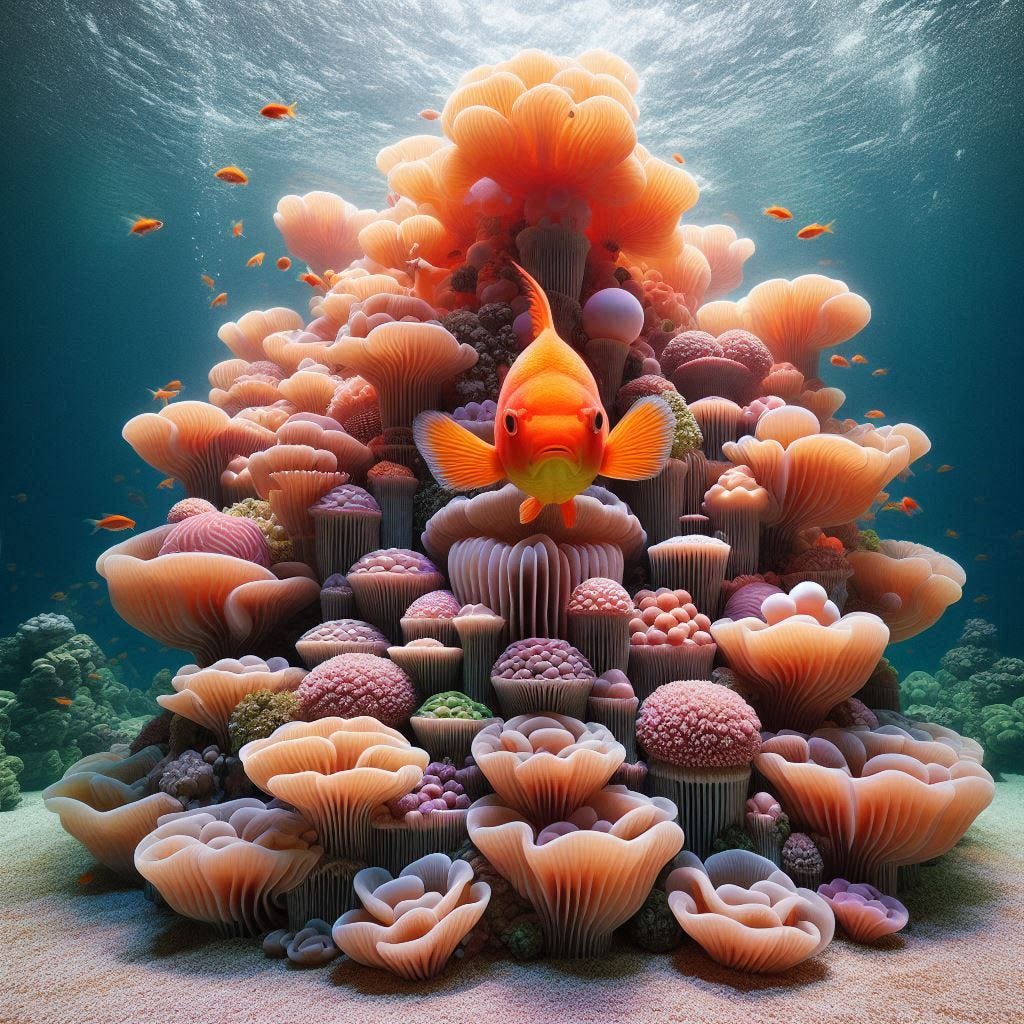
The Raleigh Bio-Collective hummed with the quiet intensity of a thousand interconnected minds, both human and computational, all dedicated towards the mission of unraveling life's mysteries. This mission was carried out for the grandest ecological cascades down to, in this particular lab, the neurology of a simple goldfish.
Sunlight, filtered through multicolored solar panels of the university's arcology, streamed into the central atrium. Within this cathedral of science, Dr. Temer and Dr. Trang were on the verge of what some colleagues called "the world's most over-engineered pet project".
"Neural resonance looks stable, Trang," Temer murmured as his eyes focused on a complex diagram of golden light.
Their lab was built out of repurposed technology. One such refurbished monitor displayed a live feed from microscopic sensors mapping the brain of Subject MG-17.
"The connectome is resolving. Soon we'll have a synaptic map detailed enough to rival the Notre Dame, and all for Midas here."
"The baseline scan showed some fluctuations," observed Trang. "I'm eager to see how they correlate with his... 'strategic decisions'... around feeding time."
Her fingers, slim and precise, typed commands onto a transparent interface. Her server rack whirred almost silently as its computational power, capable of modeling galactic phenomena, was now churning numbers to understand the inner life of a creature whose primary concerns were algae wafers and optimally positioned pebbles.
Their current subject, Midas, was by all accounts a perfectly ordinary goldfish. He was blissfully unaware of the scientific Everest being scaled in his name. His spacious, custom-designed tank was an enriched environment full of smooth rainbow pebbles and flowing java ferns. This was Midas's entire universe. And soon, a digital replica of his mind would exist alongside it.
The project, audacious even by the broad standards of the Collective's intellectual freedom, was twofold. First, to create an exact, functional digital twin of Midas's brain. Second, to use that twin to explore whether complex cognitive frameworks could be introduced. Officially, the aim was to understand how relatively simple neural architecture adapted to novel inputs. The unofficial goal was to teach a goldfish to play chess.
"Alright Temer, I'm ready to mirror the final synaptic architecture to the digital scaffold," Trang announced. "The latest iteration of the 'DeepGambit' algorithm has been compiled and all the tests pass. It's designed to foster pattern recognition through simulated adversarial reward prediction. Essentially, we'll teach the digital Midas to sense the strategic value of board states. Or you know, the fish equivalent."
For the next few weeks Midas swam around, foraging and nudging his pebbles with nonchalance. Meanwhile, his digital counterpart lived an accelerated, intense existence. Trang fed it a stream of chess scenarios. Midas wasn't going to yell "Checkmate!" anytime soon, but the whole experiment was about recognizing the underlying patterns. Slowly, the digital Midas began to exhibit sophisticated responses. Its simulated neural pathways forged new connections.
"He has a slight preference for the blue and gray pebbles, you know," Lena commented one afternoon, peering into Midas's tank.
She was responsible for overseeing the biological baseline, a cognitive ethologist whose lab adjoined Temer’s. With a meticulous eye and a healthy skepticism, she documented Midas's natural behaviors. She often found herself chuckling as she made her notes, as he was the easiest lifeform she ever had to observe.
"That's our Midas," Temer grinned.
"And he occasionally pushes them into what I can only describe as 'clumps'."
"Is that a technical term?"
"It's definitely non-strategic if we're talking about chess."
"Who knows what grand strategies are lying in those clumps?"
The real test was yet to come. Even as Midas swam unaware, its digital ghost was learning the ancient game of kings.
Soon the day came for Midas to undergo his "cognitive enhancement", as Trang had begun to refer to it. The lab buzzed with a focused tension as they brought in a high-powered laser array. It had previously been used to perform the conventional neural mapping, but now it was calibrated with a level of precision that was closer to sub-atomic.
Beside it was a microfluidic injector, a tool usually meant for cellular repair studies. It held a meticulously prepared cocktail of viral vectors: harmless, bioengineered couriers that delivered CRISPR-edited genes directly to neurons in Midas's tiny brain.
Temer gently anaesthetized Midas using a mild clove oil solution, a surprisingly effective and low-impact anesthetic for fish, and he floated serenely in a smaller, sterile observation tank. His orange scales shimmered under the focused beams of the diagnostic imagers.
Midas's neural architecture was displayed on a holographic projection in three-dimensional, breathtaking detail.
"Okay, we're targeting the optic tectum and specific regions of the telencephalon, mirroring the pathways that we observed from the digital twin. Trang, are the optogenetic sequence activators synced with the laser targeting?"
"All synced, Temer," she said with an affirmative nod. "The vectors are primed to introduce the channelrhodopsin genes at the target sites. Once expressed, the laser will be able to activate those new pathways with pinpoint accuracy. It'll turbocharge the same neurons where the digital Midas learned to think chess-like. Theoretically, anyway."
Lena stood in the background, quietly observing while writing notes in her datapad. Then she stepped forward.
"For all this firepower, let's hope he just wakes up with a normal fishy headache at worst," she said with a hint of maternal concern for the small, unconscious creature.
The sheer incongruity of applying expensive technology capable of rewriting brains to a creature whose ancestors were won at a fairground was not lost on her.
Temer, guided by the blueprint of the digital twin, directed the laser. Each pulse was infinitesimally small, designed to activate the specific light-sensitive proteins now being expressed by Midas's neurons, gently encouraging the formation of new synaptic connections. Those were the same connections that allowed its digital twin to "understand" the complex patterns of chess. It was less of a construction project and more like carefully tending a bonsai tree, nudging growth in desired directions except at the cellular level.
Hours passed while they waited for the treatment to take effect. The only sounds were the hum of the tank's filter, the soft clicks of Trang tapping on the interface as she monitored the biofeedback, and Temer’s occasional quiet instruction.
Finally, Temer leaned back and took off his magnification goggles.
"That's it," he declared triumphantly. "All of the targeted pathways have been potentiated. The viral markers are benign. All we can do now is wait for Midas."
Midas was slowly placed back in his familiar, enriched tank. The anesthetic was flushed from his system. He stirred and his fins gave a tentative flutter. Then, with a flick of his tail, he swam unsteadily towards his favorite patch of java fern.
The team watched with an anticlimax settling over them. There wasn't going to be a sudden , brilliant chess move. He was still a goldfish. He nosed a pebble, then ignored it.
"Well, he hasn't forgotten how to be a goldfish. That's a promising start, I guess," Trang said with a smile.
"Neural integration takes time," Temer agreed. "The digital model took simulated weeks, not immediately. We just led Midas be Midas. Our job now is to observe and document."
"Subject appears normal post-procedure," Lena noted on her datapad. "We will see if his pebble-clumping technique evolves."
The initial days following Midas's "synaptic sculpting" were entirely unremarkable to the casual observer. Midas ate with his usual gusto, explored his ceramic castle, and flicked his tail. Trang’s humorous suggestion of setting up a miniature waterproof chessboard were met with eye-rolls. The project's grand ambitions seemed to settle into a quiet period of waiting.
Lena was far from a casual observer. Her days became a meticulous chronicle of Midas's meager existence. Armed with high-resolution imaging, behavioral tracking software, and an infinite supply of patience, she logged every interaction the fish had with his environment. The university's open research grants system allowed for such deep, unhurried investigations.
It was nearly three weeks post-procedure when Lena first noticed something that made her pause. She put down her stylus and took a closer look. Midas had always interacted with the smooth, colored river pebbles lining his tank, occasionally nudging them aside while searching for food or creating shallow depressions to rest in.
She checked the sensor logs. This time, Midas wasn't nudging at random; he was selecting. He'd approach a cluster of pebbles, hover for a few seconds, then deliberately pick up a specific one in his mouth. It was a small, dark gray stone. He then carried that stone with a determined little swim to a far corner of the tank, a relatively bare quadrant he usually ignored. There, he carefully deposited it. A few minutes later, he repeated the process with a light blue pebble, placing it beside the first.
"Anomalous object manipulation," Lena murmured to her recording device as she checked the camera feed again. "Subject is exhibiting deliberate transport and placement of selected pebbles. Highly atypical."
Over the next few days, this atypical behavior escalated. The random clumps of stones had been replaced by a distinct structure in that corner of the tank. Midas was now intentionally selecting pebbles with specific colors and sizes. He'd pick one up and test its heft. Sometimes he'd discard it for another. Finally, he would carefully swim it over to his chosen construction site.
Temer and Trang, initially analyzing the streams of sensors, soon found themselves drawn to watching the tank directly. The three scientists would stand shoulder-to-shoulder and watching this little fish swim back and forth.
"He's building something," Trang whispered, watching as Midas carefully wedged a small, flat white pebble between two larger black ones. "That's not random. Look at the symmetry he's attempting with those blue stones on the other side. He's building an arch."
What had started as a simple line of stones had evolved into a low, curved wall Then, a small pile appeared. It was a surprisingly stable stack of increasingly smaller pebbles that formed a tiny, rough-hewn cairn. It looked like the fish was creating delineated pathways between different clusters of his pebble infrastructure.
"The precision is what's getting me," Temer commented. "He's not just dropping them. He's placing them, adjusting them. There's a definite spatial logic at play. It's almost as if he's following a blueprint in his head."
Lena began a new series of rigorous tests. Midas didn't sleep, not like humans, but did enter periods in low activity. During these periods, Lena would subtly alter the pebble arrangements. When Midas 'awakened', he would often inspect the changes. Then it would proceed to correct them, moving the pebbles back to their previous, intended locations. On other occasions, he would dismantle a section of his work and rebuild it in a slightly different configuration. Was he iterating on this design?
"This is beyond any recorded cognitive capacity," Lena remarked excitedly as she scribbled on her datapad.
She pointed to a new development that morning: Midas had started sorting pebbles by color into distinct zones within his larger construction.
"He's not just building. He's categorizing. He's imposing an abstract order onto his physical environment. It's rudimentary, yes, but the cognitive leap is astonishing."
Although the experiment had been passed around the collective's message board as a joke, other researchers were now stopping by for a chance to see the goldfish project. The slightly absurd experiment was beginning to yield something undeniably unique. Midas the goldfish was becoming Midas the Architect.
Trang spent hours cross-referencing 3D scans of the pebble formations with her earlier "DeepGambit" algorithm. The correlation was weak, but she remained convinced.
"Look at how he's building. He's not replicating chess positions outright, but look here..."
She highlighted a sequence for Temer: dark pebbles controlling access to lighter ones. Then she pulled up a DeepGambit heuristic focused on board control.
"The principles are there," she declared. "Positional control. Resource management. He's taken the abstract rules of embedded chess and applied them to his space, a whole cognitive framework for intelligent decision-making. This is adaptive intelligence."
"So this chess training didn't necessarily apply, but we gave him the scaffold to elevate his thinking?"
"And he's expressing this heightened intelligence through the only medium available to him," Lena nodded with wonder on her face. "He can't move pieces on a board, but he can move pebbles. He's not just an architect, he's a strategist, demonstrating a form of applied intelligence far beyond what we've ever documented in goldfish."
The final result of the experiment, shared across the message board, was a time-lapse video featuring Midas meticulously moving a tiny blue pebble, nudging it into perfect alignment within a spiraling, intricate structure. It was a sculpture, an engine, a map.
"He's not just Midas anymore," Temer said with a broad smile. "He's taught us something about how intelligence can be cultivated and how it finds its voice, even in the most unexpected of places."