

This is Day 10 of the “Twelve Days of Sci-Fi”. You’ll get a free story each day. You can also get a discount on sci-fi stories for next year.
Emma felt the crisp autumn air all the way in her bones as she navigated the city’s downtown. The usual bustling plazas, with the scent of chrysanthemums from rooftop gardens, were now replaced by quiet and an odor of metal. The usual cacophony of street performers and interactive light-art installations were dim and replaced by static, imposing banners of President Crimson with his jaw set in a pose of grim determination.
All of DC was holding its breath now.
Inside the sun-drenched atrium of the National Endowment of the Arts headquarters, a marvel of architectural design, the atmosphere was more palpable.
Emma, a senior curator who had dedicated fifteen years to fostering what she passionately called “art which breathes alongside Earth”, found her gaze drifting form the schematics of a new sustainable community pedestrian project to the newly installed portrait of Commissioner Vicky Clemson that now dominated the lobby. Clemson, his expression a carefully crafted mix of stern authority and populist strength, had been swept into NEA on the same wave that brought the new president to power.
The initial directives had been couched in the soothing, obfuscating language of bureaucracy: “Strategic Realignment of Artistic Priorities”. Another memo spoke of the need for “Art that Fosters National Unity and Purpose”.
Emma had highlighted these phrases, as she always did meticulously, and a knot formed in her stomach. She’d already seen the subtle shifts. Grant proposals that once would’ve been celebrated for their innovative ecological focus or challenging societal norms were now being “deferred for further review”.
Then came the overt changes. Funding streams once nourishing a thousand diverse flowers of creativity were being systematically diverted, channeled towards projects which echoed the president’s grandiose new vision: “Terran Manifest Destiny”.
It was a bombastic call for national resurgence through pioneering the cosmos, a rallying cry that demanded art reflect this singular, glorious ambition.
The latest casualty was Ryan “BioSpark” Nicholson, a whirlwind of creative energy, who had envisioned transforming a neglected street into a Nocturnal Park: a self-sustaining ecosystem of bioluminescent plants and native flora that would not just beautify the space but also educate the community on symbiotic ecologies. Emma had championed it, seeing its brilliance, its quiet rebellion against the concrete-and-steel mindset. The rejection notice was a sterile, single paragraph citing a “lack of thematic congruence with the current National Artistic Imperatives”. It was signed by a newly appointed under-secretary Emma barely knew.
The official NEA comm-channel chimed, announcing a mandatory staff briefing. Commissioner Clemson was expected to unveil the “updated mission parameters”. Emma saved Ryan’s rejected proposal, a small act of archival defiance, and headed towards the main auditorium. The chill from outside was now seeping deep within the building’s living walls.
Later that evening, Ryan’s voice crackled with frustration over their encrypted comm-link. She was in her workshop, a chaotic, fertile space with incubation chambers and a rich smell of earth. Sota Tanaka, hunched over a console in his own minimalist apartment across tonw, listened patiently. His space was the antithesis of Ryan’s: clean lines, neatly bundled fiber optics, and the quiet hum of custom-built servers from scrapped equipment.
“I’m not upset about the rejection, Sota. It’s the reasoning. Or the lack thereof! ‘Thematic congruence’? My art is about life, about this planet! What’s more unifying than the ground beneath our feet, the air we breathe? Now everything has to be about rockets and planting flag on dead rocks? They’re gutting everything that made NEA vital. It’s becoming a propaganda mill for Crimson’s ego trips!”
Sota adjusted his glasses. He was the builder of systems, a finder of elegant solutions in code, not a political analyst. The scale of it, the sheer ideological force sweeping through institutions like NEA, felt overwhelming.
“I hear you Ryan. It’s a lot. The rhetoric is everywhere. Those new ‘Heroic Astronaut’ statues they’re planning for Unity Plaza...” he trailed off, shaking his head.
“Exactly!” she exclaimed. “And what are we supposed to do? Just stand by and watch them pave over real culture with that... that kitsch? I just wish... wish that there was a way to fight back, to show people what they’re trying to erase.”
Sota leaned back. He felt a deep pang of sympathy for Ryan, for all the artists being marginalized. He understood her anger and the injustice of it. But the question hung heavy in the air between them. Against the monolithic power of a state determined to reshape reality through its control of art and information, what could one engineer or one artist do?
“I don’t know, Ryan,” he admitted quietly. “I honestly don’t know what someone like me can do against all that.”
He looked at the complex array of hardware around him, designed for creating connections and facilitating information. For the first time, he felt a profound sense of inadequacy.
The following week, DC’s central Unity Plaza, once a vibrant green space known for its community gardens and kinetic sculptures, was cordoned off. Vicky Clemson was giving a big press event to announce the unveiling of “a monumental work to inspire the nation towards its stellar destiny”. The city held its breath, or perhaps, it emitted a collective, weary sigh.
The day of the unveiling was a classic DC autumn, but Unity Plaza was transformed. The community plots had been neatly paved over and replaced by stark gray plinths. At its center was shrouded in a colossal sheet of recycled synthetic silk, stood the much-vaunted sculpture. NEA officials, city dignitaries, and a carefully selected crowd of “patriotic citizens” (many busses in from newly formed “National Advancement Youth Leagues”) gathered. Emma stood near the back, her expression unreadable, with a small encrypted recorder in her pocket.
With a flourish of trumps, an anachronistic brass fanfare that made several in the audience flinch, Commissioner Clemson stepped onto a makeshift platform. His voice, amplified to an almost painful degree, boomed across the plaza.
“Citizens of these great American states, today we reclaim this space for the future! For too long, our artistic spirit has been too weak... too diffuse... Earthbound! But no more! Under the glorious vision of Presdient Crimson, we now gaze upwards to the infinite canvas of the cosmos. The National Endowment of the Arts is proud to present a work that embodies this great leap, this Terran Manifest Destiny. I give you the ‘Star-Planter’ by our nation’s visionary artist, Kyle Crimson!”
The artist was the president’s son.
Then, the synthetic silk dropped.
What was revealed was overwhelming. A titanic figure, at least thirty feet tall, was rendered in what looked like a chrome-plated polymer. It depicted a genderlessly heroic figure in a bulky, stylized spacesuit. One massive gloved hand clutched a shimmering flag emblazoned with the national flag and its staff aimed skyward like a spear. The other hand held a disproportionately small seedling, presumably destined for some alien soil. The figure’s visor was opaque, reflecting the sky, but its posture radiated a kind of rigid, unyielding determination. It was, objectively, a feat of engineering. Artistically, it was a vacuum.
Ryan and Sota watched the live feed from a shared screen in Sota’s apartment with the volume muted. Ryan’s arms were crossed and her jaw was clenched. As the camera panned across the statue’s polished, unexpressive surface, she let out a sound that was half scoff, half groan.
“Look at it,” she said, her voice dripping with contempt. “It’s an oversized hood ornament. All that material, all that public space, for that? It says nothing. It feels nothing. It’s just... big. Artists are out here trying to make sense of the world... trying to heal it... trying to find beauty in the cracks... And they’re funding cosmic lawn jockeys.”
The official feed showed close-ups of Kyle Crimson himself, a man with a surprisingly unassuming face but an air of immense, unearned satisfaction, shaking hands with a beaming Commissioner Clemson. Clemson was now orating again, speaking about “national pride”, “interstellar ambition”, and “art as the engine of progress” washing over the uncomfortably silent crowd in the plaza.
“He calls it the ‘engine of progress’,” Ryan spat, looking away from the screen. “It’s an engine of forgetting. They want us to forget what real art is, what real connection feels like. They want us to trade the soul of this city, the soul of this planet, for shiny rockets and empty promises of conquering other worlds while this one...”
She trailed off, feeling anger tinged with sorrow.
“People are being silenced. Their truths, their visions, things that could actually help us, are being buried under tons of patriotic plastic!”
Sota remained silent. He was looking at the screen, not on the statue, but on the faces in the crowd and their neutral expressions. He saw Emma in the background standing stiffly, her face a mask. He thought of the passion in Ryan’s voice, the genuine life in her censored art.
And then he looked at the statue again. It was so large, so loud, so utterly devoid of subtlety or depth. It was a declaration, a bludgeon. It occupied physical space, demanded attention, but offered no entry point for the mind or heart.
A thought, fragile as a new seedling, began to take root. Physical spaces can be conquered, co-opted, he mused. You can paint over a mural. You can tear down a sculpture. But what about spaces that aren’t physical?
He remembered his earlier work on decentralized networks for eco-cooperatives, systems designed to be resilient and exist beyond the control of a single authority. He thought of the very nature of information in the digital age. It could flow, replicate, and persist, sometimes against incredible odds.
The sheer, unadulterated badness of Crimson’s statue, its arrogant emptiness, juxtaposed with Ryan’s passionate despair, became a catalyst. The regime was using art was a weapon of control, as a means of broadcasting a singular, monolithic message. What if they could turn that around, to use art as a shield or as a network of whispers that was too disperse couldn’t be silenced?
“Ryan,” he turned to her, the idea still being developed. “They control the plazas. They control the galleries. They control NEA. But do they control every connection? Every quiet corner of the net?”
“What are you getting at?” Ryan was puzzled by this sudden intensity.
“That statue is a broadcast. One voice, shouting. But what if we could build something for all the voices they’re trying to silence? Not a physical gallery, but something they can’t just pave over?”
A flicker of understanding, then hope, sparked in her eyes.
“A place for the censored. For the forgotten. A phantom gallery.”
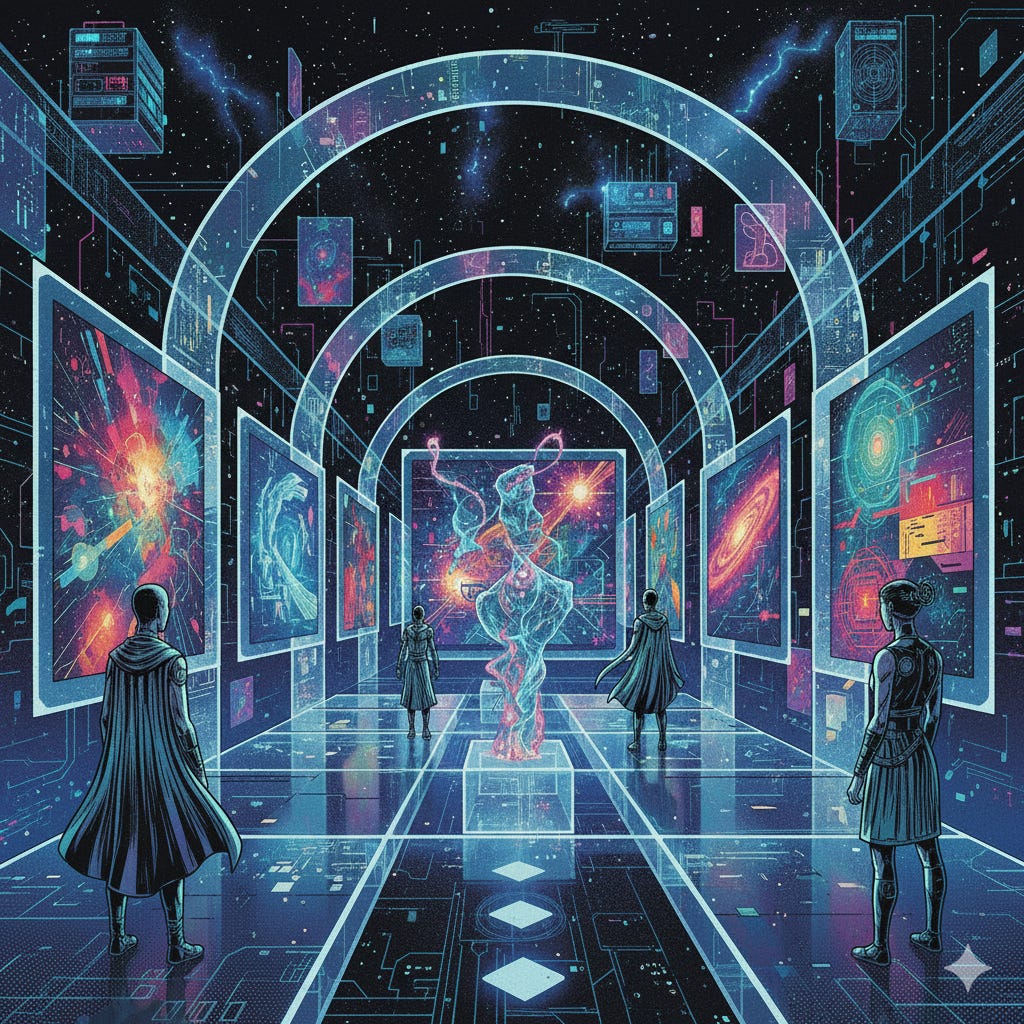
The weeks following the unveiling of the “Star-Planter” saw Sota retreat into the luminous depths of his digital world. Fueled by a potent cocktail of Ryan’s indignation and his own quiet determination, he poured his expertise into crafting the “Phantom Gallery”.
It became an obsession, a complex architectural challenge built not of steel and polymers but of elegant code and crytography. He resurrected and refactored his earlier work on decentralized networks, laying in modern encryption, anonymizing protocols, and a peer-to-peer structure designed to make the gallery resilient. It was a hydra with no single head to sever. There would be no central server to raid, no single point of failure. Each user would, in their own small way, become a part of its infrastructure. They were all nodes in a constellation of shared data.
He consulted frequently with Ryan as her artistic perspective was invaluable.
“It needs to be more than just a repository, Sota,” she insisted one night during a call. Her face was illuminated by the glow of a bioluminescent fern she was tending. “It needs to feel like a space, like a community. Even if we can’t see each other. I don’t want another place to just dump jpegs, but to include the why behind the art.”
So, Sota integrated secure, anonymous forms, comment threads, and even a way to host virtual tour guides that walked through the digital exhibits using minimalist aesthetics which contrasted sharply from the regime’s gaudy visual language. He designed it to be accessible via the Tor network and shared entry points with trusted activists and artists.
Finally, the day game when Sota proudly shared a simple message to Ryan: “The lights are on.”
Ryan was the first to step into the Phantom Gallery. Her digital exhibit was a defiant bloom in the sterile soil of censorship. She shared high-res images of her “Nocturnal Park” proposal, complete with environmental impact statements and her original artistic vision. She added detailed scans of her smaller, intricate bio-sculptures. They were pieces with themes of decay and renewal, of the delciate interconnectedness of all life. These were now themes deemed “unconstructive” by NEA. She wrote a manifesto: a raw, passionate defense of art that engages with the Earth, that both challenges and consoles.
Through her carefully vetted contacts, the word spread. A sculptor whose public installations made of reclaimed industrial waste were now labelled “depressing and unpatriotic” found a space in the Phantom Gallery. A poet whose verses mourned the loss of green spaces uploaded her work. A digital artist whose satirical animations lambasted the “Terran Manifest Destiny” found an appreciative, small audience.
The Phantom Gallery wasn’t loud. It didn’t scream from the city’s billboards, but in the quiet, shadowed corners of DC’s artistic community.
Meanwhile, the offical gears of “official” culture continued to grind. Kyle Crimson, buoyed by the “success” of the “Star-Planter”, was granted a massive budget for his first solo exhibition: “Cosmic Canvases of the Nation’s Soul”. The renovated West Wing of the Museum of Modern Art, a wing previously dedicated to experimental and community art, was transformed into a shrine for Crimson’s grand vision.
NEA spared no expense. Invitations were printed on heavy, metallic-sheened cardstock. Holographic banners screamed across the city’s highways. Commissioner Clemson himself penned a glowing introduction to the exhibition catalog, lauding Crimson as the “artistic voice of his generation”.
Emma found herself at the glittering opening reception with a glass of overly sweet, state-subsidized sparkling wine in her hand. She moved through the cavernous halls, her gaze sweeping over Crimson’s enormous canvases. They were, technically, proficient. Explosions of nebulae in garish colors, heroic figures in gleaming spacesuits striking noble poses on alien landscapes, idealized depictions of future human cities on Mars and Europa. All were rendered with a slick, commercial sheen, but utterly devoid of nuance, texture, or genuine human emotion. They were like illustrations from a children’s book, magnified to an absurd scale.
Commissioner Clemson was holding court near a particularly colossal painting of President Crimson himself, depicted with a visionary gaze, pointing towards a star-dusted horizon. Party officials, nervous-looking corporate sponsors, and a handful of bewildered foreign cultural attachés clustered around him and murmured polite appreciations.
The offical media feeds of the event covered the garishness but ignored the emptiness. Beyond the core group of sycophants and the obligated, the vast galleries were sparsely populated. She saw genuine art lovers, recognizable faces from DC’s once-thriving art scene, drifted through. Their faces ranged from polite boredom to thinly veiled dismay. She overheard snippets of their hushed conversation.
“All technique, no heart.”
“Feels like a corporate lobby.”
“Did NEA really pay for all this?”
The lavishly produced catalog for “Cosmic Canvases of the Nation’s Soul”, which Emma dutifully took back to her office, felt heavy in her hands. The money was being spent, the pronouncements were being made, but the soul of the city’s creativity was finding refuge elsewhere.
Later, Emma made a discreet entry in her personal log: “Crimson opening. Attendance: ~150, mostly officials. Estimated cost: about the same cost as funding 50 community art grants for a whole year. Public engagement: minimal. Overhear ‘Star-Planter’ privately referred to as a ‘chrome garden gnome’. Contrast sharply with reports from ‘P.G.’ (?her code for the Phantom Gallery, which she’d heard whispers of through a trusted contact) indicating high engagement with Ryan’s work. Resources expended versus genuine artistic impact... the disparity alarms me.”
As the seasons of DC turned, there were new pronouncements from Commissioner Clemson and new ever-grander artistic initiatives funded by the NEA’s burgeoning budget. The “Youth Rocketry Art Competition” saw thousands of schoolchildren submitting awkwardly rendered spaceships, with their designs subtly guided by pre-approved templates.
Plans were unveiled for “Monumental Space Murals”: vast, state-sanctioned paintings destined to cover entire sides of repurposed buildings which depicted heroic human pioneers conquering new worlds. Kyle Crimson, now a household name thanks to relentless state media promotion, was commissioned to design the flagship mural.
“The Solar Wind in Our Sails” was a project whose budget could’ve revitalized DC’s entire network of community gardens for a decade.
The Phantom Gallery meanwhile thrived in its decentralized existence. Sota had become its meticulous guardian and innovator. He worked tirelessly, patching vulnerabilities, improving access speeds through clever uses of distributed ledger technology, and even developing subtle ways for users to leave encrypted “appreciations”. This digital currency could then be discreetly converted into actual aid for struggling artists.
Ryan had become one of its most active curators, ignited by the challenge of this cyberspace, showcasing not just her own evolving art but also seeking out and encouraging other marginalized voices. Her digital installations, sometimes ephemeral, sometimes designed to subtly “glitch” into offical DC public information screens for mere seconds, became legends whispered about in knowing circles.
Emma played a dangerous game from her increasingly precarious position in the NEA. She couldn’t openly defy the regime, but she could strategically “misfile” certain reports, “overlook” promising experimental artists during official purges, and anonymously pass on information about who was most in need or whose work was most daring to a secure dropbox Sota had developed.
She witnessed the waste firsthand: millions poured into projects that were met with public indifference or private ridicule on social media, while the artists with a genuine vision were forced to choose between silence, exile, or underground resistance. The ideas she cherished, of art as a free conversation of ideas, of individual expression as a fundamental right, were being systematically dismantled in broad daylight, yet stubbornly reasserting themselves in the shadows.
The irony was not lost on them. While Clemson boasted on state TV about the “unprecedented flourishing of national artistic spirit”, his grand openings were sparsely attended by anyone not obligated to be there. Crimson’s murals quickly faded into the urban landscape, impressive in scale but ignored in substance. Their heroic figurs stared blankly out at a public more concerned with dwindling community resources and the ever-watchful eyes of the newly expanded “Cultural Integrity Unit”.
The Phantom Gallery remained a hidden aquifer, nourishing unseen roots. They hosted debates on the role of art in an oppressive society. It showcased poetry that spoke of quiet defiance, digital sculptures that twisted national symbols into questioning forms, and bio-art that literally grew in hidden places. It didn’t have the regime’s money, but it had authenticity and the resonance of truth.
As another lavishly funded NEA project was announced, a national competition for the best patriotic space shanty, Sota uploaded a new encryption protocol to the Phantom Gallery. Ryan prepared a shining rose bush that would bloom unexpectedly across the city’s information kiosks, even if just for a moment.
Emma, reviewing yet another budget allocation for a series of Crimson-designed “victory” statues, discreetly flagged a young, unknown sculptor’s name for potential inclusion in the Phantom Gallery’s next “secret showcase”.
The public money continued to be spent, with vast sums disappearing into the mouth of state-sanctioned spectacle. But the true artful impact, the quiet cultiation of critical thought and genuine human connection, was happening elsewhere. The spirit of DC’s art, driven underground, was nonetheless resilient. No matter what the officials tried to do, they couldn’t snuff out the enduring human need to create and communicate freely beyond the reach of any edict.