

The Vibe Coding Guru
This is Day 7 of the “Twelve Days of Sci-Fi”. You’ll get a free story each day. You can also get a discount on sci-fi stories for next year.
Martin snapped a photo of his new pitcher plant and then sprayed it gingerly with a water bottle. He took a deep breath of damp earth and blossoming herbs that filled the air of his townhouse.
A decade had passed since "vibe coding" swept through the tech world, throwing out all logic-driven engineering. Artistic programming paradigms had been replaced by automated code pulled from a million repositories of middling but "good enough" quality. He'd lost his job then and found solace in the physical realm: cultivating life and reading paperback books.
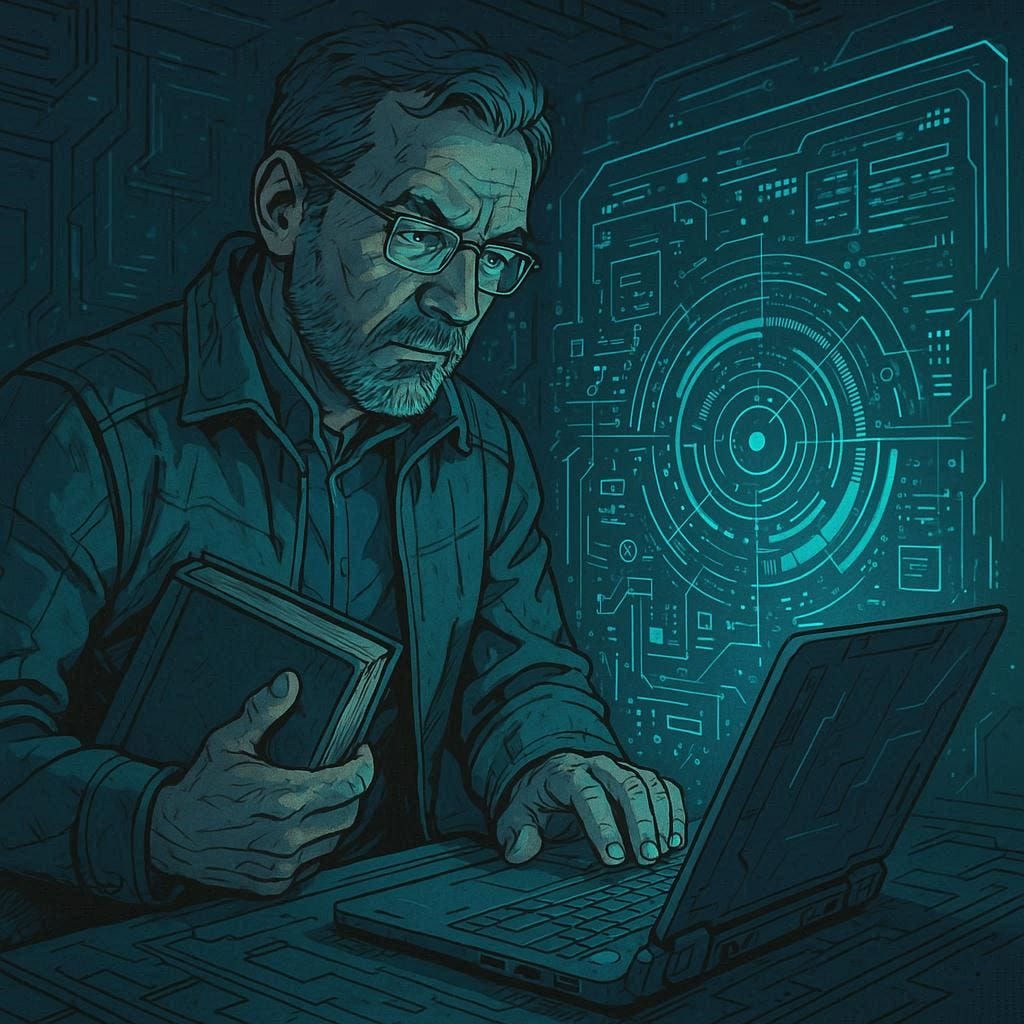
He picked up his worn, dog-eared copy of Neal Stephenson's Cryptonomicon. He had been enjoying the book and the human effort that it took to craft this story.
Before he could start the next chapter, there was a sudden ringing from his tablet. The caller was listed as anonymous, or at least not an account stored in his contacts. It was strange, he rarely received calls, but with a reluctant sigh he decided to accept it.
"Martin Lochte?" said the face of a young man with wild auburn hair. He was strikingly young.
"Yeah?" Martin narrowed his eyes.
"My name's Kevin Chen. You may have heard of me?"
Martin hadn't.
"Well anyways, I've got a problem. And everyone says you're the guy for this kind of stuff."
"What kind of problem Mr. Chen?" he asked calmly, a stark contrast to Kevin's frenetic energy.
"I've got ransomware. Millions of users in our database have lost their data! Our entire metaverse platform has been deleted. The launcher just streams messages about Bitcoin and data exfiltration. We can't vibe this away, and believe me we've tried everything. Every flow, every prompt. None of it works. My lead architect was your intern once. He told me how you used to debug operating systems by hand, or something crazy like that. Said you understood the bare metal."
Martin placed his book down on his side table and a smirk played on his lips.
"The metal hasn't changed, only the layers of abstraction that live atop it. What is this metaverse platform of yours?"
"It's everything! A one-stop shop for our users to order food, visit health appointments, exercise, communicate, and more. It's built entirely on vibe code. Millions rely on it for their daily lives. We've got food shipments stuck, payments being declined, all kinds of things are borked. People are panicking."
Something in Kevin's voice had a genuine sense of desperation. While Martin couldn't easily empathize with those whose entire lives revolved around a digital world, it did seem like the impact of this crisis was legitimate.
"Alright, send me the server access instructions. But keep in mind my rates for cleaning up 'vibes' are not low."
"Thank you, Mr. Lochte!" Kevin said breathlessly. "Oh thank you! Whatever you want, just name it! We'll send a runner immediately!"
Martin pulled up a document on the tablet, his personal playbook, he'd refined over many years and many crises. He also grabbed his wireless keyboard and placed both in his bag.
The runner, an autonomous drone, arrived half an1 hour later holding a USB drive. Martin, after checking it with a portable malware detector, plugged it into the tablet's dock. The drive held one file containing the encrypted access keys.
Then, he followed the drone to Kevin's headquarters. The building was massive, somewhat unsettling to Martin. Nestled within a reclaimed industrial zone now bloomed with vertical farms and solar panels. The building itself seemed to blend in with the surrounding nature. The interior was bathed in natural light and indoor grass. Everything struck him as being openly opulent. Vast, open spaces seemed to be designed for aesthetics rather than function, the epitome of "vibes".
Kevin met him at the entrance and could hardly contain himself. "Mr. Lochte! It is incredible to meet you! Come, come. The war room is just over here."
The "war room" was a large space resembling a cave dominated by a colossal, curving screen that displayed intricate patterns like a constantly shifting kaleidoscope. It was the visual representation of the metaverse's vibe code.
"This is the entire platform rendered as a flow state. We call it our Synaptic Thread. Users interact directly with our Intention Nodes and the system self-organizes the underlying behaviors. It's meant to respond in realtime to the emotional needs of the user. But right now... do you see those red tendrils? That's the ransomware. That's a really, really bad vibe."
Martin walked a little closer. He didn't see any data structures or legible API calls. There didn't seem to be any sort of network topology he could assess. It made him wish for the elegant intentions of Assembly. This was just a mess that refused to be analyzed.
"Where are the actual lines of code? Or data packets? Or even a syscall" he asked the group, trying to hide his revulsion.
"Oh we abstract all that away," Kevin chuckled nervously. "That's the beauty of vibe coding! You don't get bogged down in the minutiae. You just say your intentions and your outcome and our metaverse's self-optimizing interpreter will figure out how to accomplish that. Like, if you want food delivery, the system vibes up the entire logistical chain."
Martin rubbed his chin. "So, when a malicious actor introduces a 'bad vibe', you have no direct visibility into what it's actually doing at the machine level?"
"Well, not in the traditional sense," Kevin stammered. "We just re-vibe the network when that happens. Re-harmonize flows. But this one has been persisting. And it re-establishes itself every time we try to form another release."
This was worse than Martin thought. He grabbed the tablet and connected it to a data port in the room along with the USB drive. He started typing on his keyboard, feeling the satisfying click underneath his fingers. Kevin and the rest of the team sat there with a quiet anxiety.
Martin opened up a terminal. Nothing but a console and his keyboard.
He stared with a network traffic analysis. He looked for raw packet captures and the streams of data being sent in and out. Then, he looked at the system logs for any anomalies. He checked for privilege escalation attempts or unusual processes running in the background.
Kevin watched fervently as Martin ignored the flashing vibe-displays and focused intently on the dense, monochrome text.
"What is all of that?" he asked curiously.
"The bytes. Every single one. That is where the truth lives. Not in how it feels."
Hours passed as Martin studied the system at a granular level. The frantic energy of Kevin and the team slowly faded to a weary silence, punctuated only be clicks on a keyboard. He ignored the numerous vibe coders who peered over his shoulder and their unhelpful advice.
His computer science and network forensic background started to yield results. He noticed some TCP/IP packets were coming from within the core of the metaverse's logic. The malware seemed to be highly sophisticated, and it seemed to be originally introduced a week ago until a signal earlier that day caused it to ramp up in intensity.
Martin scanned the dependency graphs until he found a single line of code that raised a red flag.
"Found it," he muttered.
"The bad vibe?"
"A deliberate piece of malware. It's not a simple exploit. It's a supply chain attack. Your metaverse platform pulled in a dependency a week ago. It seems to be labeled as a seemingly benign bio-resource management library to help with your virtual community garden."
"Yeah, that was the Verdant Nodes module. It's super-efficient. It was the best one recommended."
"Efficient, sure, but very compromised. It was a cleverly obfuscated rootkit to exploit your permissive security model. Every time a user wanted to vibe some plants, the rootkit woke up and ran more of its attack. It's been silently establishing more backdoors and stealing your data to a remote server."
"But how? We scan everything through our vibe auditor."
"Vibes can't detect zero-day exploits or polymorphic code. This rootkit was intended to bypass a simple check by bundling itself with useful code. If someone had inspected the dependencies before being installed... but now it's buried pretty deep in the network."
"So it's over? We can't do anything about it?"
"I have a patch right here," Martin showed a tight block of Assembly, less than twenty lines long. "This will precisely snip out the affected blocks of the container file system and remove the rootkit's persistent hooks from the kernel."
Kevin didn't understand anything that was said as Martin deployed the patch. The command line didn't show any bright colors, but after a few minutes it just printed out the word "Done".
The red tendrils wrapped around the colossal holoscreen began to recede, replaced by the vibrant patterns of a normal metaverse network. The looping ransomeware message vanished from user devices. The database appeared with everything preserved.
"It's gone..." Kevin whispered. "You fixed it, just like that."
"Intuition is a wonderful guide, but it's not a substitute for meticulous attention to detail when people depend on it."
Kevin simply nodded. A silent acknowledgment passed between them.
The consultancy fee that landed in Martin's secure digital wallet was substantial, a perk of having rare, foundational knowledge in a world often blinded by surface-level innovation. Most of that went into his long-term investment account.
He found his paperback still on the side table with the bookmark tucked halfway through. He knew that the era of the low-level software engineer, the kind where he learned his skills, was largely past. THe industry had moved on, driven by speed and abstraction. Yet he knew that a deep understanding of the fundamentals would always be indispensable. He found a new niche.
He settled into his armchair and opened up the book. As he read about fictional code-breaking and historical intrigue, he felt a sense of peace. His life was richer than before, no longer just another worker but a specialist whose skills were found more valuable than in the past.