

The Weaver of Ardahan
Amelia thought about all of the tourists coming through the Rawls Museum. She thought about their sense of awe as they looked up at light shining through the sunroof, scattering through glass-thin flowers to create a mosaic of colors on the tiled floor. She thought about their sense of artistic community as they observed illuminating galleries depicting the past and future.
She couldn’t see any of it herself though, as she was relegated to the soft whirring of a server room where her desk was shoved in-between two racks.
It was here that she leaned over a painting placed on a workbench with a small drone helping to magnify the details of the masterpiece. The Weaver of Ardahan was painted by Vardan Gasparian long ago, depicting his wife working steadily at her loom with a stoic look. A year after it had been finished in 1914, they had to flee due to horrific purges. During the chaos, the painting had been slashed. A large diagonal cut went through the top-left corner of the tapestry, leaving a missing section in the frame.
“She’s ready for the magic,” Rufus came in with a bright voice.
“It’s not magic, Rufus. It’s a simple artistic infill algorithm,” she retorted as she stretched her back.
“That’s all semantics. Look, I’ve trained her on Gasparian’s entire catalogue. It knows his strokes, his use of pigments, and other kinds of Armenian art from that time period.”
“It’s basically a collaborator. A recreated version of him.”
“We can finally fix this tapestry to the best of our capability. The art world will be enraptured by this.”
“For good or bad.”
The idea of using an algorithm to paint was controversial, to say the least. Yet the museum’s mission was explore the hidden worlds of art using whatever tools were available, including technology. In a way, this was supposed to enhance preservation by returning the painting to the artist’s original intent.
“Let’s run a projection before committing to anything. Just to check.”
Rufus run the sequence and the AI began its work. On a large monitor beside the workbench a flurry of pixels began to fly onto the screen. Drawing upon its trained dataset, it started choosing colors and dots. It flawlessly replicated Gasparian’s brushwork, how he captured the way the light struck the wool and the subtle imperfections in the hand-dyed thread.
Amelia watched with a professional curiosity. It was technically brilliant, exactly what she expected. The artificial brush strokes blended perfectly across the tear to fill in the remaining corner.
“Isn’t that a perfect fix?” Rufus asked.
In just a minute, the AI finished the restoration. The slash had vanished and there was now a whole tapestry. Amelia was about to answer Rufus’s question but the AI was still working. Small lines started to appear within the new section. They were finer than the standard brush strokes.
“What’s it doing?” she leaned in closer.
“There’s a second pass for consistency. Gasparian’s brushstrokes had subtle changes in the pressure around this damaged area, so there might’ve been some under-layer. It’s trying to balance everything out.”
The lines it was drawing weren’t random. She could see it forming curves all intersecting with each other. Amelia squinted harder. Were these numbers? The symbols were definitely not part of any Armenian style that she was familiar with.
“Can you stop the program?” she whispered. “Can you enhance those secondary lines?”
“Got it,” he said, his demeanor now serious.
The original tapestry faded out of view, leaving just the faint lines that now were clearly visible. It was a map. She could see the contours of topography and a market location. She was surprised how well Gasparian had managed to disguise that within a painted textile.
Somehow, they had uncovered a secret that had been laying out of sight for over a century. The room was entirely quiet aside from the soft whirring of fans.
“That’s a glitch, right?” Amelia whispered, her throat suddenly dry. “Your algorithm created a false positive. It hallucinated a pattern that wasn’t really there? We just report to the acquisitions board the machine restore failed and we try doing it by hand.”
“No,” Rufus’s eyes were still wide. “Look at the detail. Look at those contours. That’s consistent with early 20th-cemntury cartography. Those look like coordinates. The AI actually managed to find these pigment variations in an underpainting. We never would’ve been able to figure that out if done by hand.”
“Your algorithm is just guessing. What does it even have as a basis? Some bad sensor data?” she argued. “We can’t tell anyone about this. Would they actually believe it? We’d be laughed out of every artistic preservation community. Seeing a treasure map in an old painting? I wouldn’t believe it.”
“Reputation isn’t everything,” he countered. “The Rawls’s charter... I mean our entire careers here have ben about the ‘uninhibited pursuit of knowledge’. We are supposed to empower our guests to look deeper, why not ourselves? Can we really ignore it just because we’re scared of what the board might think?”
Amelia scratched her chin. The museum’s core philosophy was about academic and scientific freedoms. That was what drew her to this place in particular. They were always encouraged to use new tools and to experiment, just like they were doing now. She looked down to see the earnestness of Rufus’s face. She had to admit he was right. They couldn’t turn away now.
“Let’s investigate this, but quietly. Build a case before we tell anyone. And do it by the book.”
“I’m ready to investigate.”
Over the next three days, the small space became even more cramped. Amelia pulled all the museum’s archives on the artist, both digital and physical. A pile of books and assorted documents became an eyesore. The name was Ardashes Gasparian, not Vardan. Apparently he had changed his name when he entered the world of art, according to the archive’s definitive biography. He had been not just a painter, but a prominent liberal intellectual in Ardahan.
That was until 1915. The historical records detailed in chilling detail how Ardahan became a flashpoint of violence. There were forced deportations. Many families were given just a few hours to gather what they could before they were sent out on a march south into the desert of Syria. The historical lists included Ardashes and his wife, the weaver in the painting. They also had two young sons.
“But then if you cross with this other document, a list of all the resettled recorded in the camps, they never made it,” Amelia said with a deep melancholy.
“Some letters from others who arrived say that the family got lost as they passed through the highlands,” Rufus read carefully.
“So he knew the deportations were happening,” Amelia remarked after a moment of silence.
“Does that mean Gasparian planned for it?”
“Let me re-train the AI. We can scan the rest of these documents. The personal journals and letters from our archives so we can check if there are any other hidden clues in how he wrote.
As the AI began to ingest terabytes of text, Amelia decided to pull up satellite images and compare that to the map they’d uncovered in the painting. When she overlaid the AI-produced map over a topographical representation of the Ardahan region as it may have been a century before, she realized it was a perfect match.
“Look at this,” she whispered to him. He spun his chair from his supervision of the AI to see what she was pointing at.
“The lines on his hidden map match perfectly with these remote, rocky hills thirty kilometers south of the city.”
“It doesn’t look like there’s any structures or even farms there.”
“Exactly. It’s a place you wouldn’t go unless you were trying to hide something.”
Their conversation was interrupted by a ping from the workstation.
“The AI found something,” Rufus spun back to read what was flagged. “There is a recurring phrase Gasparian wrote in his journal in the later months of 1914. ‘I must leave a part of myself behind... a seed planted in stone... so that the song of the weaver echoes into the future’. It’s written a dozen times.”
A seed planted in stone.
Amelia looked at the map again. It was a clear message from Ardashes. As he was facing the imminent erasure of his people and his culture, he had decided to push back by hiding his work for someone in the future to discover.
“All the paintings we thought were lost to time had actually been intentionally hidden,” she realized.
Amelia looked at the map, back to the original painting. She looked at the face of the weaver on the easel, someone who must have been full of anxiety about the future. The next step was clear.
“We go to Ardahan,” she decided.
The approval for their trip came quickly, but it wasn’t easy. Amelia decided to not even mention their treasure map. Instead, she framed the proposal using the academic language of a research grant. She mentioned the cryptic writing in Gasparian’s journal and the AI analysis of his underpainting technique.
The funding was requested to study on-site the “potential material degradation” in a “geologically distinct region”. She was familiar with the kinds of language that would most appeal to the board, and at no point did she technically lie. The special projects committee encouraged this kind of bold research through their endowment, and the budget was relatively low compared to other things they funded.
Amelia felt a jarring transition as the two of them stepped off the train into the dry, arid air of Kars. It was the closest major city they could reach. The city still felt like the cities of her youth, filled with the scent of diesel but also strong coffee.
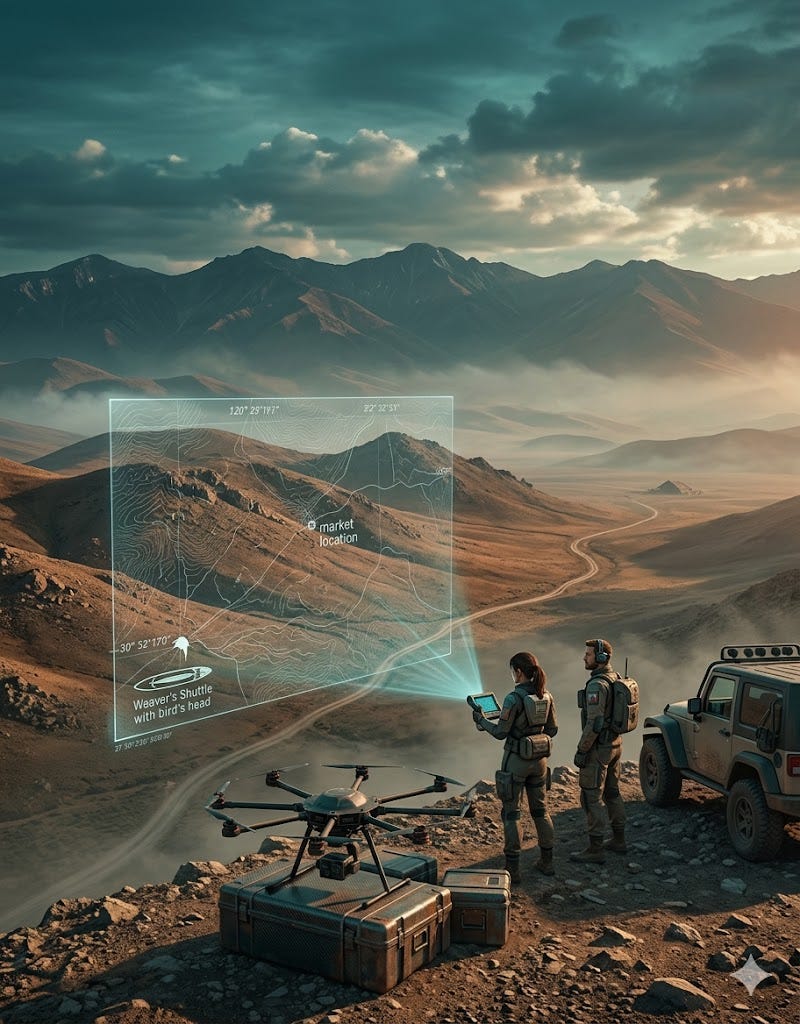
From there, they had to rent a jeep and drive south. Rufus was handed the keys to a gas jeep. It was the first time he’d ever driven something that wasn’t powered by an electric motor and battery. As they left the city, the road quickly turned into rough gravel roads which wound their way through the vast highlands of Eastern Anatolia.
Amelia looked out the window at the landscape around her, so large and vast, yet also so empty. A sea of sandy-brown hills stretched out in all directions underneath an immense blue sky. The land seemed so special to be so untouched after millennia, and Gasparian likely felt the same way when he walked across these same paths.
“I saw these exact hills from the satellite images, but it’s just quite another thing to actually be in the midst of it,” she remarked. “The place feels so vast. So endless.”
“You’re not kidding, we’re basically in the middle of another world,” Rufus continued to keep his eyes on the narrow road as they bumped over some large stones. “The cell connection is spotty out here. It’s like we’re in another time period.”
As their drive continued, the scale of the region only grew more oppressive.
“What if there’s nothing out here?” Rufus asked as he flicked on the headlights around sunset. “What if his ‘seed planted in stone’ was just some sort of local phrase, or a bit of poetry? We’d be all the way out here for nothing.”
“Gasparian didn’t seem like someone who wasted words,” she replied as she rolled up the window to keep out an approaching rainstorm.
“It was written over a hundred years ago and run through a translator. We can’t be sure it wasn’t a glitch.”
“We thought the map was a glitch too, but it was right,” her voice grew firmer, more confident. “Gasparian saw what was coming. He wouldn’t have produced a map of that precision just for a moment of poetry. We need to trust him.”
They spent that night in the jeep, at least a hundred miles away from civilization. Amelia climbed into the back and tried to get herself into a comfortable position on the aging leather seats. Rufus had a restless night, his back leaning against the console and the parking brake in a way that left him sore in the morning. They ate Twinkies and energy drinks for breakfast.
By the third day, Rufus’s drone flew ahead of them and broadcast that they found the location they’d been seeking. He drove them over there. There was a small, stony outcrop which seemed unremarkable at first glance. Yet they saw long vines and overgrown thistle were hiding a small shepherd’s hut.
Their hearts pounded as Rufus turned off the car. They got out and began to climb the small hill to the hut. The roof had caved in a long time ago and the walls were barely held together. Time had not been good to the structure.
When she peeked her head inside, she felt her excitement turn to disappointment. She couldn’t find anything inside but dirt and rock. There wasn’t any sort of cellar door.
“Check the coordinates,” she urged.
“This is the spot,” Rufus’s eyes jumped between the original map and the drone’s bird-eye view.
Amelia ran her hand along the rough stone of the remaining wall. She felt the dampness, the lichen that had grown in the weathered cracks. Then her fingers brushed against a different feeling. She looked at a series of carved lines hidden in the stone near the floor. It was too deliberate to be more erosion.
“Rufus, give me a light,” she dropped to her knees and began pulling up weeds.
His powerful LED torch was turned on, illuminating the carving. It was a simple image of a weaver’s shuttle with a bird’s head on top.
“I recognize this from the archives,” Amelia gasped.
She unfolded her phone and opened the artist’s biography. She jumped through several pages until she found what she was looking for. She double-tapped on it so it could take up the full screen. It was his maker’s mark during his early years before he took on the name Vardan.
Rufus looked at the phone and then back at the stone block with the carving.
“You know, this stone doesn’t seem to be load-bearing,” he remarked.
He pushed against it, throwing his shoulder into it with a lot of force. He let out a groan of effort as the stone shifted inward a few inches. Amelia took his torch and looked down, revealing a narrow opening into the darkness below.
Amelia immediately got a whiff of damp earth and moldy air that was probably hidden below for over a century. The torch flashed over a short flight of steps carved out of stone leading down somewhere.
“Well?” Rufus said from behind. “This is your world. You should go first.”
Amelia took a tentative step. The stone, though old, still felt sturdy. She descended step-by-step, making sure that the ground wouldn’t give out underneath her. The space below the hut was a small cellar which looked to be dug by hand. The walls were lined with fieldstone.
When she saw objects against the far wall, her breath caught in her throat. Dozens of them were laying there in different sizes. Each one had been carefully wrapped in dark cloth and twine.
Amelia touched the first one. With a light grasp on the edge, it instantly confirmed what she thought. These were paintings.
“He actually did it,” Rufus whispered as he entered the small studio behind her.
They found the seed planted in the stone. It was more than just one painting. They had uncovered an entire lifetime of work. A whole new cultural legacy had been rediscovered that had refused to be eliminated. Amelia’s fingers trembled as she gently worked the knot loose and peeled back the heavy canvas around it.
The painting was vibrant, and in remarkable condition. If it had been finished just yesterday she’d believe it. They were staring at a moment in time, a bustling market in the heart of Ardahan before it had been wiped off the earth. Rays of sunlight beamed from overhead, illuminating the merchants, children, and musicians. It was a scene of understated joy.
“Incredible...” Rufus murmured.
They opened another, then another. One was a portrait of Gasparian’s two young sons. They had bright faces and an innocence of youth, before their futures were stolen. Some were landscapes of the hills they had just crossed, images of staggering beauty. They seemed to be painting in the springtime, even more lush and colorful than they could see today. Each canvas was a piece of world lost to time. But they could finally, for the first time, truly see the struggle that Ardashes faced against the forces of history.
A team of volunteers were put to work over the next month. Slowly, and delicately, they documented each painting and noted any potential restoration requirements. Then each was carefully packed for its journey to the museum. They had to keep the entire thing secret until they were ready to share the story.
When they debuted the “Lost Collection of Ardashes Gasparian”, they finally told the story of the artist, the genocide, and the map they discovered.
The galleries were filled with guests eager to participate in this historical event of art preservation. Once they were full of gourmet cheeses and champagne, Amelia walked up to a podium. She looked up at the bright moonlight shining through the skyroof. Rufus stood beside her, offering her quiet support.
Amelia cleared her throat and began to speak.
“To paint is to capture a memory. Tonight, we are observers of memory, but also the destination of those memories.”
She continued, telling the story of Gasparian, his flight, and his plan to hide his paintings for future artists to find.
“He faced a force in his time and place that wanted to erase him and his entire culture. He managed to outlast them. He put his trust in a future that had the tools and the humanity to find him.”
She looked back and Rufus, who gave her a cordial smile.
“That future is today. Technology is now a partner in human endeavor, revealing a path for us to follow. We were able to hear a defiant message that was waiting over a century for our ears.”
Then she walked away from the podium to a large piece of parchment on the wall. She peeled it away to reveal the final piece of the exhibit. “The Weaver of Ardahan” had been fully restored and hanging in a place of honor. The intricate map had been recreated in that lost corner, allowing everyone to see how the fusion of AI and art could provide greater insights than either one individually.
Late that night, as the crowds were on their way out, Amelia and Rufus stopped in front of the painting again. The weaver’s face had once looked to depict stoic sorrow. But now her expression seemed to change. She seemed to have a profound sense of peace. The tapestry on her loom had been completed and her story had been finished.
“The weaver’s song is complete,” Amelia said softly.
“He just had to wait for the right people to listen to it.”
This story is based on an article in Nature about restoring art using AI. When you visit a museum, the paintings they have on display are a small fraction of their total collection. Many have to be restored before showing off, and that takes time and money. But if we can make this work much faster, what kinds of history might be uncover?