

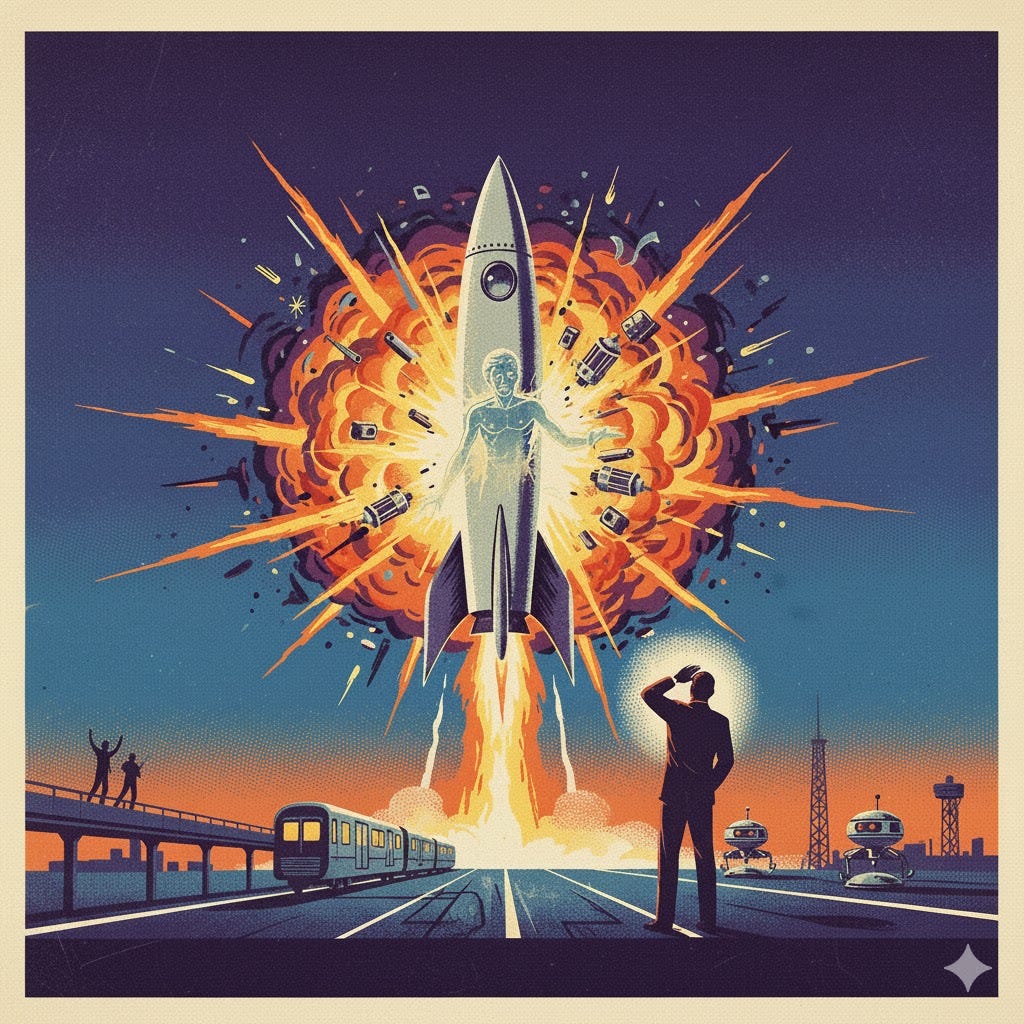
Spencer Owens was sitting in his office, looking out the window at the grand main street of Rocket City. He had cracked it open just a bit, letting in cool air all too rare this side of Texas.
As passengers raced by on the city’s light rail, there was a knock at his door.
“Dr. Owens?” a junior technician began tentatively. “We’re seeing a two percent deviation in the tertiary modulation array. Should I initiate the recalibration protocol?”
Owens, without turning around, scoffed.
“Recalibration? Are you still reading archaic manuals so strictly? The array tolerates a five percent fluctuation. I designed it to be robust, not fragile. I swear, so few people actually have an understanding of fluid dynamics.”
He turned around, looking right at her startled face.
“Don’t waste my time, nor the company’s resources, with these tiny deviations. My engine design isn’t temperamental. It’s a precisely engineered system. Get back to work and trust the system.”
Her face grew flush and she disappeared muttering apologies.
Owens just grunted and returned to his calculations, not having the time to deal with the trail of frustrated colleagues left in his wake. He was the technical lead for the groundbreaking propulsion design that would revolutionize space travel, bringing down costs. That was why he was hired. That was why he moved to Rocket City.
That city’s peace was then shattered.
Junior technicians ran down the hall of the R&D complex. The sound had come from an autonomous cleaning bot as its optical sensors discovered something that warranted alert: Dr. Owens lay near the main fuel reactor. A single, jagged fracture to his skull was surrounded by a pool of blood. Initial scans confirmed what they already knew: he was dead.
The emergency call jolted Chief Terry Burke from a deep dive on an ongoing spearphishing campaign targeting Gravita’s orbital satellite network. Terry was the head of security, someone familiar with algorithms and digital forensics. His day-to-day was fighting in the ethereal realms of cybersecurity. His usual foes were ransomware and rogue AI attacks.
Now, he stood over a cooling corpse with the odor of death assailing his nose.
“Initial assessment, Chief?” asked a nervous junior officer, his voice droned out by emergency sirens growing louder.
“Localized impact. No signs of forced entry. This wasn’t an external attack. It was internal.”
His gaze swept over the meticulously clean lab and settled on a small round indentation in the floor near the reactor It looked like the footprint of a heavy, pressurized object.
Suspicion almost immediately gravitated towards Dr. Tommy Dixon. Dixon was the head of a rival reactor project and known for his heated philosophical and professional clashes with Owens. Their last public argument had been the day before in the communal dining room, and had been so intense it silenced the entire room.
The sterile scent of the forensics lab clung to Terry’s uniform. He was familiar with security in the domain of cybersecurity, but now the vulnerability was flesh and blood. It was real.
The investigation began in a minimalist interview room in the main R&D complex. The walls were a sky blue that did little to calm down his first suspect. Dr. Dixon sat rigid with his hands clasped tight on the table.
“Dr. Dixon,” Terry began, “you were seen arguing with Dr. Owens just yesterday. Can you speak about that?”
“It was just a professional disagreement,” Dixon bristled. “Nothing more. Spencer is... was... stubborn. He was his fuel reactor as the only path, oblivious to its inherent risks. My project is the truly sustainable option. We merely debated methodologies. I was in the catalyst lab all night running simulations. I have logs.”
His alibi was too neat. Almost rehearsed. Terry wrote it down on his tablet while noting the slight tremor in Dixon’s hands. Was it from anger, or fear?
Feeling a growing frustration with Dixon’s evasiveness, Terry decided that digital forensics could wait. A human crime required human observation. He left the R&D complex and got onto the light rail.
The Rocket City Transit Authority was the continent’s largest privately operated transit system, serving the employees of Rocket City and their family. Sleek silver cars glided silently along with magnetic levitation, powered by the vast arrays of photovoltaic cells shimmering around the city’s borders.
As the car whisked Terry through the town’s main thoroughfares, the planned beauty unfolded, The townhouses, arranged in crescent arcs and hexagonal clusters, were clad in self-cleaning smart glass and living walls of native Texas succulents. Each house boasted windows that doubled as solar panels and efficient rainwater recovery systems on the roof.
The residential blocks were interspersed with community garden spaces rather than manicured lawns. These were sophisticated planned parks with native plants and wooden playgrounds. Children laughed and played in these green spaces as maintenance drones quietly tended to the plants.
Most days it was like a utopia. And Terry now had the obligation to keep it that way.
Terry disembarked at the ‘Outer Rim’ station, a less polished part of town that was once the initial seed of construction. These townhouses, the pilot homes, felt a little more lived-in now. There were fewer limitations on what décor were allowed outside. This was where Aubrey lived.
His townhouse was easy to spot. A custom-built e-bike with a cargo wagon leaned against the front porch while a patch of wild, unkempt native grass grew amidst the otherwise tidy yard. Inside, the air was thick with the scent of grease and soldering fumes.
“Chief Burke,” Aubrey grunted, gesturing to a worn leather couch. “Heard about Owens. Not surprised, honestly. That man was a walking disaster waiting to happen.”
“Did you have any recent encounters with him?”
“He canned me! Because I dared to question his genius,” Aubrey resented. “I told him his reactor conversion rates were unstable in high-pressure conditions that could easily happen in the upper atmosphere. He called me an alarmist and said I lacked vision. I didn’t need a vision, I had hard data! My own simulations showed it could be catastrophic. He just buried my reports and was obsessed with cost-cutting.”
“He fired you just for disagreeing?”
“I blew the whistle! I had to! He was cutting corners. But he just used that as further evidence that I wasn’t a good fit for the company culture. I was one of the first employees! That’s why I live in Outer Rim.”
“So the reactor is still dangerous?”
“Anyone else could’ve figured it out. Let me show you.”
He pulled up a schematic on his tablet. It seemed to be a diagram of the fuel reaction process.
“Look at this. I’ve been re-running the simulations on my own rig, just to prove I wasn’t crazy. If this component was stressed or altered, even subtly, it could lead to erratic performance. Even a catastrophic failure.”
“Isn’t that proprietary information? Should you be having that?”
“Owens wasn’t a good manager. He fired me but didn’t take back my company laptop or cut me off from servers. Not getting a paycheck though.”
“Owens should’ve told me to cut you off.”
“You should be lucky I have this. Owens is dead. Do you want more employees to be at risk?”
“Don’t tell anyone else about this. I’ll let it slide for now. One thing at a time.”
Terry sought the city’s postman, Caleb, at the town’s central mail hub. Caleb, as he did every day, oversaw a fleet of small delivery drones and was loading a few last-mile packages onto his own electric cargo trike. Caleb was an institution unto himself, a friendly man who seemed to know everyone and every rhythm. His weathered face always seemed to have a smile on it.
“Chief Burke, what can I do ya for?” he chirped as he was waved down on the road. “Heard about Dr. Owens. Tragic. I’m sure you’ve been having a bad day.”
“It’s definitely not been my favorite.”
“Well, let me know if there’s anything I can do. I’m always happy to help.”
“I’d like to ask a few questions. You seem to get around a lot every day. Did you notice anything unusual yesterday near the R&D lab? Any strange vehicles, unfamiliar faces?”
Caleb stroked his chin.
“Owens always had a parcel for delivery. It’d be special orders usually, like components from off-world. My route takes me right past that R&D wing every morning. I saw Dixon get off the light rail earlier than usual, just before 0700.”
“Was he acting differently? Was he by himself?”
“I do remember seeing something odd. There was a delivery drone, but definitely not one of mine. It was one of the older industrial models, exiting the R&D service entrance. It was carrying a large, dark container. I think it was a hazardous materials package, but it was unmarked. And it couldn’t have been logged on the usual manifest. I know the company does classified transfers sometimes, so I didn’t think anything of it at the time.”
Back in his command center, Terry brought up the clues on his tablet and tried to piece them together. Dixon’s early arrival, the unlogged drone delivery, Aubrey’s warnings about cutting corners...
Terry pulled up the company’s internal network logs, focusing on the reactor’s secure servers. This was more familiar to him. He initiated an AI scan, looking for any anomalous activity. The murder might’ve been physical, but Terry suspected there were also some digital footprints that could explain why his reactor was targeted.
By connecting Aubrey’s theoretical simulations with the raw data of Owens’s project logs, Terry discovered something chilling. The stressed modulation circuit was precisely where Terry found an anomalous digital fragment. There wasn’t a brute-force hack, but a highly sophisticated, almost imperceptible modification to the fuel flow. The change was designed not to destroy the reactor outright, but to add critical inefficiencies. It was the kind of failure that would discredit Owens, ruin his reputation, and elevate a rival’s to the forefront.
The timestamps on these digital alterations precisely correlated with Dixon’s unique biometric key login, used for administrative access to the R&D network. Furthermore, that circular indentation now had an obvious purpose: the footprint of a specialized atmospheric-pressure modulator, a sensitive diagnostic tool unique to their advanced propulsion labs.
He pulled up the tool’s access logs. It had been checked out the day before the murder, and signed by none other than Tommy Dixon. He had not only tampered with the digital core of the reactor but physically used the modulator to simulate the catastrophic failure during his confrontation. It may have been a final, fatal demonstration of this supposed flaw. And the concussive force that had killed Owens was not from the reactor, but from this very tool.
Terry issued a company-wide alert for unlogged transfers and retrieved the flight path for that drone. It showed the drone departing from a secondary, unsecured transit depot on the edge of Rocket City, directly after Owens’s estimated time of death. The drone had been carrying the very same specialized atmospheric-pressure modulator. Dixon hadn’t just murdered Owens; he had used the equipment and then arranged for its discreet removal in an attempt to erase his presence.
A shiver went down his spine. Accidents could happen. Space travel had inherent risks. But this was a level of premeditated murder he didn’t actually think he’d find. But he did. And now he had to do something about it.
He had to move quickly. He marched to the astrophysics lab with two non-lethal security drones. He found Dixon there, currently calibrating new instruments with a look of scientific detachment.
“Dr. Dixon,” Terry stated coldly. “The atmospheric-pressure modulator. You checked it out yesterday. And the digital alterations to Owens’s reactor algorithms were timestamped to your biometric key. Throne’s death was no an accident, it was murder. The concussive force... the single fracture... it all points to that modulator, precisely calibrated to a lethal frequency. You showed him the flaw in his design, and then you silenced him.”
Dixon’s composure immediately fell apart. His face twisted with rage.
“He was going to ruin everything!” he roared, slamming his fist on a console. “His reactor design was a scientific abomination! Unstable! He was reckless, driven by ego and low-cost transport targets! He was a danger to this company, and to my future. My reactor design was the responsible path. He was a blight on everybody, so I had to stop him!”
Terry frowned. He signaled the drones to move in. Dixon then made a desperate lunge. Taken off guard, Terry was thrown to the floor. He watched as Dixon ran to the exit. He barked out orders, but Dixon was driven by adrenaline and weaved through the sterile corridors.
Dixon ran past stunned employees and burst out onto the tarmac. In front of him was the Astraea F4, an experimental single stage rocket. It was smaller than the traditional commercial launchers but designed for rapid, uncrewed deployment of small payloads. It stood on the auxiliary path with its pre-flight checks chirping unaware.
Its launch hatch was open, a tantalizing escape route. He didn’t have time to second-guess. He scrambled up the gantry with a hope to take refuge to an orbital station overriding all other reason. He disappeared into the gleaming white hall.
As Terry slowly followed Dixon’s path, he heard an alert come over his radio.
“Chief Burke, we have an unauthorized launch coming on Pad Thirteen. The F4 is experimental. It’s guidance systems aren’t calibrated for manned flight!”
“Stop the launch!” Terry demanded as he stepped outside onto the tarmac.
“It’s too late! Dixon has already overridden the automated safety lockouts.”
The ground underneath Terry began shaking. The F4’s engine ignited with a bright column of plasma beneath it.
Slowly at first, then with terrifying acceleration, the rocket lifted off its pad. It climbed into the sky with a streak of white against the blue Texan sky. For a moment, a fleeting, desperate hope might’ve flickered in Dixon’s eyes.
Then Terry saw a series of bright, erratic flashes. He shielded his eyes.
“What’s going on?” he asked to one of the ground crew.
“That rocket wasn’t authorized for launch. It was being worked on for an advanced demo. Owens had developed a new reactor design.”
With a final flash and a concussive boom, the escape had been prematurely halted. A shower of glittering debris rained down, a fiery punctuation mark on a tale of rivalry.
For a few stunned moments, the busy rhythms of the spaceport ceased. Technicians stood frozen on gantries, security drones halted, and the light rail came to an emergency stop to assess the tracks. A thin, shimmering cloud was the only physical remnant of the desperate attempt to flee.
Terry watched it vanish with a deep, weary sorrow. The investigation was now closed. The murderer was identified, apprehended, and delivered a stark justice by the very technology he sought to corrupt. Yet, the human cost was undeniable. Two brilliant minds, however flawed, were now extinguished.
In the days that followed, Rocket City began to heal. Official statements were released, citing “catastrophic experimental failure” and “unauthorized access”, minimizing the true depths of the internal sabotage and the personal tragedy. Yet it was a necessary shield for a company built on trust and innovation. Cleanup crews carefully removed the scattered debris, keeping their promise to environmental integrity.
Terry found himself spending more time walking the town’s communal greenways, watching children playing and residents conversing. The physical world had brutally showed it mattered more than following algorithms online. Terry’s understanding of security had been irrevocably broadened.
No firewall or encryption could protect against the jealousies of the human soul. It was clear he had to develop a deeper engagement with employees and develop a more nuanced understanding of the social fabric holding the city together.
A few days later, in a confidential briefing for senior leadership, Terry delivered the final report. It included photographs and copies of data logs, images, and simulated trajectories.
“The evidence is conclusive. Dr. Spencer Owens’s death was the direct result of a targeted attack by Dr. Tommy Dixon. The motive was a professional rivalry and a misguided belief that Owens’s reactor project posed an existential threat to the corporation’s long-term sustainability goals. That would then clear the path for his own reactor initiative.
“Dixon used an atmospheric-pressure modulator to deliver the final concussive force, then attempted to flee in the F4 experimental rocket, resulting in its unforeseen and catastrophic failure, a direct consequence of overriding critical safety protocols on an experimental platform.
“This case highlights not just the vulnerabilities in our physical spaces, but the complex human heart that cybersecurity alone cannot address.”
There was one final slide: a simple, stark ‘CASE CLOSED’.