

Unboxing the Politico Slate
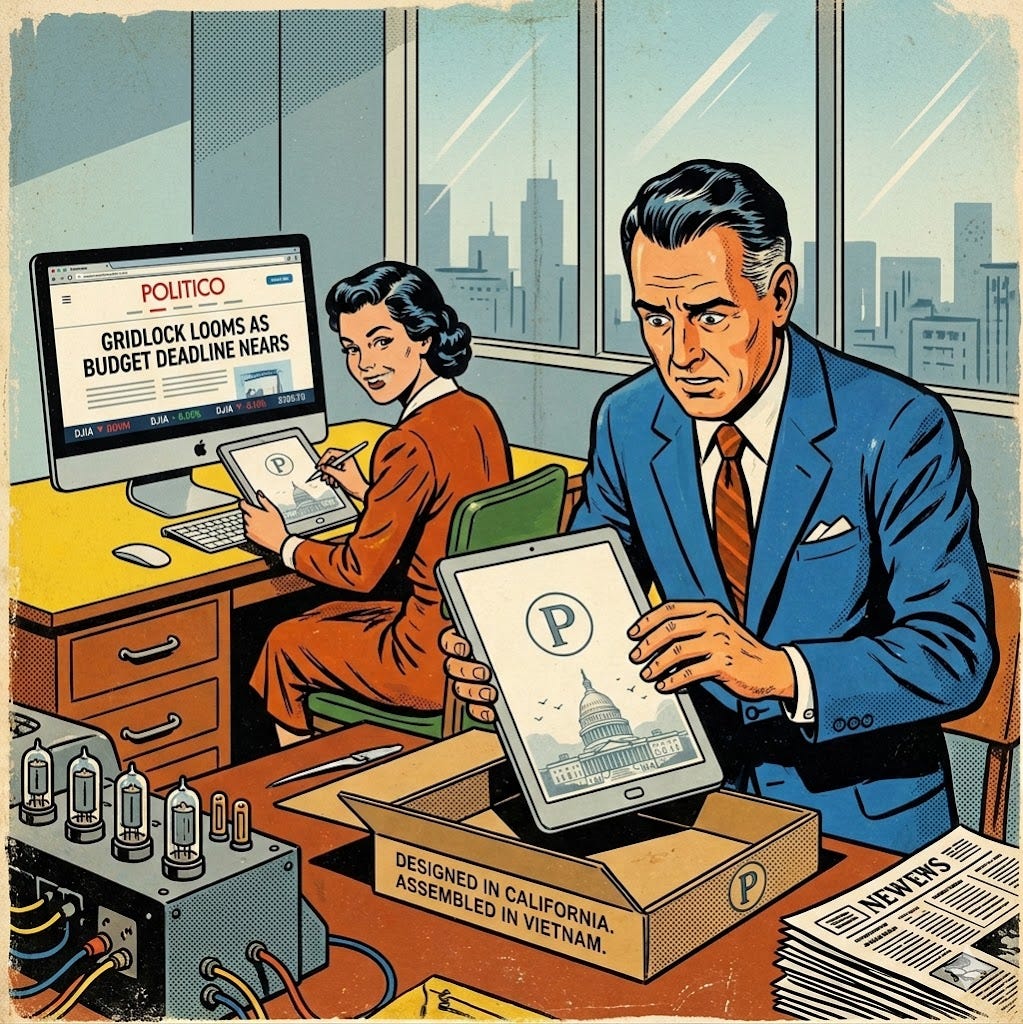
The mornings were quiet now, giving Mason a sense of eeriness as he sipped his coffee and watched the sun rise. Not long ago, paper editions of Politico would greet him with a satisfying thud on the floor and a quick knock on the door. The absence of such a critical outlet was not entirely gone. After all, their office still had their digital access which was available on all their devices. Yet it was too easy to get distracted by other notifications and the onslaught of social media posts. Now, what made Politico any special from the rest of the online noise?
But then, it arrived. A junior staffer came into the room with a box they had picked up from the mailroom. The box was simple and white with a stylized “P” on the front contained within a simple circle. It looked like something out of Silicon Valley than something produced by journalists. On the back it read: “Designed in California. Assembled in Vietnam.”
“Great, leave it,” Mason said, already dreading having to set up another gadget.
Senator Itzel came in at that point, passing by the staffer and nearly spilling tea from her mug. She noticed the box and asked, “The replacement?”
“I can set it up for you today,” Mason offered, but then heard the buzzing from his phone. He pulled it up. “It’s Senator Thompson’s Chief of Staff. Please excuse me, ma’am.” He jabbed the answer button. “Dan, what’s new? The tablet? I don’t know why they decided to stagger the deliveries. There aren’t too many of us who would’ve requested it. No, I’m sure the Senator is seething right now. I wish I could help.”
As Mason was busy with the call, Maria took the box and carried it over to her desk. She grabbed a letter opener and sliced through the tape sealing the box. When she lifted the lid, she saw the Politico Slate nestled in a molded cardboard tray. The tablet was 7 inches diagonally, making it resemble something like a Kindle or iPad Mini. She lifted it and was pleasantly surprised by how it felt in her hands. Not too heavy, with a smooth back, and a color eInk display that promised no blue-light glare.
She touched the power button, which doubled as a biometric scanner. The button had a satisfying click as it powered on. As the device booted, she found a small USB-C cable at the bottom of the box. That was good. There was no need for proprietary nonsense in such a niche device. She hoped it supported wireless charging as well.
“Dan, I assure you I’m frustrated too,” Mason’s voice faded away as Maria began to tap the device’s interface and set it up.
She entered her Politico credentials and connected it to the office Wi-Fi. She thought back to her old days as a teenage hacker, lurking on message boards and an avid follower of the Cult of the Dead Cow. Those days, the world of the Internet seemed so small compared to the systems of the press. But now, the line between those blurred more and more.
The screen came to life. The homescreen was clean, blending the elements of a news website and a tablet interface. Each section of the news site: Congress, White House, Defense, and others, appeared as large, tappable icons.
The background of the homescreen had a subtle animated image of the Capitol dome which implicitly showed the current season and weather, giving it a touch of elegance. Small birds occasionally flew across the screen, adding a bit of liveliness. The details seemed well thought out.
The very top of the screen was the top few headlines of the day. The main headline read: “GRIDLOCK LOOMS AS BUDGET DEADLINE NEARS.” The bottom of the screen was a dock with quick access to saved articles, settings, and a stock ticker. Right now it just showed the default Dow Jones Industrial Average, which was slightly down given the budget issues.
A notification at the top of the screen invited her to the system tutorial, to acquaint her to the device’s features. She ignored it, instead jumping straight into the settings menu.
It had all the usual options like Wi-Fi, Display, and Accessibility. There weren’t any more complex features, like being able to access the file system or see a list of apps. The thing felt locked down, like a single-purpose gadget meant only for reading Politico. But every system was built on a stack of technologies.
She scrolled down to see further options: About Slate, Legal Notices, Open Source Licenses. She tapped on the last one, curious to see what open source components were used in the device. As she scrolled through the list of libraries and frameworks, she felt a bit of nostalgia for the days when she used to build things without needing to deal with bureaucracy. Then, she found a line of text that caught her eye:
Based on Android Kernel Version 6.14.
That made a lot of sense. Android would’ve given them a solid foundation to base their software, but it meant that this was just a device dumbed down for a specific audience. But underneath the glossy interface, it would have a bootloader, a file system, and all other kinds of vulnerabilities.
Mason finally hung up and let out a loud sigh. He smoothed over his hair with his hand, as he was done trying to pull it out from the call.
“Senator, this whole Slate thing is a mess. Thompson’s office is claiming the whole thing is a surveillance tool. Several staffers can’t even seem to log in. It’s a logistical nightmare.”
He stopped, expecting the legislator to be upset, or to discuss the potential political implications. But Maria’s attention was now fully captured on the device. It was now connected to her office computer, with the cable as an umbilical cord, and her monitor was now a black command terminal. She was already busy digging into the system and testing its limits.
“Don’t worry about it. I think this is going to be incredibly useful,” she said, with an uncharacteristic grin spreading across her face.