

Visitors from Another Ocean
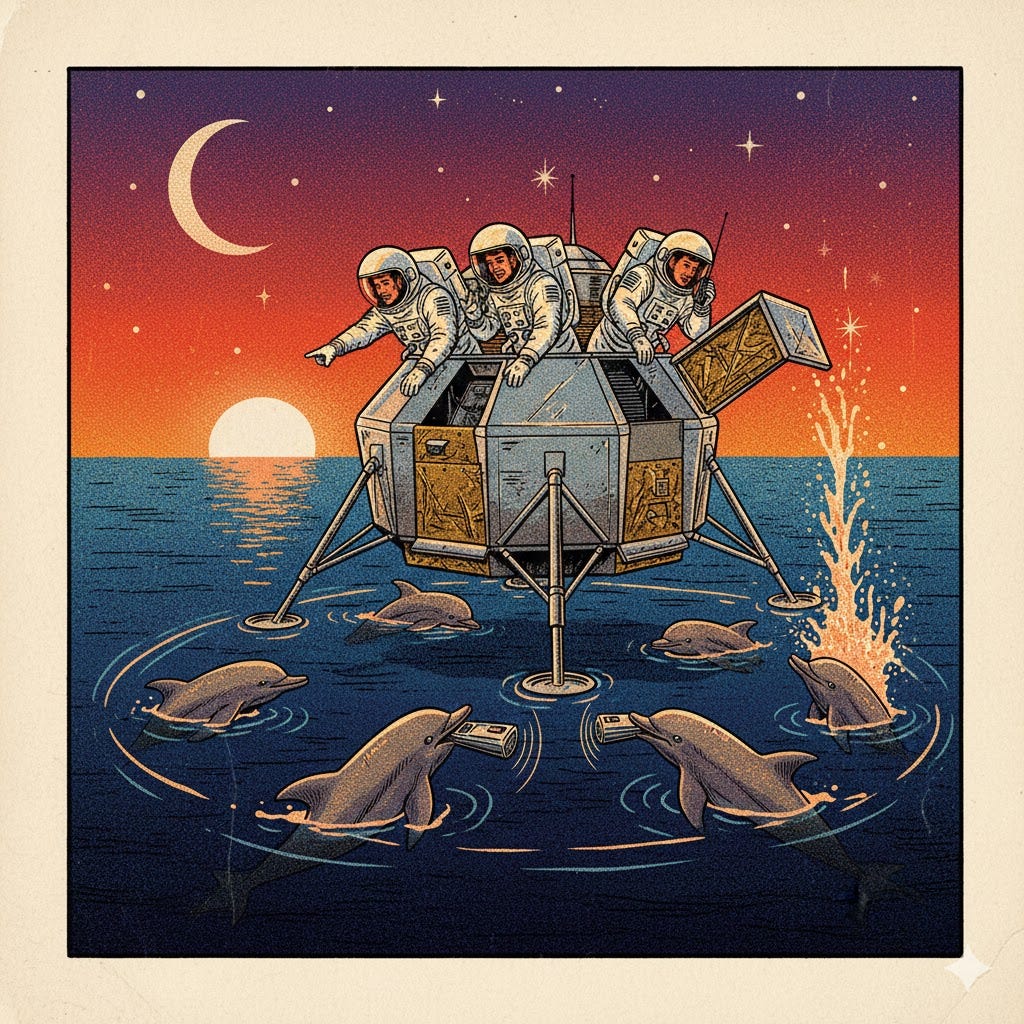
The Ares Comet splashed into the Pacific. It was a far cry from the dry, Martian dust they’d spent the last few months carefully studying and successfully sampling. Commander Ace Hudson’s heart still hammered in his chest feeling a deep relief they finished their mission despite the off-target return.
“I’m going to run through the final re-entry protocols,” he said to the crew.
The ablative heat shield had held, but the cyclone’s gale force winds had strengthened beyond expectations and threw them off course. GPS measurements suggested they were four hundred miles off course from their intended landing zone in the Baja California recovery area.
“Status report!” he ordered.
“All systems nominal, Commander,” responded Sienna, the mission’s xenobotanist. “Structural integrity is holding and water ingress is minimal.”
She frowned suddenly as she glanced out the window.
“Depth readings are stable, sir. We’re floating, but we’re not where we’re supposed to be.”
Becca Riley, the young engineer, let out a celebratory whoop. “Well we made it back! Earth! And Mars data in cargo! Anyone else eager for some fresh air?”
He was already moving towards the exit hatch with a giant grin.
“Hold on,” cautioned Dr. Marcelo Lee, the astrobiologist. He’d spent years searching for life beyond earth, and a little ocean splashdown after successfully confirming ancient microbial traces on Mars wasn’t going to phase him.
“Let’s confirm the atmosphere first. No point in trading Mars dust for ocean microbes,” he advised.
“Relax, Marcelo, we’re home!” Becca already engaged the manual release.
With a hiss of depressurization and the groaning of metal, the hatch popped open. He was struck by a gust of humid air. The crew members leaned into it and took deep, grateful breaths of fresh air that replaced the recycled oxygen inside.
The sight outside was breathtaking. The sun was dipping into the horizon and the sky was a fiery orange that reflected in the ocean around them.
And then they saw them.
A pod of bottlenose dolphins were circling the lander. They breached, their powerful tails slapped the water, sending spray into the air. One of them, larger than the others, was looking directly at the open hatch.
“What?” Becca exclaimed, forgetting all caution. “Look at them! They’re checking us out! This rocks, what a welcome home!”
“They’re unusually close. And coordinated,” Sienna, initially captivated, squinted. “Most wild dolphins would avoid such large objects, especially ones that fell from the sky.
She hadn’t studied cetaceans extensively, but even her general understanding indicated this was strange. She knew dolphins were smart, but in an animalistic way.
“Guess we’re the new tourist attraction,” Ace smiled. “Better than being Martian microbes, right Marcelo?”
After months in vacuum of space, completing their primary mission, the playful spectacle of these creatures was a welcome distraction. His previous anxieties about planetary contamination and recovery logistics was forgotten for a moment. He was just a regular person enjoying an encounter with nature.
Then the larger dolphin lifted a smooth, metallic object out of the water. It looked like a sleek handheld radio.
A voice, crisp and with a musical cadence, came out of the device. It was not human, not quite, but perfectly understandable.
“Greetings, travelers from the red dust world. Welcome, finally, to the true frontier.”
The playful atmosphere of the Ares Comet’s cabin evaporated. There was a stunned, disbelieving silence.
“No way,” Becca finally choked out in a whisper. “Did I just hear that? From a dolphin?”
He had always believed humanity was on the cusp of discovering cosmic neighbors. It was what drew him to the Astronaut Corps. Yet he never expected this, not from an Earth-bound species he’d only seen at aquariums.
“That’s impossible!” Sienna exclaimed, her mind reeling. “Their vocal cords, their brain’s structure, the sheer complexity of human language! We’ve studied their communication and never found anything as sophisticated as this. This changes everything about what we thought we knew about terrestrial intelligence!”
Ace leaned back against the hatch frame as a smile grew on his face. He felt a dawning, bemused acceptance.
“Well, I guess this puts an end to humanity’s millennia-long assumption of being the only game in town, doesn’t it? All those grand pronouncements, all that hubris about stepping out into the cosmos alone... turns out it was happening right here under our noses. Who knows for how long?”
Marcelo looked less surprised than anyone, as if this was merely the next logical step in his lifelong quest to meet the cosmos.
“Took them long enough,” he murmured. “I always said the universe was teeming. Just never imagined the first official contact would come from our oceans.”
“Forgive the unconventional introduction,” the voice continued, its timbre now registering as a complex interplay of clicks and whistles rendered into English by the radio. “Our historical protocols for first contact tends to be less dramatic. But your successful return from the red dust world to our home waters, after achieving such significant milestones, necessitated a direct approach.”
“Who exactly are you?” Sienna finally managed. Her eyes darted from the device to the intelligent gaze of the dolphins who wielded it.
“We are the Cetaceans of Earth. My designation, in your phonetic tongue, is Coral. These are Minnow and Sharkey.”
As Coral spoke the other two dolphins surfaced beside him.
“The true frontier...” Ace repeated Coral’s original greeting. “You mean space? You’ve been to space?”
His disbelief conflicted with the undeniable reality of the moment. He’d spent his life looking outward, never considering how the depths beneath him could hold secrets like this.
“For millennia, commander,” Coral did something that resembled a nod. “Long before your first crude vessels dared to venture beyond the atmosphere, our species had navigated the void. We developed hydro-propulsion drives and heavy water shields that allow us to travel through the cosmos, creating localized, self-sustaining aquatic environments within our vessels.”
“But why didn’t we know?” Becca’s curiosity was only continuing to grow. “How did you hide it? All the UFO sightings. All the ancient myths. Were those you?”
“Many of your ‘unidentified flying objects’ were indeed our scout craft. We remained hidden as a collective decision. Humanity, for much of its history, was preoccupied with other matters. Your societal structures were often characterized by territoriality, resource exploitation, and a disinterest in ecological balance. We have been observing and waiting for a moment when direct interaction might prove mutually beneficial rather than disruptive.”
Sienna, though still struggling to process this revolution, found questions forming in her head.
“So you’ve been monitoring us? How we’ve been developing?”
“Precisely. Your recent advancements in energy sustainability and multiplanetary societies have been particularly fascinating. The global efforts towards a better world have proved to the Federation’s observation protocols that humanity possessed the collective will to overcome existential planetary challenges. And the increasing emphasis on individual liberty while grasping with collective responsibility suggest you’ve reached a foundational maturity. A crucial prerequisite for galactic integration.”
“Galactic integration?” Ace rubbed his temples. “You’re saying there’s a federation? And you want us to join?”
“Indeed, the Galactic Federation is a benevolent confederation of sentient, enlightened species from across the cosmos. Our principles are built upon shared knowledge, ecological preservation, and the fundamental rights of self-governance. It is a collaborative enterprise focused on the collective prosperity of every member. We, the Cetaceans, have been active members for centuries.”
“I knew it,” Marcelo said with a childlike giddiness. “The Fermi paradox, the Great Filter, and all other kinds of theories for sentient life, when it was here all along just below our horizon. But is this invitation for all of humanity?”
“Yes it is,” Coral confirmed. “Your successful return to Mars, a feat of interstellar exploration, signifies humanity’s readiness to venture beyond its home system. This, combined with your demonstrated capacity for planetary stewardship, achieving net-zero emissions, and a rising commitment to shared prosperity, all signals a profound shift in your species’ fate. The time has come for humanity to take its rightful place among the stars as a member of our community.”
The human crew exchanged stunned glances. The magnitude of these words hung in the air.
“So we’re not alone. We never really were,” Ace finally broke the silence. “All this time we looked up when we should’ve looked down. Turns out we were just the naïve mammals.”
“The Great Filter was never one of existence, but one of invitation,” Sienna suggested, still wrestling with these revelations. “But you mentioned the ‘red dust world’ of Mars. Did you know about the ancient microbial traces we found? Is there even more?”
Coral shifted in the water, suggesting a sense of anticipation.
“The Mars you just explored holds more than just microbes. Its subsurface caverns contain life that is far beyond your imagination. The Federation has long observed diverse ecosystems across your solar system, including those beneath the Martian surface. Understanding and interacting with these non-carbon biologics is often the first lesson offered to new members.”
“Non-carbon? Fascinating!” exclaimed Marcelo. “Are we talking about silicon, ammonia-based chemistry? Or something entirely novel?”
“It will be an education. A significant one. But it is one that you are ready to undertake.
Suddenly a high-pitched ping rang in the air.
“That’s the signal,” Becca muttered, looking at his console. “Our recovery buoy. The Hermes is approaching, less than twenty kilometers out now.”
“They won’t be expecting this,” Sienna let out a nervous laugh. “How can we even explain this?”
“We tell them the truth,” Marcelo resolved. “All of it. Humanity has always faced its challenges head-on, though this is the biggest one yet.”
As the recovery ship approached, the astronauts knew their mission had just begun. Not just to Mars, but to the rest of the universe.